

The Salary Number on Your Job Offer Doesn't Tell You Everything
Research Methodology
This guide combines firsthand observations from overseas workers, recruitment contract reviews, employer benefit packages, and official labor guidance published by destination countries.
Last Fact-Checked: June 15, 2026
When my brother got his security guard job in Dubai one of the things included was accommodation. That sounded like a genuine benefit. Free place to stay.
The reality was a shared hall style room with more than twenty other workers. No kitchen. No cooking equipment. Food was not part of the salary package so he buys food from outside every single day.
Nobody lied to him. Accommodation was genuinely provided. But "accommodation provided" and "you will have no living costs" are two completely different things. The gap between what a benefit sounds like and what it actually means in daily life is where a lot of overseas workers get caught off guard.
This guide walks through the salary and benefit terms that show up on job offers for Gulf countries, Japan, Korea, and Singapore, and what they actually mean in practice. Understanding these before you accept an offer helps you make a genuinely informed decision rather than being surprised after you arrive.
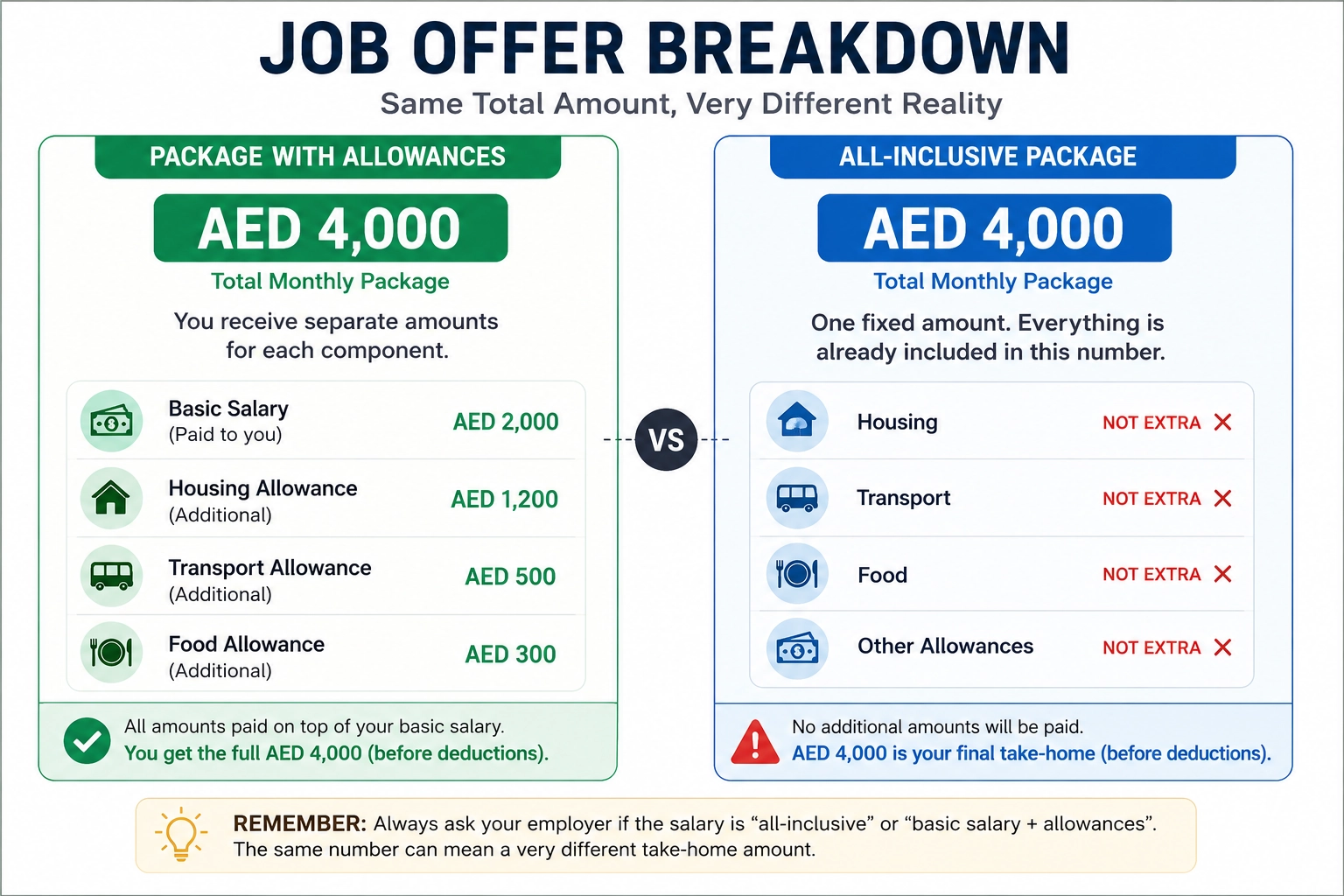
"All-Inclusive" Salary — One Number That Covers Everything
Many Gulf job offers list a single salary figure described as all-inclusive. Something like AED 1,500 all-inclusive per month.
The word all-inclusive means that single number is meant to cover your basic pay and any allowances combined into one figure. It is not your basic salary with housing and transport allowances added separately on top.
This matters because some workers see a number like AED 1,500 and assume that is just their basic pay, expecting housing and transport allowances to be additional amounts on top of that. When the number is all-inclusive there is nothing extra coming. That is the total.
Before accepting any offer ask directly whether the salary figure is all-inclusive or whether it is a basic salary with separate allowances. The difference between these two structures can be significant even when the headline number looks the same.
Structure Breakdown Comparison
One flat figure. Zero extra housing, transport, or food allowances will be added to your bank account monthly.
Basic Salary vs Allowances — Why the Breakdown Matters
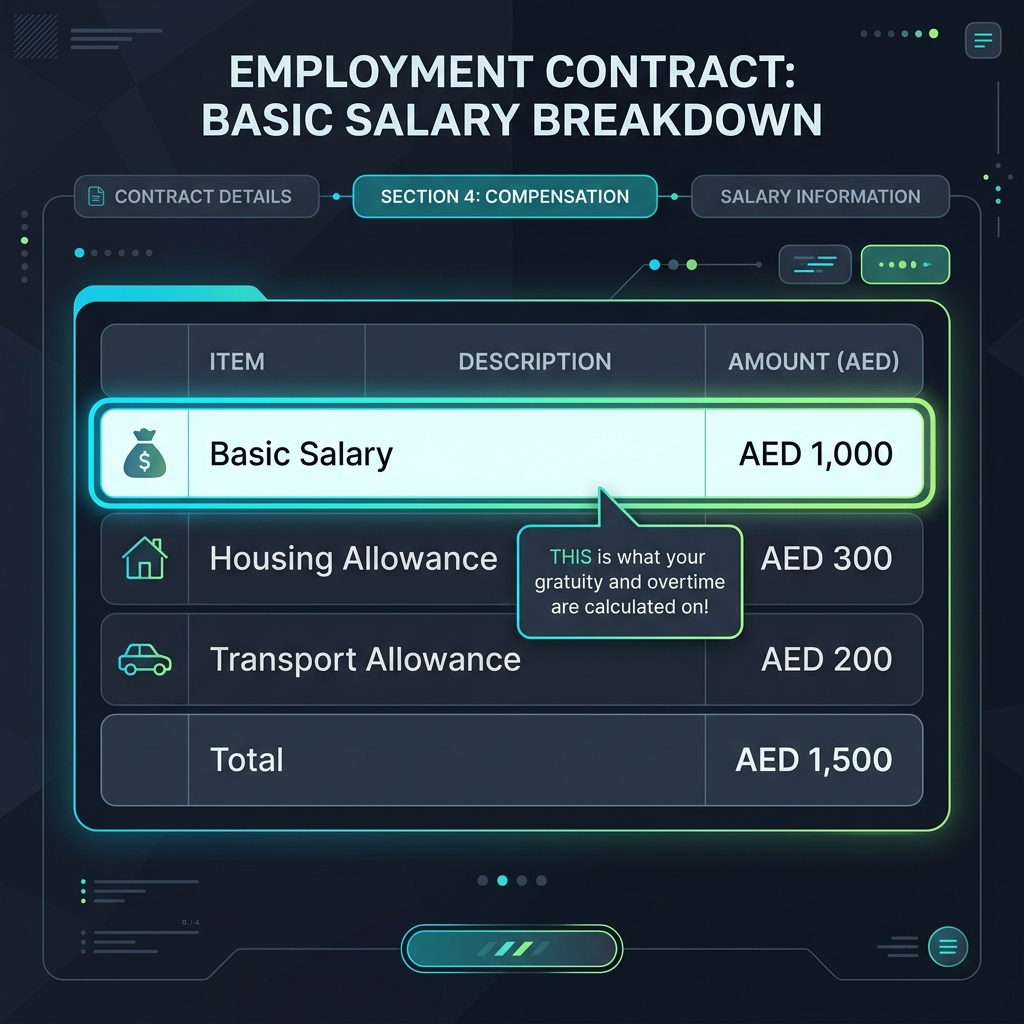
If your offer does break the salary into basic salary plus allowances, for example:
Basic Salary: AED 1,000
Housing Allowance: AED 300
Transport Allowance: AED 200
Total: AED 1,500
Most workers only look at the total. But the basic salary figure specifically can matter for things beyond your monthly take-home.
In many countries certain legal calculations such as end of service benefits, overtime rates, and some types of leave pay are calculated based on your basic salary, not your total monthly package. A lower basic salary with higher allowances might give you the same total monthly amount but result in lower end of service payments compared to a structure with a higher basic salary and lower allowances.
This is genuinely worth asking about, especially for longer contracts. If you are unsure how a specific country calculates these benefits, asking the employer or recruitment agency directly to explain how your basic salary affects your end of service entitlement is a reasonable and important question.
"Accommodation Provided" — What That Actually Means
This is the part that affected my brother directly.
When a job offer says accommodation is provided, that statement alone tells you very little about what your actual living situation will be like.
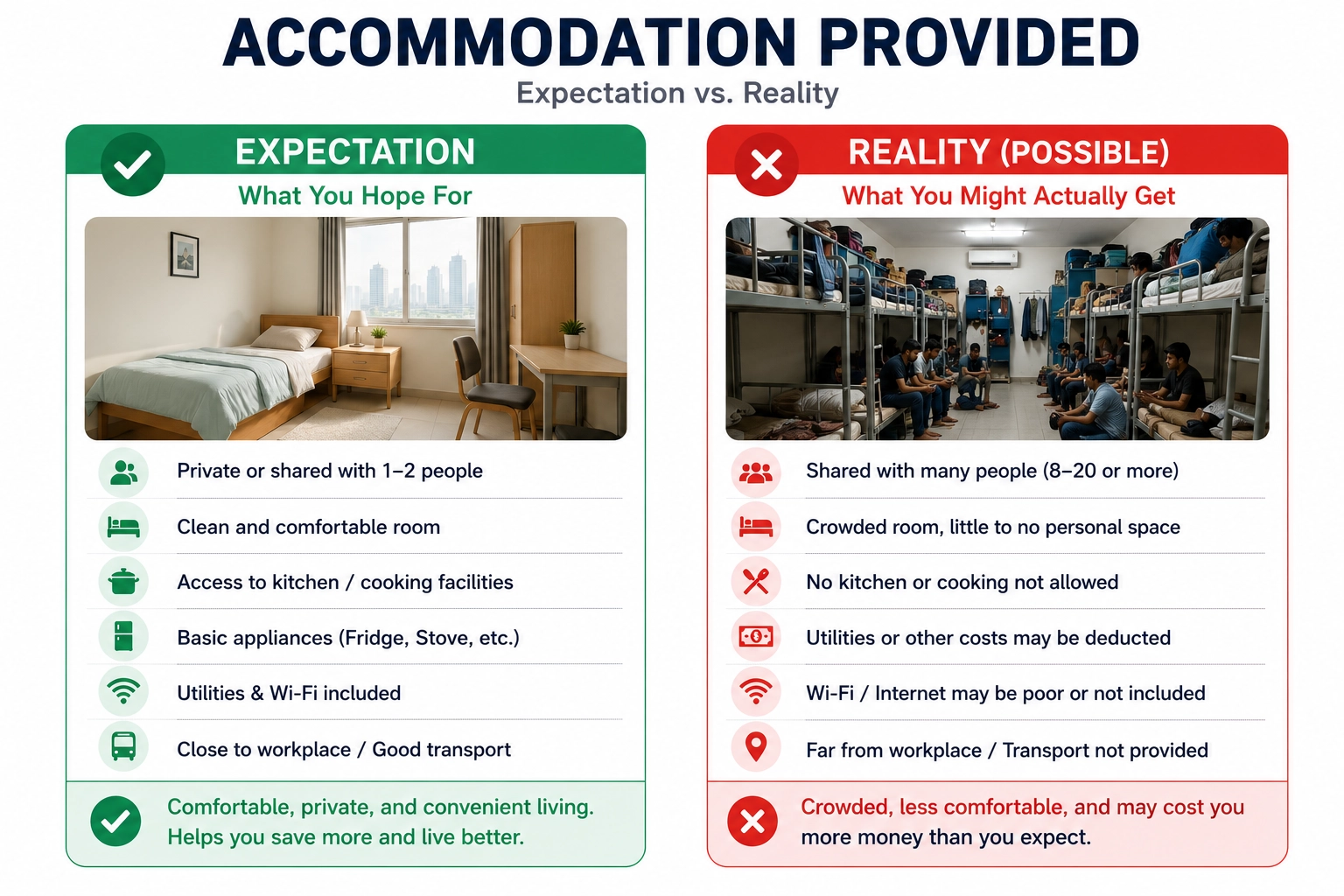
It could mean a private room. It could mean a shared room with one other person. It could mean a shared hall with twenty or more people, which is what my brother experienced.
It could include cooking facilities or it could not. If there is no kitchen and you cannot cook, every meal becomes an additional cost that is not reflected anywhere in the salary number you were quoted.
Before accepting a job ask specific questions. How many people share a room. Is there a kitchen or cooking facility. Is food included or is it your own responsibility. If food is your own responsibility, what is the realistic monthly cost of food in that location.
These questions are not unreasonable or pushy. They are exactly the kind of information you need to understand what your real monthly expenses will look like, which directly affects how much you can actually save and send home.
Accommodation Verification Checklist
Overtime — Do Not Count On It Before You Arrive
Many workers go into a job expecting that working overtime will significantly increase their income. Sometimes this is true. Often it is not as straightforward as expected.
Overtime availability depends heavily on the employer, the industry, and the time of year. Construction work might have overtime during busy project phases and very little during quieter periods. Hospitality work might have more overtime during tourist seasons and less during off seasons.
Overtime pay rates are also regulated differently in different countries. In some places overtime must legally be paid at a higher rate than your normal hourly rate. In others the rules are less consistently enforced.
If overtime income is an important part of your financial planning, ask specifically about how regularly overtime is typically available in the role you are applying for, and what the overtime pay rate actually is. Do not build your financial expectations around overtime that has not been confirmed.
When Will You Actually Get Paid
Salary payment timing is something that genuinely affects people's daily lives, especially in your first few months when you may have limited savings.
Ask when salary is paid each month, whether it is paid on a fixed date or can vary, and what happens if there is a delay.
Salary delays are a real issue that some workers experience, particularly with certain employers or in certain sectors. In countries with stronger regulatory enforcement like UAE, the Wage Protection System requires employers to pay salaries electronically and on time, and delays can be reported to the relevant labour authority. In other contexts enforcement may be less consistent.
Having some savings before you arrive, even a modest amount, gives you a buffer if your first salary payment is delayed or if unexpected costs come up before you are settled.
Never borrow money based on expected overtime income or expected future salary increases. Make financial decisions based on the guaranteed salary written in your contract.
A Higher Salary Does Not Always Mean More Savings
It is tempting to compare job offers purely by the headline salary number. A job offering AED 2,000 per month looks better than one offering AED 1,500 per month on the surface.
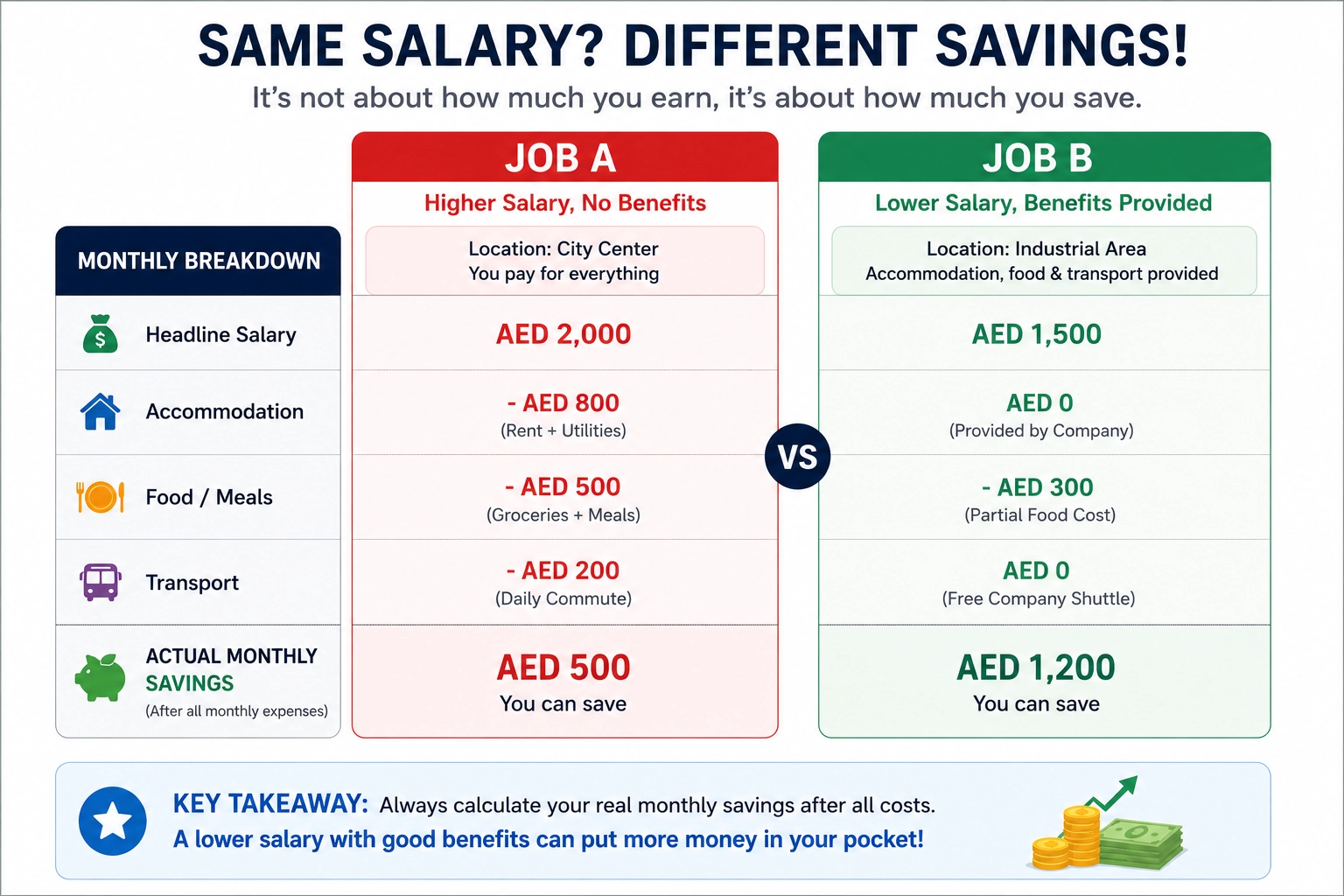
But what actually matters for your financial goals is not the salary number itself. It is how much you can realistically save after covering your actual living costs.
If the AED 2,000 job requires you to pay for your own accommodation and food in an expensive area, and the AED 1,500 job provides accommodation and most meals, the lower salary job might actually let you save more money each month.
| Monthly Budget Item | Job A (No Benefits) | Job B (Benefits Provided) |
|---|---|---|
| Headline Salary | AED 2,000 | AED 1,500 |
| Accommodation Cost | -AED 800 | AED 0 (Free) |
| Food / Meal Costs | -AED 500 | -AED 300 (Partial food cost) |
| Transport Cost | -AED 200 | AED 0 (Free Shuttle) |
| Actual Monthly Savings | AED 500 | AED 1,200 |
This same principle applies when comparing opportunities across different countries. A higher salary in Singapore or Korea needs to be considered against the genuinely higher cost of living in those places. You should compare real cost of living figures in our Singapore guide and our Korea guide honestly against any salary offer you are considering.
Recruitment Fees and Salary Deductions
Many workers do not realize that monthly salary deductions can happen after they arrive. They expect to receive their full salary only to find significant portions taken out to cover various costs.
These deductions are often used by employers or agencies to recoup expenses like:
- Visa and processing costs — Even when laws state employers must cover visa fees, some companies still deduct these from salaries.
- Medical checkup fees — Mandatory health screenings required for your work residency card.
- Accommodation security deposits — Deductions taken during your first few months as a room deposit.
- Uniform or safety equipment fees — Cuts made to cover safety boots, overalls, or security uniforms.
Before signing your employment contract, ask specifically: "Are there any fees, processing costs, uniform costs, or medical expenses that will be deducted from my monthly salary?" Make sure you get the answer in writing.
Red Flags in a Job Offer
Many workers discover serious problems only after arriving at their destination because they accepted vague or incomplete job offers. Be cautious and treat it as a warning sign if:
- Salary breakdown is missing — The offer states a single flat total without clarifying basic salary vs allowances.
- Overtime pay is not mentioned — The document does not describe how overtime is calculated or paid.
- Accommodation details are not provided — The offer lists 'Accommodation Provided' without detailing room capacity or facilities.
- Deductions are not explained — The employer avoids giving a clear written list of potential visa, uniform, or medical deductions.
- Contract differs from recruitment advertisement — The written offer shows lower pay or different terms than the initial job post.
- Employer refuses to provide written offer — You are pressured to make verbal agreements or pay fees before receiving a written document.
Singapore & Korea Salary Examples
While many examples focus on the Gulf region, similar salary structure rules apply in high-cost destinations like Singapore and South Korea.
- • Basic Salary: SGD 1,800/month
- • Housing: Shared Dormitory Provided
- • Food: Not Included (Self-paid)
- • Transport: Factory Shuttle Provided
- • Monthly Salary: KRW 2.2 million
- • Housing: Company Housing Provided
- • Deductions: National Pension (Mandatory)
- • Deductions: National Health Insurance
Can I Live on This Salary?
One of the most common questions workers search for is whether a specific salary is enough to live on and save. Here is a realistic breakdown of monthly savings potential based on common salary tiers:
Dubai (UAE) Survival & Savings Guide
| Monthly Salary (AED) | Realistic Savings Potential | Living Standard |
|---|---|---|
| AED 1,000 - 1,500 | Low (AED 100 - 300) | Shared labor camp dorms, basic meals |
| AED 2,000 - 2,500 | Moderate (AED 500 - 1,000) | Shared worker housing, self-cooked meals |
| AED 3,000 - 4,000+ | Good (AED 1,500 - 2,500) | Better shared partitions, food budgets |
Singapore Survival & Savings Guide
| Monthly Salary (SGD) | Realistic Savings Potential | Living Standard |
|---|---|---|
| SGD 1,000 - 1,500 | Low (SGD 200 - 400) | Industrial dormitories, cheap hawker meals |
| SGD 2,000 - 2,500 | Moderate (SGD 800 - 1,200) | Shared room in HDB flat, self-cooking |
| SGD 3,000 - 4,000+ | Good (SGD 1,800 - 2,500) | Private partition or HDB room, food budgets |
Tax-Free Salary — What It Actually Means
Gulf countries are often described as offering tax-free salaries, and for most workers this is genuinely true. There is typically no income tax deducted from your salary in UAE, Saudi Arabia, Qatar, Kuwait, Bahrain, and Oman.
However tax-free does not automatically mean you will save more than you would in a country with income tax. Your actual savings depend on your total income minus your total living costs, which includes accommodation, food, transport, and any other expenses.
A worker earning a tax-free salary in the Gulf with high accommodation and food costs might save less each month than a worker earning a taxed salary in a country where accommodation is provided and food costs are lower. The tax status of your income is just one factor among several that determine your actual savings.
Questions to Ask Before You Accept Any Job Offer
Before signing any contract or accepting any offer, getting clear answers to these questions helps you understand what you are actually agreeing to.
Is the salary figure all-inclusive or is it broken into basic salary plus allowances. If broken down, what is the basic salary specifically?
What does accommodation provided actually include. How many people per room. Is there a kitchen. Is food included or your own responsibility?
What is the realistic availability of overtime in this specific role, and what is the overtime pay rate?
When is salary paid each month, and what happens if there is a delay?
Are there any deductions from your salary for recruitment fees, accommodation costs, or anything else, and if so how much and for how long?
What does the contract say about who pays for your flight home at the end of the contract?
Getting clear written answers to these questions before you sign anything is one of the most important things you can do to protect yourself financially.
Understanding your salary offer is one part of preparing for an overseas job. Making sure your CV gets you the offer in the first place is the other part. Our Gulf CV examples page shows real formatted CV examples for security guard, hotel staff, driver, and construction worker roles. We also suggest reading our guide on how to spot fake recruitment agencies to protect yourself from scams, and our detailed Gulf work guide which covers contract details, laws, and worker rights in full.
Ready to build your professional CV?
Build Your Free CVQuestions Real Workers Ask
What does "all-inclusive salary" mean exactly?
An all-inclusive salary means the single number quoted is the total amount you will receive, already combining your basic pay with any allowances such as housing and transport. It is not a basic salary with additional allowances on top. If a job offer says AED 1,500 all-inclusive, that AED 1,500 is the complete monthly amount.
Why does my basic salary matter if my total package is the same?
In many countries certain benefits including end of service payments, overtime rates, and some leave entitlements are calculated based on your basic salary rather than your total monthly package. A salary structure with a higher basic salary and lower allowances may result in better long-term benefits even if the total monthly amount is identical to a structure with a lower basic salary and higher allowances.
If accommodation is provided, should I still budget for housing costs?
You should ask exactly what the provided accommodation includes before assuming you have no housing-related costs. Provided accommodation can range from a private room to a shared hall with many other workers. It may or may not include utilities, internet, or cooking facilities. Understanding the specifics helps you budget accurately for what is and is not covered.
Can I rely on overtime to increase my income significantly?
Not without confirmation. Overtime availability varies significantly by employer, industry, and season. Some roles have consistent overtime opportunities while others have very little. Ask specifically about typical overtime availability for the role you are applying for and what the overtime pay rate is, rather than assuming overtime will be a significant part of your income.
What should I do if my salary is delayed after I start working?
Document everything including your contract, any communication about the delay, and dates. In countries with stronger labour protections like UAE, salary payment is monitored through systems like the Wage Protection System and delays can be reported to the labour authority. Having some personal savings before you arrive gives you a buffer to manage short-term delays without significant stress.
How do I compare job offers from different countries fairly?
Compare your realistic monthly savings rather than just the headline salary. Calculate your expected income minus your realistic living costs including accommodation if not provided, food, transport, and any other regular expenses. A lower salary in a country with lower living costs or better provided benefits can result in higher actual savings than a higher salary in a more expensive location.