

How to Spot a Fake Recruitment Agency Before You Lose Your Money
Real warning signs of fake recruitment agencies based on firsthand experience. Learn how job scams work, how to verify agencies, spot fake documents, and protect your money before accepting any overseas job offer.
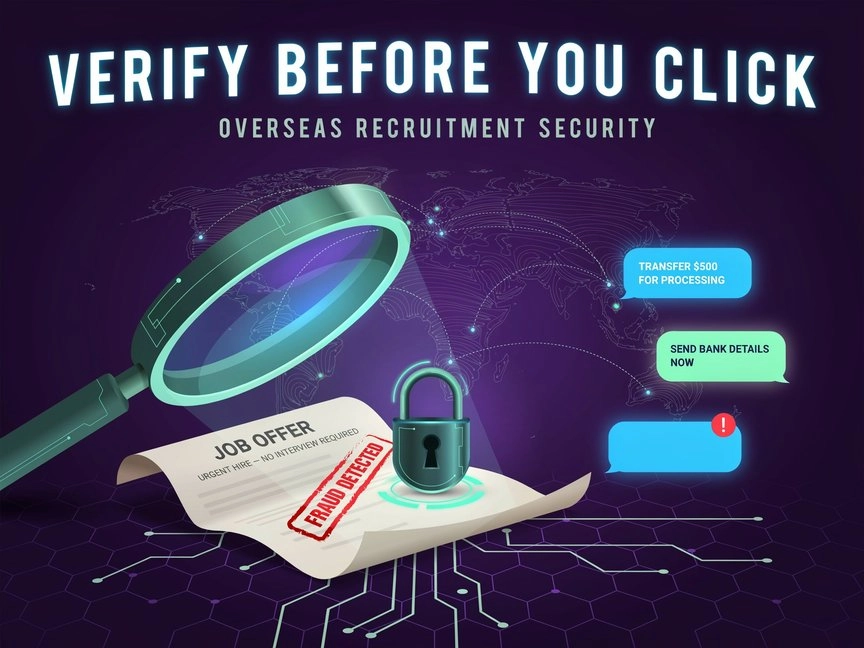
Security Awareness Alert
How to Spot a Fake Recruitment Agency Before You Lose Your Money
I worked at a licensed manpower agency in Nepal. I saw how the legitimate process works from the inside. And I have personally met people who lost their money to fake recruiters. Not strangers. People from my own community who genuinely wanted to build a better life by working in Gulf countries.
The Reality of WhatsApp Recruitment Scams
The way it happened to them was not complicated. Someone contacted them on WhatsApp. The person claimed to have a job offer waiting in Dubai or Qatar. They sent documents through the screen. The job letter looked real. The visa papers looked official. The victim paid. The recruiter stopped replying. The WhatsApp number went silent or got blocked.
I remember a young man named Ramesh from my own village who came to me in our Kathmandu office, clutching his phone with shaking hands. He had just transferred 50,000 NPR (about $375 USD)—his family's entire savings—to a WhatsApp number claiming to represent a Dubai security agency. The recruiter had promised a ready visa and told him the money was for a mandatory medical certificate stamp. But the second the transfer went through, the recruiter blocked him. That was when I realized these scams are not just online statistics; they destroy real lives.
That was it. Money gone. No job. No recourse.
This is not a rare story. It happens regularly across Nepal, India, Bangladesh, Pakistan, and other South Asian countries every year. And it keeps happening because most people do not know what to look for before they trust someone with their money and their future.
This post covers the real warning signs based on what I personally witnessed and heard in our office and our community. Not generic internet advice. What actually happens.
Scam Warning Metrics
90%+
of fake recruitment starts and finishes entirely on WhatsApp
0 Recovery
Once digital wallet transfers are completed to unverified agents
How These Scams Actually Start
Most people imagine recruitment scams involve suspicious strangers approaching them out of nowhere. The reality is more subtle and more dangerous.
While working at the agency, I noticed how scammers exploit trusted circles. One candidate told me he trusted the recruiter because his neighbor's brother-in-law had recommended him. The neighbor didn't know the recruiter personally; they had just passed along a WhatsApp number from a Facebook group. This "referred trust" is incredibly dangerous. In our office, we always insisted that candidates only trust agents they could meet face-to-face inside our physical building.
Others start through Facebook posts or WhatsApp groups where job offers are shared with photos of official looking documents and promises of good salaries.
By the time the conversation begins the victim already has a level of trust. They are not talking to a complete stranger. They are talking to someone recommended by a person they know or someone who appeared in a trusted community space.
That initial trust is what the scammer relies on.
Agent (Dubai Recruitment)
online
Hello brother. We have urgent vacancy for Security Guard in Qatar. Basic salary 2,200 QAR + free housing + medical. Ready visa. Interested?
10:42 AMHello. Yes, I want to apply. Do I need to visit your office in Kathmandu?
10:45 AM⚠️ Upfront Fee Warning
No need of office visit. Process is online. Just send passport photo here. I will send you job offer letter and visa paper. But you must pay 20,000 NPR registration fee first.
10:48 AMWhat Fake Documents Actually Look Like
Once the conversation starts the scammer moves quickly to build credibility. The most common way they do this is by sending documents through WhatsApp.
I have examined several fake job offers brought to me by worried community members. A common mistake I noticed on these documents was the email address. Legitimate employers in the Gulf use custom corporate domains. I remember looking at a supposed "official offer" from a major Qatari hospitality group, but the contact email listed at the bottom was a generic Gmail account. Another red flag I saw was low-resolution, pixelated company seals that looked like they were cropped from a web search and pasted into a basic Microsoft Word template.
These documents look convincing on a small phone screen. A job offer letter with a company name and logo. A visa approval paper with official looking stamps and formatting. Sometimes a fake employment contract with salary figures and job title that matches exactly what the victim was hoping to hear.
The documents are designed to look real enough to pass a quick visual check on a phone screen. They are not designed to survive any kind of proper verification.
The victim sees something that looks official, feels reassured, and moves forward with paying the fee.
Fake Document Red Flags
- Generic email domains (e.g.
companyname@gmail.com) instead of official corporate domains. - No online presence or matching registered office details in Dubai/Qatar.
- Low quality, pixelated logos and generic looking signatures or seals.
- Direct requests for fees written inside the job offer letter itself.
Genuine Document Features
- Official corporate domains (e.g.
hr@dubaiportcompany.com). - Verifiable registration numbers checkable via official governmental systems.
- Clear, professional letterhead with matching physical addresses.
- Zero demands for visa processing fees in the offer letter content.
The Fee Request — Where the Scam Completes
After the documents are shared the scammer asks for a fee. The reason given varies. Visa processing. Document authentication. Agency service charge. Flight booking deposit. Medical clearance fee.
In a legitimate agency like the one I worked at, every single transaction is documented with a physical receipt signed by our finance head. We never asked candidates to send money via digital wallets to personal phone numbers. Yet, almost every scam victim I met described the exact same pattern: the recruiter claimed the fee was 'urgent'—for document translation or immediate medical clearance—and requested payment via mobile money or a direct transfer to an individual's personal bank account. Once that transfer went through, the conversation disappeared.
The amount varies too. Sometimes it is a few hundred dollars. Sometimes it is more. The scammer often starts with a smaller amount to build trust and then asks for more.
Payment is requested digitally. Bank transfer, mobile money, or a local middleman who collects cash and passes it up the chain. The digital payment method means the transaction leaves almost no useful trail for the victim to follow later.
Once the payment is made the contact goes quiet. Messages are ignored. Eventually the WhatsApp number stops responding or the victim gets blocked entirely.
By this point the victim is left with nothing. No job. No refund. No way to reach the person. Often no evidence that would help a police report go anywhere.
What I Saw Inside a Real Manpower Agency
During my time working at a licensed manpower agency in Nepal, I noticed that genuine candidates almost always visited the office at least once before any major payment was made. They could see the agency's licence displayed on the wall, talk to staff face-to-face, and receive receipts for every payment. Candidates received copies of contracts and were informed about the recruitment process. The scam stories I later heard were completely different. Everything happened through WhatsApp and the victim never met anyone in person.
What a Legitimate Agency Actually Looks Like
When I worked at a licensed manpower agency in Nepal I noticed specific things about how legitimate agencies operated that are very different from what scammers do.
A legitimate agency has a physical office you can walk into. You can meet the people you are dealing with face to face. There is an address you can verify and return to if something goes wrong.
Legitimate agencies in Nepal are registered with the Department of Foreign Employment and display their registration certificate. In India legitimate overseas employment agencies are registered with the Ministry of External Affairs through the eMigrate system. In Bangladesh they are registered with the Bureau of Manpower Employment and Training. These registrations are verifiable. You can check them independently before paying anything.
Legitimate agencies give you paperwork. Receipts for any fees paid. A copy of the employment contract. Written documentation of what was agreed. They do not just send photos of documents through WhatsApp and ask you to trust them.
Legitimate agencies also explain the process clearly. The steps involved, the timeline, what documents you need to prepare, what fees are legally allowed to be charged. They are not evasive when you ask questions.
The contrast with a scammer is stark. A scammer operates entirely through a phone screen. There is no office, no registration number, no receipt, no accountability.
Government Registration Check
The Red Flags to Watch For
⚠️Everything happens on WhatsApp with no physical meeting possible.
A recruiter who cannot meet you in person and has no verifiable office address is a serious warning sign regardless of how professional their messages look. I have never seen a legitimate Gulf recruiter refuse an office meeting.
⚠️Documents are sent as photos or screenshots through WhatsApp.
Real employment documents from a genuine employer are provided through official channels. A job offer letter sent as a WhatsApp image has not been verified by anyone. I once saw a scammer send a blurred screenshot of a license that turned out to belong to a completely different company.
⚠️You are being pressured to pay quickly.
Urgency is a manipulation tactic. Legitimate opportunities do not disappear overnight. Any recruiter saying you must pay today or lose the job is using pressure to prevent you from thinking clearly or doing verification.
⚠️The recruiter cannot provide a verifiable registration number.
Ask directly for their registration number and check it against your country's official overseas employment authority. A legitimate agency will give you this without hesitation. A scammer will deflect, give a fake number, or become aggressive.
⚠️The fee seems high or the reason for it is vague.
Research the legally permitted recruitment fees in your country before engaging with any agent. If what you are being asked to pay exceeds the legal limit or the explanation for why it is needed is unclear, stop.
⚠️The job offer matches exactly what you hoped to hear.
Scammers research what their targets want and offer it precisely. A job that sounds perfect in every way from a recruiter you found through WhatsApp deserves extra verification not less.
What to Do Before Paying Anything
Before you pay any recruitment fee to any agent do these things:
- Check that the agency is registered with your country's official overseas employment authority. In Nepal this is the Department of Foreign Employment. In India it is the eMigrate portal. In Bangladesh it is the Bureau of Manpower Employment and Training. In Pakistan it is the Bureau of Emigration and Overseas Employment. Registration numbers are public information you can verify independently.
- Search for the employer named in the job offer letter. A genuine company in Dubai or Qatar has a verifiable online presence. Search the company name, check if they have a real website, look for their contact details independently and call or email them directly to verify the job offer is real.
- Never pay based on documents sent through WhatsApp alone. Ask for original documents and ask how you can verify them with the relevant authorities.
- Tell someone you trust about the opportunity before paying. A second opinion from someone not emotionally invested in the outcome can catch things you might miss when you are excited about a job offer.
- If something feels wrong trust that feeling. Legitimate opportunities do not require you to act quickly without verification.
📋 5-Step Verification Checklist
Verify Government Licence
Check DOFE (Nepal), eMigrate (India), or BMET (Bangladesh) registries.
Direct Employer Check
Contact the Dubai/Qatar employer directly using contact info you find independently.
Refuse Digital Wallet Deposit Requests
Reject instant mobile transfer or cash demands lacking official receipts.
Consult a Trusted Peer
Get an objective second opinion on the documents and agent statements.
Verify Allowable Legal Fees
Research the maximum legally permitted fee in your country.
If You Have Already Been Scammed
If you have already paid money and the recruiter has stopped responding there are steps you can take even if recovery feels unlikely:
- Report the incident to your country's overseas employment authority. In Nepal this is the Department of Foreign Employment. They maintain records of reported scams and use them to warn others and sometimes to take legal action.
- File a police report even if you believe nothing will come of it. A formal report creates a record and in some cases combined reports about the same scammer have led to investigations.
- Report the WhatsApp number to WhatsApp directly through the app's reporting feature. This does not recover your money but it can help get the account removed and prevent the same scammer from reaching other victims.
- Share your experience in community groups and with people you know. Many victims stay silent because they feel embarrassed. But silence is exactly what allows the same scammer to keep operating. Warning others is one of the most useful things you can do after a scam.
Before You Apply for Any Gulf Job
Understanding the risks is the first step. The second step is making sure that when you do find a legitimate opportunity your CV is ready to make the strongest possible impression.
Complete Gulf Work Guide
For a full guide on what Gulf employers actually look for and how to protect yourself through the entire process from finding a job to understanding your contract, read our complete Gulf work guide.
ATS CV Optimization Guide
When your CV is ready and you want to make sure it is formatted correctly for the ATS systems many Gulf employers use, see our ATS CV guide or use our free CV builder.