

Working in Gulf Countries — What South Asian Workers Actually Need to Know
Research Methodology
Information in this guide was verified using official sources including MoHRE (UAE), MHRSD (Saudi Arabia), Department of Foreign Employment Nepal (DoFE), eMigrate India, BMET Bangladesh, and the International Labour Organization (ILO). Wage, visa, and contract regulations reflect officially published 2026 data.
Last Fact-Checked: May 31, 2026
Every year hundreds of thousands of workers from South Asia pack their bags and head to the Gulf. UAE, Saudi Arabia, Qatar, Kuwait, Bahrain, Oman. They go for the same reason. Better pay, better opportunities, and a chance to support their families back home.
Most of them are told it will be straightforward. Sign here, pay the fee, we will handle everything, your salary will be good, the work will be fine.
The reality is often different.
This guide is not going to tell you Gulf countries are bad places to work. Many people have genuinely good experiences and build better lives through Gulf employment. But this guide is going to tell you the truth about what the process actually looks like, what risks are real, and what you need to know before you trust anyone with your money and your future.
The Scam Problem Nobody Talks About Openly
This needs to come first because it is the most important thing in this entire guide.
Fake recruitment agents are a serious and widespread problem across South Asia. The pattern is almost always the same.
Someone approaches you or you find an agent online or through a contact. They tell you they can get you a job in Dubai or Qatar. The salary sounds good. The opportunity sounds real. They ask you to pay a fee upfront to process your visa, secure your job, or handle your documents.
You pay. They disappear.
This happens to real people regularly. Not just strangers. People in communities across Nepal, India, Bangladesh, Pakistan, and Sri Lanka have lost significant amounts of money this way. Some have lost their entire family savings.
How to protect yourself:
- Only work with officially registered recruitment agencies. In Nepal for example legitimate manpower agencies must be registered with the Department of Foreign Employment (DoFE). Similar registration systems exist in India (via the eMigrate Portal), Bangladesh (via the Bureau of Manpower Employment and Training), Pakistan, and Sri Lanka. Always verify registration before paying anything.
- Never pay large fees upfront before seeing a verified job offer with a real contract from a real employer.
- A legitimate agency in most South Asian countries is legally limited in how much they can charge you. Research the legal fee limit in your country before engaging any agent.
- If an agent is pressuring you to decide quickly or pay immediately that is a warning sign. Legitimate processes take time and no genuine opportunity disappears overnight.
- Ask for the name and contact details of the employer in the Gulf country directly. A real job offer comes from a real company that you can verify independently.
The Contract Reality — What You Are Promised Versus What You Sign
This is the second biggest problem South Asian Gulf workers face.
Verbal promises are common in recruitment. An agent tells you the salary will be a certain amount. They tell you accommodation is provided. They tell you the job is in a hotel or a specific company. They tell you the hours are reasonable.
Then you arrive. The contract says something different.
The salary is lower. The accommodation is a shared labour camp with many people in one room. The job role is not what was described. The hours are longer than you were told.
By the time you discover this you are already in the country with your passport sometimes held by your employer, your return ticket gone, and very little money.
What to do before you leave:
- Read your contract carefully before you sign anything in your home country. If you cannot read English ask someone you trust to read it with you.
- The contract should clearly state your salary in numbers, your job title, your working hours, your accommodation arrangement, and who pays for your flight home at the end of your contract.
- If the written contract does not match what you were verbally promised do not sign it. Do not let anyone pressure you into signing something that does not reflect what you agreed to.
- Some Gulf countries have what is called an electronic contract system where your contract is registered with the government before you travel. In UAE this is registered through the Ministry of Human Resources and Emiratisation (MoHRE) portal. In Saudi Arabia it is registered electronically with the Ministry of Human Resources and Social Development (MHRSD). Ask your agent to show you the registered contract before you travel.
The Reality of Gulf Work Hours
Many South Asian workers arrive in Gulf countries expecting an eight or nine hour working day with two days off per week.
The reality in many sectors is different.
Construction, hospitality, domestic work, cleaning, security, and many service jobs commonly involve ten to twelve hour days, six days a week. This is not illegal in most Gulf countries. It is simply how many of these industries operate.
This does not mean every job is like this. Corporate roles, some hotel positions, and professional jobs tend to have more standard hours. But for labour and service jobs the long hours are common and worth knowing in advance.
Before you accept a job ask specifically about working hours and rest days. Get the answer in writing in your contract not just verbally.
Heat — A Genuine Safety Issue for Outdoor Workers
Summer temperatures in Gulf countries regularly exceed 40 degrees Celsius. In parts of Saudi Arabia, Kuwait, and UAE outdoor temperatures can reach 45 to 50 degrees Celsius during peak summer months.
For outdoor workers in construction, agriculture, or landscaping this is a genuine health risk.
Most Gulf countries have laws restricting outdoor work during the hottest part of the day in summer, typically from around 12:30pm to 3pm. These rules exist because the heat is genuinely dangerous.
If you are taking an outdoor job make sure you understand how the employer handles summer heat. Is there shade available. Is there clean drinking water always accessible. Does the employer follow the midday outdoor work ban. These are not small questions.
Accommodation — What You Might Actually Get
Accommodation in Gulf countries varies enormously depending on your employer and your role.
Some employers provide good quality single or shared rooms with proper facilities. Some larger companies have well-maintained labour accommodation with amenities.
Other employers place workers in crowded labour camps where many people share a room, facilities are poor, and living conditions are difficult. The International Labour Organization has documented cases of substandard worker accommodation across Gulf countries despite legal requirements for proper housing.
Before you accept a job ask specific questions about accommodation. How many people share a room. What facilities are included. Is the accommodation close to the worksite or far. Ask for photos if possible.
If an employer is vague or evasive about accommodation details that is worth taking seriously before you commit.
Visas and Legal Ways to Enter Gulf Countries for Work
There are several legitimate visa routes into Gulf countries for South Asian workers.
Employment Visa
This is the standard route for most workers. Your employer sponsors your visa and applies for it on your behalf after you have signed an employment contract. You cannot get a work visa without a genuine employer sponsor in most Gulf countries.
The employment visa is tied to your specific employer. If you want to change jobs in some Gulf countries you need your current employer's permission through a system called the No Objection Certificate or NOC. Rules around job mobility vary by country and have been changing in recent years, particularly in UAE and Qatar which have made it easier to change employers.
Free Zone Visa (UAE)
UAE has numerous free zones where companies can sponsor employees under different rules. Free zone visas sometimes offer more flexibility but the work is generally limited to the free zone or internationally.
Visit Visa
Some workers enter Gulf countries on visit visas hoping to find work while there. This is risky and in most Gulf countries working on a visit visa is illegal. If you are caught working without a proper work visa you can be deported and banned from returning.
Always enter Gulf countries with the correct visa for your purpose.
What Jobs Are Actually Available for South Asian Workers
The most common sectors employing South Asian workers across Gulf countries are:
- Construction and civil engineering including general labour, skilled trades like electricians and plumbers, and site supervision roles.
- Hospitality including hotel housekeeping, front desk, food and beverage service, kitchen staff, and cleaning.
- Security guard positions across residential buildings, commercial properties, and events.
- Driving including delivery drivers, taxi drivers, and heavy vehicle operators.
- Domestic work including household helpers and caregivers, particularly in Saudi Arabia and Kuwait.
- Healthcare including nurses, care workers, and medical support staff particularly from India and the Philippines.
- Retail and sales in shopping malls and commercial areas.
- Manufacturing and industrial work in factories and processing facilities.
Your CV for Gulf Jobs — What Actually Matters
Gulf employers and recruitment agencies look at CVs differently from employers in Western countries.
CV Example: Gulf Format layout
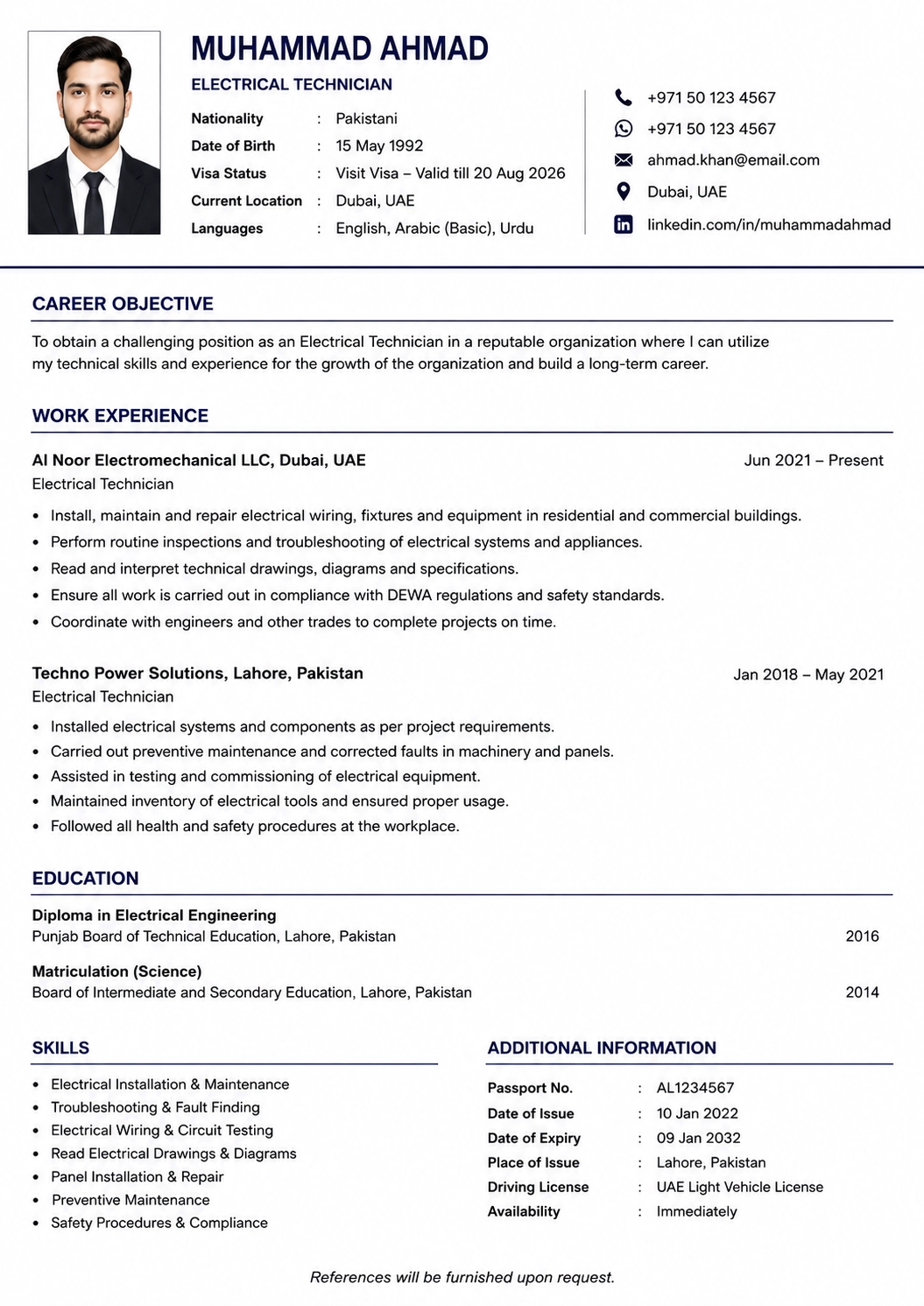
Personal information comes first
Many Gulf employers and recruitment agencies want to see specific personal details upfront because they need this information to assess your eligibility and begin visa processing.
This typically includes your nationality, your current visa status or location, and a professional passport style photo.
A photo is commonly expected for most roles in Gulf countries including security, hospitality, and service positions. Use a passport style photo with a plain background and professional clothing.
Visa status matters
State your current situation clearly. If you are currently in your home country say so and mention that you are available for immediate relocation. If you are already in a Gulf country on a visit visa or transferable residence visa state that clearly because it affects the employer's timeline and costs.
Keep it short and specific
For most labour and service roles one page is enough. Two pages maximum for experienced professionals.
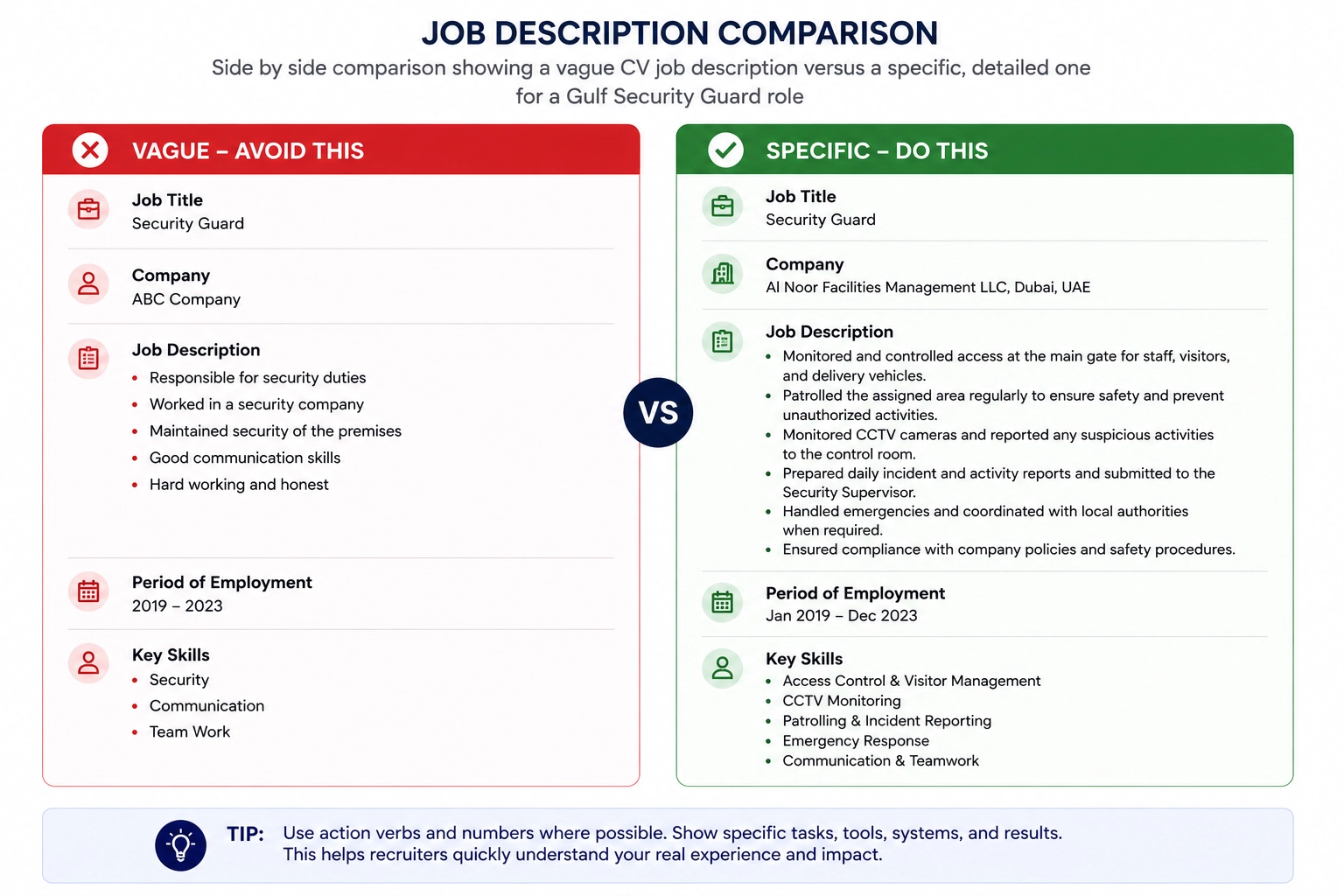
Describe your previous jobs specifically. Not "responsible for security duties" but "monitored access control and CCTV systems for a 200 unit residential building working 12 hour night shifts." Specific details show real experience.
Job Description Comparison
List relevant certifications
If you have a valid driving licence state the vehicle categories. If you have any safety certifications like first aid mention them. If you have hospitality training or food handling certificates include them.
Contact details
Include your phone number with your country code. WhatsApp is widely used for recruitment communication in Gulf countries so make sure the number you list is WhatsApp enabled.
For a full explanation of how ATS systems read your CV and why formatting matters, see our ATS guide.
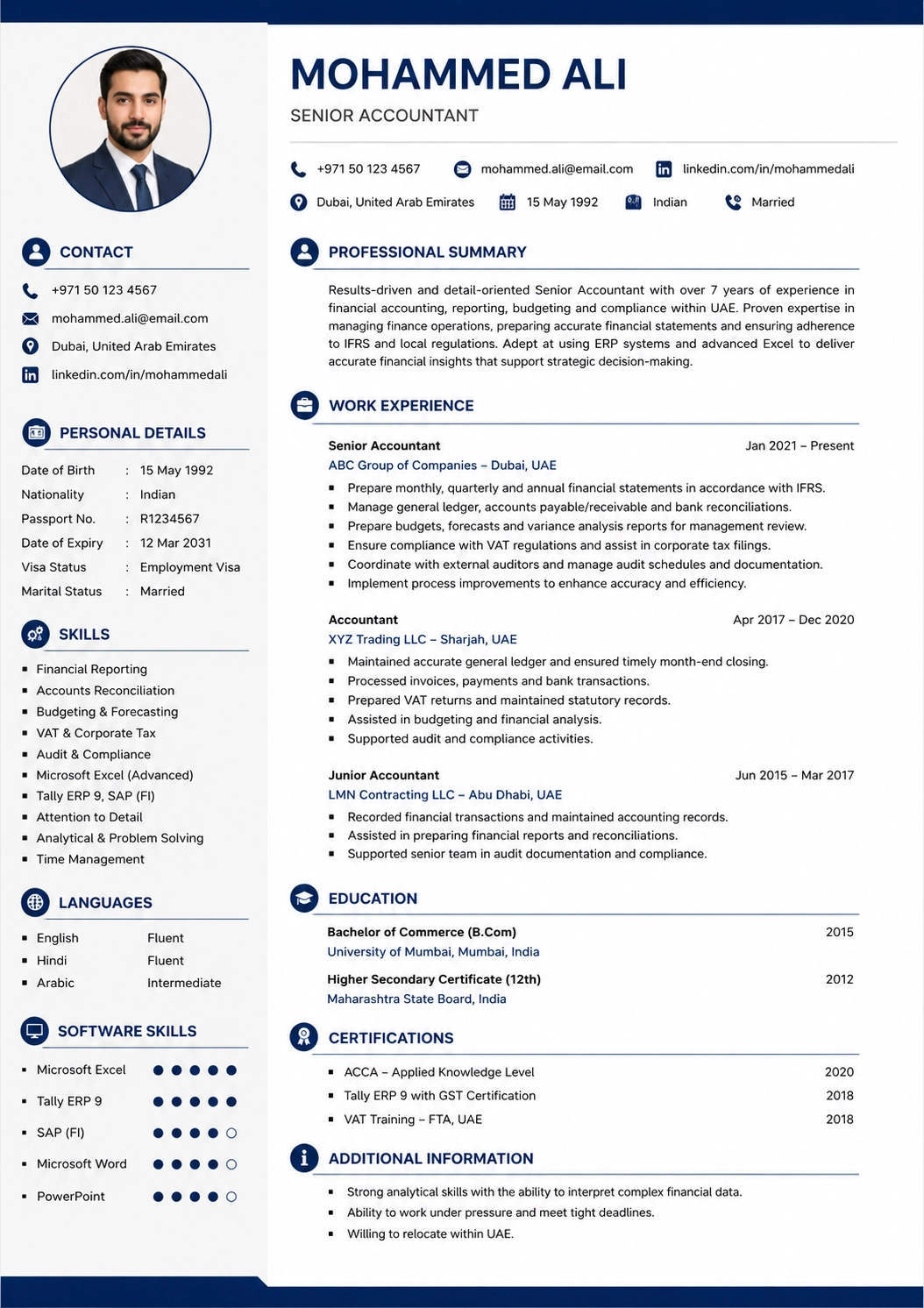
Gulf CV template layout
Banking and Money in Gulf Countries
Opening a bank account in Gulf countries as a foreign worker requires your residency visa and Emirates ID in UAE, Iqama in Saudi Arabia, or the equivalent residency document in other Gulf countries.
You cannot open a bank account until your employer has processed your residency permit which typically takes a few weeks after you arrive.
Until your account is open your employer may pay salary in cash or through a salary card. In UAE the Wage Protection System means employers are legally required to pay salaries electronically and on time.
Sending money home is straightforward from Gulf countries. Exchange houses like Al Ansari Exchange in UAE or similar services in other countries offer competitive rates and fast transfers to most South Asian countries. Many workers use these regularly to send remittances to their families.
Getting a SIM Card
Getting a local SIM card is one of the first practical things to sort after arriving.
In UAE the main providers are Etisalat and du. In Saudi Arabia they are STC, Mobily, and Zain. In Qatar it is Ooredoo and Vodafone Qatar.
You typically need your passport and residency visa to register a SIM card. In your first days before your residency is processed some providers offer tourist SIM cards that work on your passport alone.
Having a local number is important for job hunting, communicating with your employer, and everyday life.
Laws and Cultural Rules You Need to Know
Gulf countries have laws and social rules that are different from most South Asian countries. Knowing these before you arrive is important.
Alcohol is completely prohibited in Saudi Arabia and Kuwait. In UAE, Qatar, and Bahrain alcohol is available but only in licensed venues. Drinking in public or being publicly intoxicated anywhere in the Gulf is a serious offence.
Public displays of affection are not acceptable in most Gulf countries.
Criticism of the government, ruling families, or Islam on social media or in public can result in serious legal consequences including imprisonment and deportation. Many workers have faced problems because of social media posts that would be considered normal in their home countries.
During Ramadan eating, drinking, or smoking in public during daylight hours is prohibited in most Gulf countries even for non-Muslims.
Dress codes in public spaces are more conservative than in most South Asian cities. This is particularly important in Saudi Arabia.
These are not small rules. Violations can result in fines, imprisonment, or deportation. Understanding them before you arrive helps you avoid problems that can seriously affect your life and employment.
Your Rights as a Worker in Gulf Countries
Gulf countries have labour laws that protect workers, although enforcement varies and the system is not perfect.
Most Gulf countries have a Ministry of Labour or equivalent government body with hotlines and complaint systems for workers facing problems. In UAE, the Ministry of Human Resources and Emiratisation (MoHRE) handles worker complaints directly. In Saudi Arabia, it is the Ministry of Human Resources and Social Development (MHRSD).
If your employer is not paying your salary, is withholding your passport, or is treating you illegally you have the right to file a complaint with the relevant authority.
Passport confiscation by employers is illegal in all Gulf countries. If your employer takes your passport you have the right to ask for it back and to report the situation to the relevant labour authority.
Knowing these rights before you go means you are not completely powerless if things go wrong.
Frequently Asked Questions
How do I know if a recruitment agency is legitimate?
Check whether the agency is registered with your country's official government authority for overseas employment. In Nepal this is the Department of Foreign Employment. In India it is the Ministry of External Affairs eMigrate system. In Bangladesh it is the Bureau of Manpower Employment and Training. Registered agencies have licence numbers you can verify. If an agency cannot show you a valid registration number treat that as a serious warning sign.
Is it safe to work in Gulf countries?
Many hundreds of thousands of South Asian workers have safe and positive experiences working in Gulf countries. The risks are real but they are manageable if you use legitimate agencies, read your contract carefully, and know your rights before you go. The biggest risks come from fake agents and contracts that do not match what was promised verbally.
Can I change jobs if I am unhappy with my employer?
This depends on the country and your contract. UAE and Qatar have made significant changes in recent years making it easier for workers to change employers without needing a No Objection Certificate (NOC) from their current employer. Saudi Arabia has also made some reforms. The rules are specific and change over time so checking the current regulations for the specific country you are going to is important before you commit to a contract.
What should I do if my employer does not pay my salary?
Contact the Ministry of Labour or equivalent authority in the country you are working in. Most Gulf countries have systems for reporting unpaid wages. In UAE the Wage Protection System (WPS) means salary payment records are monitored by the government. Document everything including your contract, any payment records, and communications with your employer before filing a complaint.
How much money should I save before going to Gulf countries?
Even if your employer covers your flight and accommodation you should have some savings before you go. Processing times, unexpected delays, and the period before your first salary arrives mean having at least one to two months of living expenses saved is sensible. Do not arrive in a Gulf country with no money and no backup plan.
Do I need to speak Arabic to work in Gulf countries?
English is widely used across Gulf countries especially in UAE and Qatar where the workforce is highly international. Many workplaces operate entirely in English. Basic Arabic is helpful for daily life, shopping, and communicating outside the workplace but it is not a requirement for most jobs. Learning a few practical phrases before you go makes everyday life easier.
What happens to my visa if I lose my job?
In most Gulf countries your work visa is tied to your employer. If you lose your job you typically have a grace period of 30 to 60 days to find a new employer or leave the country. The specific rules vary by country. In UAE this grace period has been extended in recent years. Understanding what happens to your visa if employment ends before you sign a contract helps you plan for this possibility.
Sources & Further Reading
To verify visa regulations, immigration procedures, and professional integration requirements discussed in this guide, please visit the following official resources:
- •Ministry of Human Resources and Emiratisation (MoHRE) - United Arab Emirates Official Portal
- •Ministry of Human Resources and Social Development (MHRSD) - Kingdom of Saudi Arabia Official Portal
- •Department of Foreign Employment (DoFE) - Government of Nepal
- •eMigrate Portal - Ministry of External Affairs, Government of India
- •Bureau of Manpower Employment and Training (BMET) - Government of Bangladesh
- •International Labour Organization (ILO) - Arab States Migrant Work Database & Housing Reports
Licensed Agencies & Consultancies
To apply for visas legally and safely, you must process your applications through licensed recruitment agencies recognized by the respective governments. We have compiled complete directory listings for verified manpower agencies and educational consultancies across Nepal, India, the Philippines, Vietnam, and Bangladesh.
Manpower Agencies Directory
Find licensed recruitment agencies across Nepal, India, Philippines, Vietnam, and Bangladesh to help secure verified employment visas.
Educational Consultancies Directory
Discover professional student consultancies to assist with overseas university admissions, scholarships, and student passes.
Free CV Builder
Build Your Gulf CV for Free
Pick from 30+ professional templates to build a clean, job-ready CV in minutes. 100% Free.
Cover Letter Maker
Professional matching correspondence. Build for Free.
Business Card Maker
Sleek, modern designs for authority branding. 100% Free.
100% Free • No Credit Card • No Watermarks • Instant Access
More Guides
More Guides
Explore more guides to help you secure your job in the Gulf.
Japan Work Guide
Visas, jobs, accommodation, banking, and what living in Japan actually costs. A practical guide for workers and students from Asia moving to Japan in 2026.
South Korea Guide
Honest guide to South Korea. Learn about GKS scholarships, E-9 visas, Korean language reality, contract verification, and what to know before you go.
ATS CV Guide
Most people misunderstand what ATS actually does. This guide explains how it really works and what your CV needs to pass it in 2026.