

Moving to South Korea — What South Asian Workers and Students Actually Need to Know
Research Methodology
Information in this guide was verified using official sources including HRDKorea (Employment Permit System), Korea Immigration Service, Study in Korea (NIIED), and the Ministry of Employment and Labor. Wage and quota figures reflect officially published 2026 data.
Last Fact-Checked: June 1, 2026
South Korea attracts two very different types of people from South Asia.
Students who want to study at Korean universities, get a scholarship, and build an international career. And workers who want to earn a decent income in manufacturing, construction, agriculture, or services and send money home.
Both groups often arrive with expectations built on YouTube videos, social media posts, and information from people who either love Korea or hate it. The reality is almost always somewhere in the middle.
Before anything else this guide asks you to answer one honest question. What do you actually want from South Korea? Because the answer changes everything about which path makes sense for you.
South Korea at a Glance (2026)
| Metric | Value |
|---|---|
| Population | 51 million (Statistics Korea) |
| Minimum Wage (2026) | 10,320 KRW / hour (Ministry of Employment and Labor) |
| E-9 Worker Quota (2026) | 80,000 (Ministry of Employment and Labor) |
| GKS Recipients | ~1,500 globally (NIIED / Study in Korea) |
| Major Industries Hiring Foreign Workers | Manufacturing, Construction, Agriculture, Fisheries, Services |
Ask Yourself This Before You Plan Anything
Most guides jump straight into visa types and application steps. This one starts differently.
Think about your end goal. Do you want a Korean education and an international career after? Do you want to earn money and return home after a few years? Do you want to eventually settle in Korea long term? Or are you mainly looking for the fastest route to a stable income?
Your answer determines whether you should be looking at the student route, the work route, or a combination of both. Going to Korea without a clear answer often leads to confusion, wasted time, and money spent on the wrong path.
The second question is just as important. What do you actually have right now?
Your age, your highest education level, your English ability, your Korean ability, how much savings you have, and your work experience. These six things matter more than almost anything else when deciding whether South Korea is realistic for you and which route gives you the best chance.
A 22 year old with strong grades and no savings has different options than a 30 year old with five years of factory experience and some savings. Be honest with yourself about where you are starting from.
The Student Route — Universities, Scholarships, and Real Expectations
The GKS Scholarship — What It Actually Is
The Global Korea Scholarship, commonly called GKS, is a fully funded government scholarship offered by the South Korean government through the National Institute for International Education. It is one of the most generous scholarships available to international students anywhere in Asia.
According to the National Institute for International Education (NIIED), GKS covers the following for most recipients:
- Full university tuition for the duration of your program
- A monthly living allowance of around 900,000 to 1,000,000 Korean won
- Round trip airfare to Korea
- One year of Korean language training before your academic program begins
- Health insurance throughout your stay
- A settlement allowance when you first arrive
For students from South Asian countries including Nepal, India, Bangladesh, Pakistan, and Sri Lanka, GKS is a genuinely life-changing opportunity when you get it.
GKS Scholarship Application Timeline
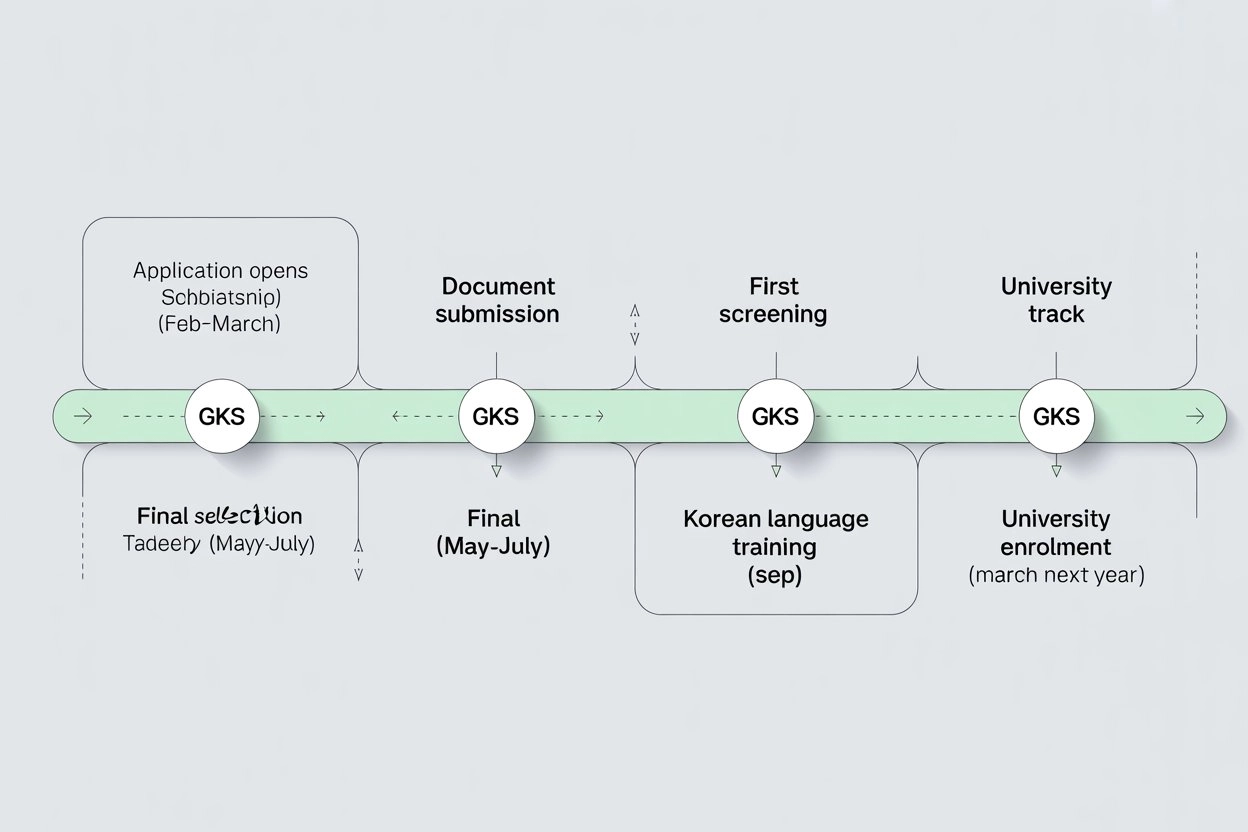
The Honest Reality About GKS
Here is what most GKS guides do not tell you clearly enough.
GKS is extremely competitive. According to NIIED's published selection data, around 1,500 students receive it globally each year across more than 150 eligible countries. For India alone only around 20 to 30 students receive it per year. The numbers are similarly small for other South Asian countries relative to the number of applicants.
Many academically strong applicants with 80 percent and above grades do not get it. The competition includes students from every part of the world and the selection process involves your academic record, your application quality, sometimes an interview, and factors you cannot fully control.
Do not build your entire plan around GKS. Have backup options ready before you apply. These include university-specific scholarships which many Korean universities offer independently of the government program. Self-funded study if your financial situation allows. The work route if you qualify. Other government or private scholarships specifically for your country.
Spending two or three years preparing only for GKS and not getting it leaves you with no plan. Start preparing your backup path at the same time as your GKS application. Students applying for scholarships should also prepare an academic CV. You can create one easily using our free builder:
GKS Basic Requirements
You and both of your parents must be non-Korean citizens. This does not mean your parents need Korean visas. It simply means none of you can hold Korean citizenship. South Asian applicants almost always meet this requirement without any issue.
According to the official GKS guidelines published by NIIED, for undergraduate programs you must be under 25 years old at the time of application. For graduate programs you must be under 40 years old.
Academic performance of 80 percent or above, or a CGPA equivalent, is required. You must have completed your previous level of education before the scholarship begins.
There are two ways to apply. The Embassy Track allows you to apply through the Korean Embassy or Consulate in your country and list up to three university choices. The University Track means you apply directly to a specific GKS-participating university. According to the Study in Korea portal, from 2026 all applications go through their online system.
Are Courses Taught in Korean or English
This is one of the most common questions and the honest answer is both, depending on the university and the program.
Many Korean universities offer programs taught entirely in English, particularly at the graduate level and in fields like engineering, business, science, and technology. Universities like Seoul National University, KAIST, Yonsei, and Korea University have significant numbers of English medium programs.
However daily life in Korea is another matter entirely. Hospitals, banks, government offices, apartment contracts, and most part time jobs operate primarily in Korean. Even if your classes are in English, getting through daily life without any Korean is genuinely difficult.
The GKS scholarship includes one year of Korean language training before your academic program begins. Use that year seriously. Students who treat it as optional often struggle more than those who commit to learning the language properly.
Part Time Work as a Student
International students in South Korea on a D-2 visa can legally work part time. The general limit is 20 hours per week during the semester and more during vacation periods.
According to the Ministry of Employment and Labor, the minimum wage in South Korea for 2026 is 10,320 Korean won per hour. Part time at 20 hours per week gives you a useful supplement to your living allowance but it is not enough to fully fund your studies.
Most part time jobs for international students require Korean language ability. Convenience stores, restaurants, and cafes typically require you to communicate with Korean customers. This is another practical reason investing in Korean from the beginning pays off.
The Work Route — E-9 Visa and Employment Permit System
What the E-9 Visa Actually Is
The E-9 is South Korea's main work visa for foreign nationals in non-professional roles. It operates under the Employment Permit System, commonly called EPS, which is a government-managed program that matches foreign workers with Korean employers in specific sectors.
The E-9 visa covers manufacturing, agriculture, fisheries, construction, and some service sectors. It allows you to work in Korea for up to four years and ten months. Extensions are possible under certain conditions.
South Asian countries eligible for the E-9 programme include Nepal, Bangladesh, Pakistan, and Sri Lanka among others. India is not currently on the E-9 eligible country list. Indian workers need to look at other visa routes such as the E-7 for professional roles. Before applying through EPS, most employers will still request a structured resume. You can format yours easily using our free builder:
The E-9 Quota Reality in 2026
This is something your research needs to factor in honestly.
According to the Ministry of Employment and Labor's annual allocation announcements, South Korea has been reducing its E-9 visa quota significantly. In 2024 the quota was 165,000. In 2025 it dropped to 130,000. In 2026 it has been further reduced to 80,000.
Competition for these slots is becoming more intense each year. This does not mean E-9 is impossible. It means you need to be prepared, realistic about the competition, and serious about your EPS-TOPIK preparation.
The EPS-TOPIK Test — Why Korean Matters for Workers Too
To qualify for the E-9 visa you must pass the EPS-TOPIK, which is a Korean language and basic job aptitude test administered in your home country.
Your score directly affects how competitive you are in the employment matching system. A higher score means better chances of being matched with a Korean employer.
Beyond the test, daily life in Korea as a worker requires Korean. Communicating with supervisors, understanding workplace safety instructions, dealing with accommodation issues, visiting a doctor. Workers who invest in Korean before arriving have a meaningfully easier experience.
What E-9 Workers Are Paid and What Employers Must Provide
According to the Ministry of Employment and Labor, the minimum monthly wage for E-9 workers effective January 2026 is 2,060,740 Korean won, which is roughly 1,500 to 1,550 US dollars per month.
Under the Employment Permit System regulations, Korean labour law requires employers hiring E-9 workers to provide free accommodation or an equivalent housing allowance. Meals are also commonly provided or subsidised depending on the employer and sector.
Under Korea's Labour Standards Act, overtime is paid at 150 percent of the regular wage. The standard work week is 40 hours with overtime capped at 12 additional hours per week.
These legal protections exist. Whether every employer follows them properly is a different question. Read your contract carefully and know your rights before you sign anything.
Contract Warnings — Same Principles Apply Everywhere
The same contract warnings that apply in Gulf countries apply in Korea.
Make sure the job offer is legitimate. Use licensed recruitment agencies and verify independently where possible. Do not pay large upfront fees to agents. Read your contract yourself even if an agent explains it to you.
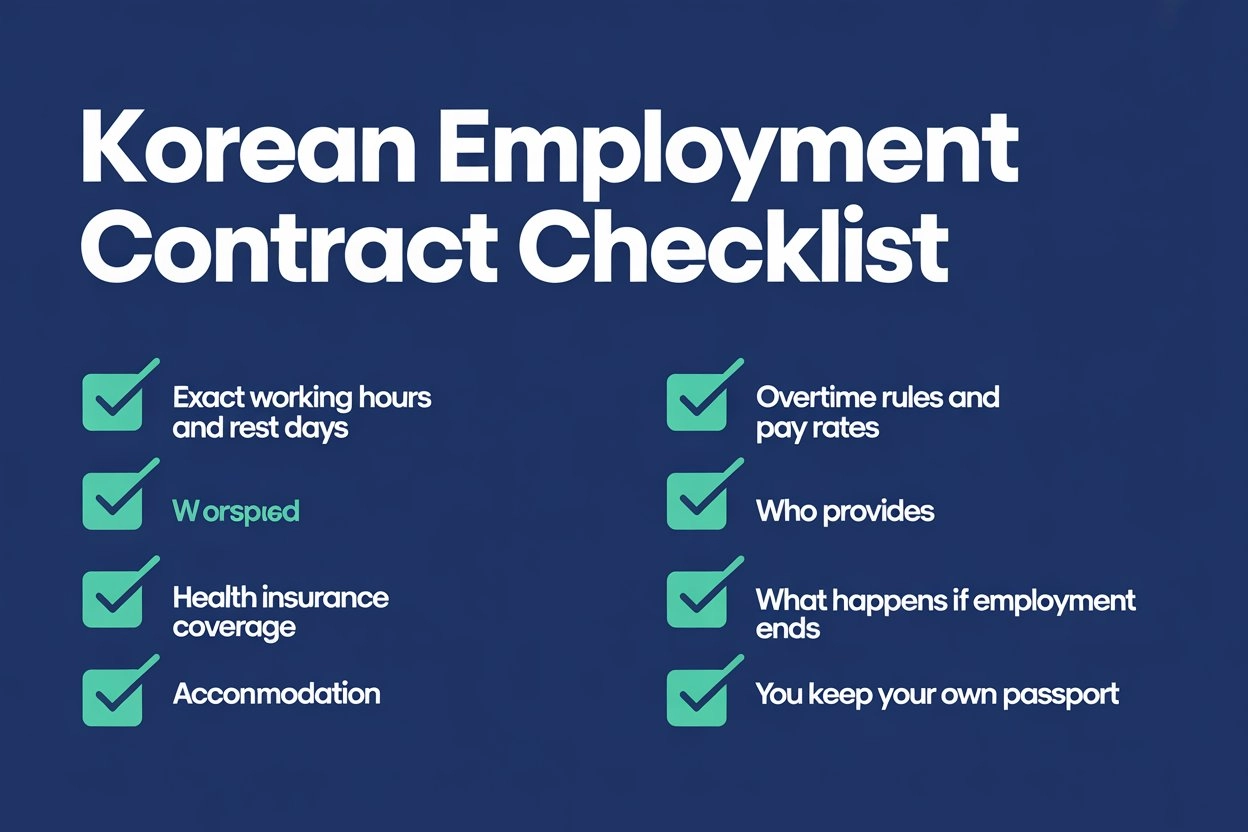
Before signing any Korean employment contract confirm the following in writing:
- Exact working hours and rest days
- Overtime rules and pay rates
- Who provides accommodation and at what standard
- Health insurance coverage
- What happens to your visa if employment ends
- That you keep your own passport at all times
Passport confiscation is illegal under Korean law. If an employer tries to hold your passport that is a serious warning sign.
Korean Employment Contract Checklist
The E-7 Visa for Professional Workers
If you have a bachelor's degree and professional experience the E-7 visa covers white collar and specialist roles including IT, engineering, finance, and education.
According to the Korea Immigration Service, the minimum annual salary for an E-7-1 visa in 2026 is 31,120,000 Korean won per year. Your employer sponsors and applies for the visa on your behalf. You cannot initiate the process without a job offer from a Korean company first.
Before submitting your Korean job application, make sure your CV is formatted correctly for ATS systems. Our ATS guide covers everything you need to know.
The Korean Language — More Important Than Most People Expect
Korean language ability comes up repeatedly in this guide and that is intentional because it genuinely affects almost every aspect of life in Korea.
For students it determines how well you function outside the classroom. For E-9 workers it directly affects your EPS-TOPIK score and therefore your chances in the employment system. For professional workers it determines how naturally you integrate into a Korean workplace.
The internationally recognized test for Korean proficiency is TOPIK, ranging from Level 1 at the most basic to Level 6 at the most advanced. A practical baseline that makes daily life manageable is around Level 2 to 3.
Free and affordable study resources include the KIIP program, Talk To Me In Korean, and Sejong Korean online materials. Starting Korean preparation several months before you apply for any visa or scholarship puts you in a significantly better position than starting after you arrive.
Accommodation — What to Expect
For E-9 workers Korean law requires employers to provide free accommodation or a housing allowance. In practice most manufacturing and agricultural employers provide dormitory-style housing close to the worksite. Quality varies by employer so asking specific questions about accommodation before accepting a job is worth doing.
For students the most practical first-year option is university dormitories. They are affordable, convenient, and remove the complexity of navigating the Korean rental market while you are still settling in. Dormitory spots are competitive so apply early.
Off-campus options include gosiwon which are small single rooms rented by the month, share houses, and standard apartment rentals. The Korean rental system uses a deposit model that can be complex for first-time foreign renters. Getting proper advice before signing any rental contract is recommended.
The Loneliness Reality Nobody Mentions
After reviewing discussions from international student communities and interviews published by Korean universities, loneliness and feeling isolated during the first six months consistently appears as one of the most commonly reported adjustment challenges for international students and workers.
You can be surrounded by people every day and still feel lonely. Making close Korean friends takes time. Social circles in Korea can feel difficult to enter as a foreigner, particularly in the beginning.
This is not unique to Korea but it is worth knowing before you go. Having realistic expectations about the social adjustment period means you are less likely to be blindsided by it when it happens. Connecting with other international students or workers in similar situations helps in the early months.
Save Money Before You Go
Even if you receive a scholarship or secure a job offer that covers accommodation, having savings before you arrive gives you meaningful security.
The period between arriving and receiving your first salary or stipend payment can be several weeks. There are administrative processes, registration requirements, and unexpected costs in the first weeks that savings help you handle without stress. Most people who arrive with almost no financial cushion experience significantly more difficulty in their first months than those who have a buffer.
Banking and Practical Life
Opening a bank account in Korea requires your Alien Registration Card, which you receive after registering with the local immigration office. This typically takes a few weeks after arrival.
KEB Hana Bank and Woori Bank are both known for being accessible to foreign nationals. Many universities have preferred banking partners for international students which simplifies the process.
For a SIM card the main providers are SK Telecom, KT, and LG U+. MVNO providers running on the same networks offer lower prices. You need your passport and Alien Registration Card for a contract SIM. Tourist SIMs available at the airport work on passport alone and are useful in your first days.
Sending money home is straightforward through remittance services. Korea's banking system is efficient and international transfers are generally processed quickly.
Licensed Agencies & Consultancies
To apply for visas legally and safely, you must process your applications through licensed recruitment agencies recognized by the respective governments. We have compiled complete directory listings for verified manpower agencies and educational consultancies across Nepal, India, the Philippines, Vietnam, and Bangladesh.
Manpower Agencies Directory
Find licensed recruitment agencies across Nepal, India, Philippines, Vietnam, and Bangladesh to help secure verified employment visas.
Educational Consultancies Directory
Discover professional student consultancies to assist with overseas university admissions, scholarships, and student passes.
Sources and Further Reading
To verify visa regulations, immigration procedures, and professional integration requirements discussed in this guide, please visit the following official resources:
Frequently Asked Questions
Can South Asian workers get an E-9 visa for Korea?
Nepal, Bangladesh, Pakistan, and Sri Lanka are among the eligible countries for the E-9 Employment Permit System. India is not currently on the E-9 eligible country list. Indian workers typically need to explore the E-7 professional visa route which requires a bachelor's degree and relevant work experience. Always check the current eligible country list on the HRDKorea official website as it can change.
What is the EPS-TOPIK and do I need it?
The EPS-TOPIK is a Korean language and basic job aptitude test required for E-9 visa applicants. It is administered in your home country. Your score affects how competitive you are in the employment matching system. A higher score improves your chances of being matched with a Korean employer. Free study materials are available through the official HRDKorea website.
How competitive is the GKS scholarship really?
Very competitive. According to NIIED's published selection data, around 1,500 students receive GKS globally each year from more than 150 eligible countries. For large countries like India that works out to roughly 20 to 30 recipients per year. Many academically qualified applicants do not receive it. Applying is worth doing but having parallel backup plans is essential.
Do I need to speak Korean before going to Korea?
Not fluently but some Korean ability is strongly recommended regardless of whether you are going as a student or worker. For E-9 applicants the EPS-TOPIK score directly affects employment chances. For students daily life outside the classroom is conducted in Korean. Starting Korean preparation several months before you plan to go is one of the most useful things you can do.
What are the main risks for South Asian workers going to Korea?
The main risks include misleading job offers, contracts that differ from verbal promises, employers who violate accommodation or wage obligations, and the difficulty of daily life without Korean language ability. Using officially registered agencies, reading contracts carefully, keeping your own passport, and knowing your rights under Korean labour law helps manage these risks significantly.
Can international students work part time in Korea?
Yes. International students on a D-2 visa can generally work up to 20 hours per week during the semester. According to the Ministry of Employment and Labor, the 2026 minimum wage is 10,320 Korean won per hour. Most part time jobs available to students require Korean language ability as they typically involve customer interaction in Korean workplaces.
What happens if I want to change jobs under the E-9 visa?
E-9 visa holders can change employers under certain conditions but the process requires approval through official channels. The visa is tied to a specific employer. If you need to change due to contract violations or workplace problems there are official processes through the Employment Permit System to handle this. Contact HRDKorea or the local employment center for guidance specific to your situation.
Free CV Builder
Build Your South Korea CV for Free
Pick from 30+ professional templates to build a clean, job-ready CV in minutes. 100% Free.
Cover Letter Maker
Professional matching correspondence. Build for Free.
Business Card Maker
Sleek, modern designs for authority branding. 100% Free.
100% Free • No Credit Card • No Watermarks • Instant Access
More Guides
More Guides
Explore more guides to help you secure your job or scholarship.
Japan Work Guide
Visas, jobs, accommodation, banking, and what living in Japan actually costs. A practical guide for workers and students from Asia moving to Japan in 2026.
Gulf Work Guide
Honest guide to working in Gulf countries. Avoid scams, understand contracts, know your rights, and build a CV that gets you hired in UAE, Saudi, and Qatar.
ATS CV Guide
Most people misunderstand what ATS actually does. This guide explains how it really works and what your CV needs to pass it in 2026.
The Social Media Reality Check
Many people decide to go to South Korea after watching YouTube or TikTok content about life there.
Some of that content shows Korea as an ideal destination with high salaries, amazing food, safe streets, and exciting culture. Some of it shows exploitation, loneliness, and unfair treatment of foreign workers. Both types of content exist and neither tells the full story.
Most people's actual experiences fall somewhere in the middle. Korea has genuine advantages and genuine challenges. Go in with realistic expectations based on verified information rather than viral content from people with reasons to make their experience look better or worse than it actually was.