

Moving to Japan for Work - A Complete Guide for South Asian Workers and Students
Research Methodology
Information in this guide was verified using official sources including the Immigration Services Agency of Japan (ISA), Japan External Trade Organization (JETRO), the Ministry of Foreign Affairs of Japan (MOFA), and the official JLPT website. Visa requirements and wage figures reflect officially published 2026 data.
Last Fact-Checked: May 12, 2026
Japan is not the easiest country to move to.
The language is different. The culture is different. And the process of getting there legally takes real effort.
But Japan is genuinely looking for workers right now. The country has serious labour shortages across construction, hospitality, agriculture, food manufacturing, and care work.
The government has created specific visa pathways to bring in people from South Asian countries to fill those gaps. If you have the right skills and are willing to prepare properly, the door is open.
This guide covers everything. Not just the CV. The whole picture - how to get there, what visa you need, what jobs are available, whether your employer provides housing, how to open a bank account, how to get a SIM card, and what to expect when you arrive knowing very few people.
What Jobs Are Available for South Asian Workers in Japan
Japan created a visa called the Specified Skilled Worker visa specifically for foreign workers. It covers 16 industries including:
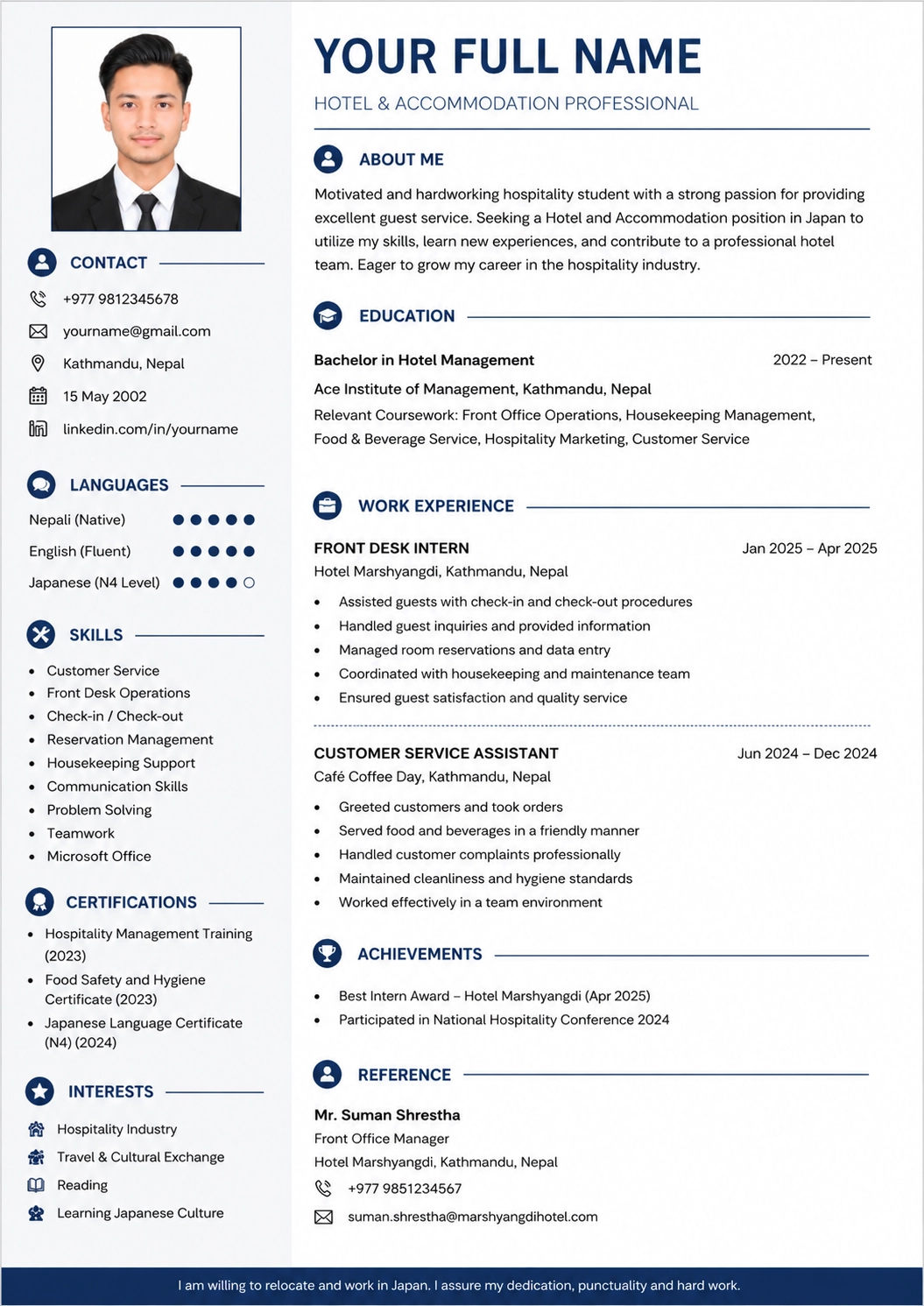
Hotel and accommodation work
Here is the real CV example for the Hotel and accommodation work job:
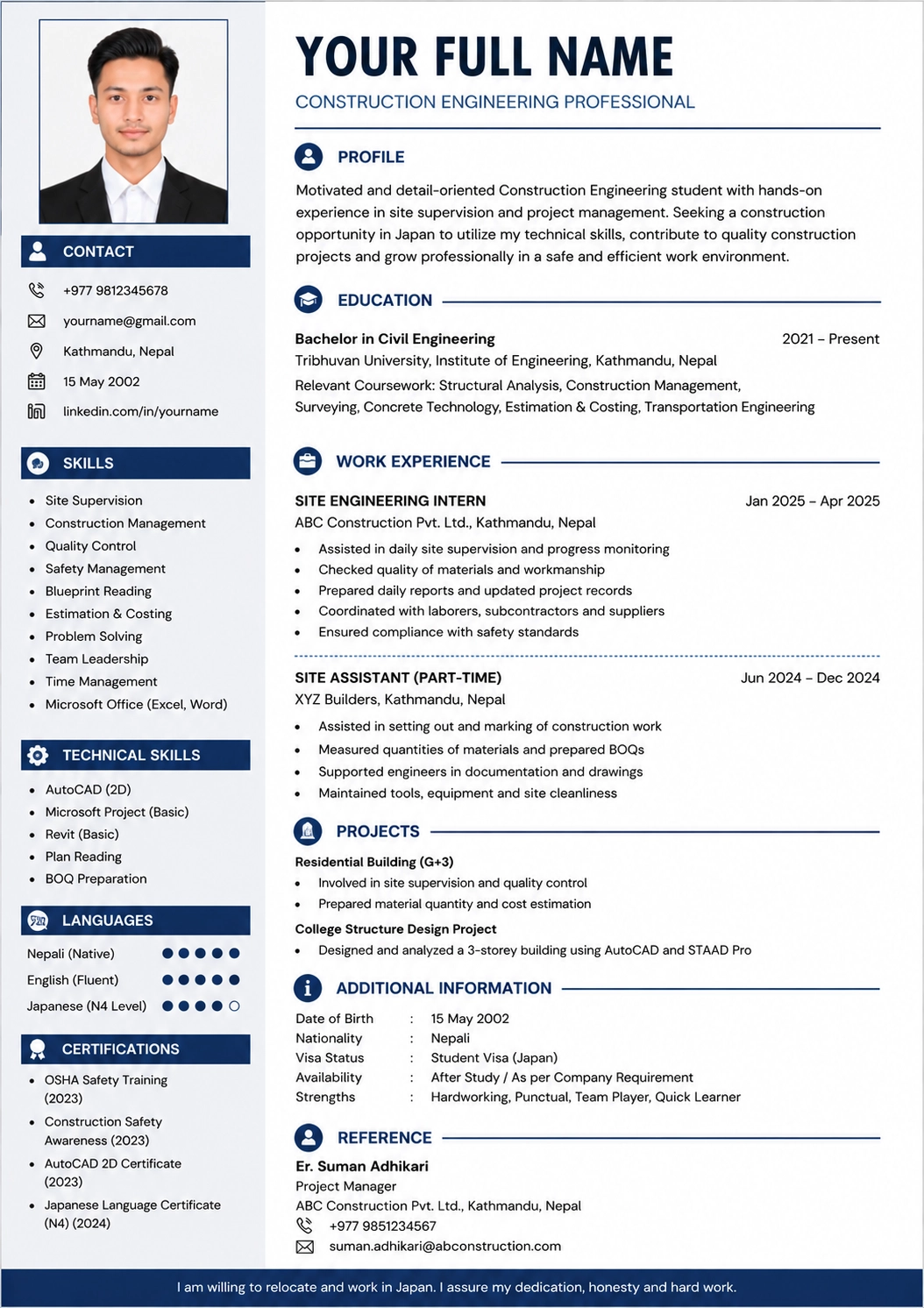
Construction
Here is the real CV example for the Construction job:
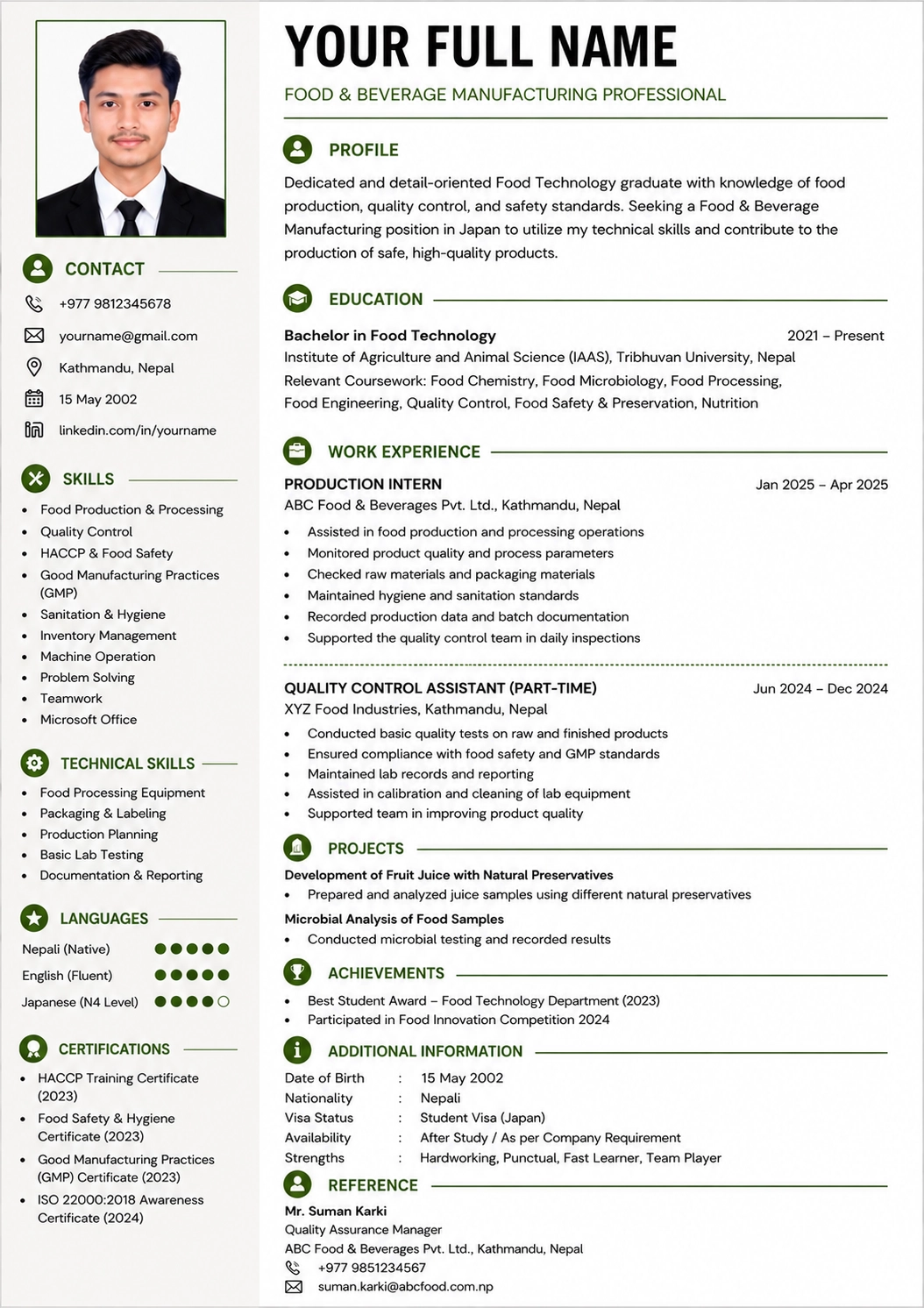
Food and beverage manufacturing
Here is the real CV example for the Food and beverage manufacturing job:
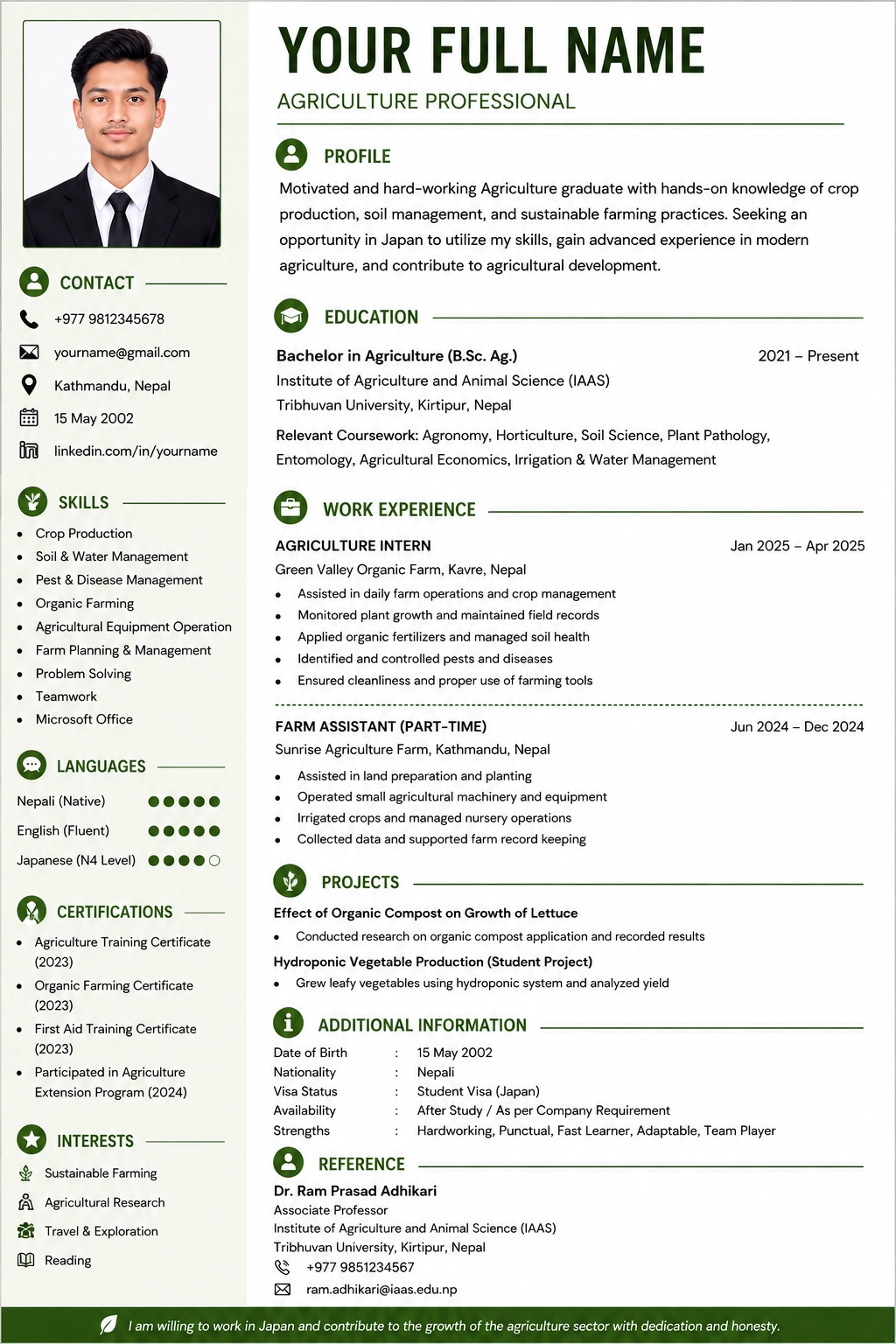
Agriculture
Here is the real CV example for the Agriculture job:
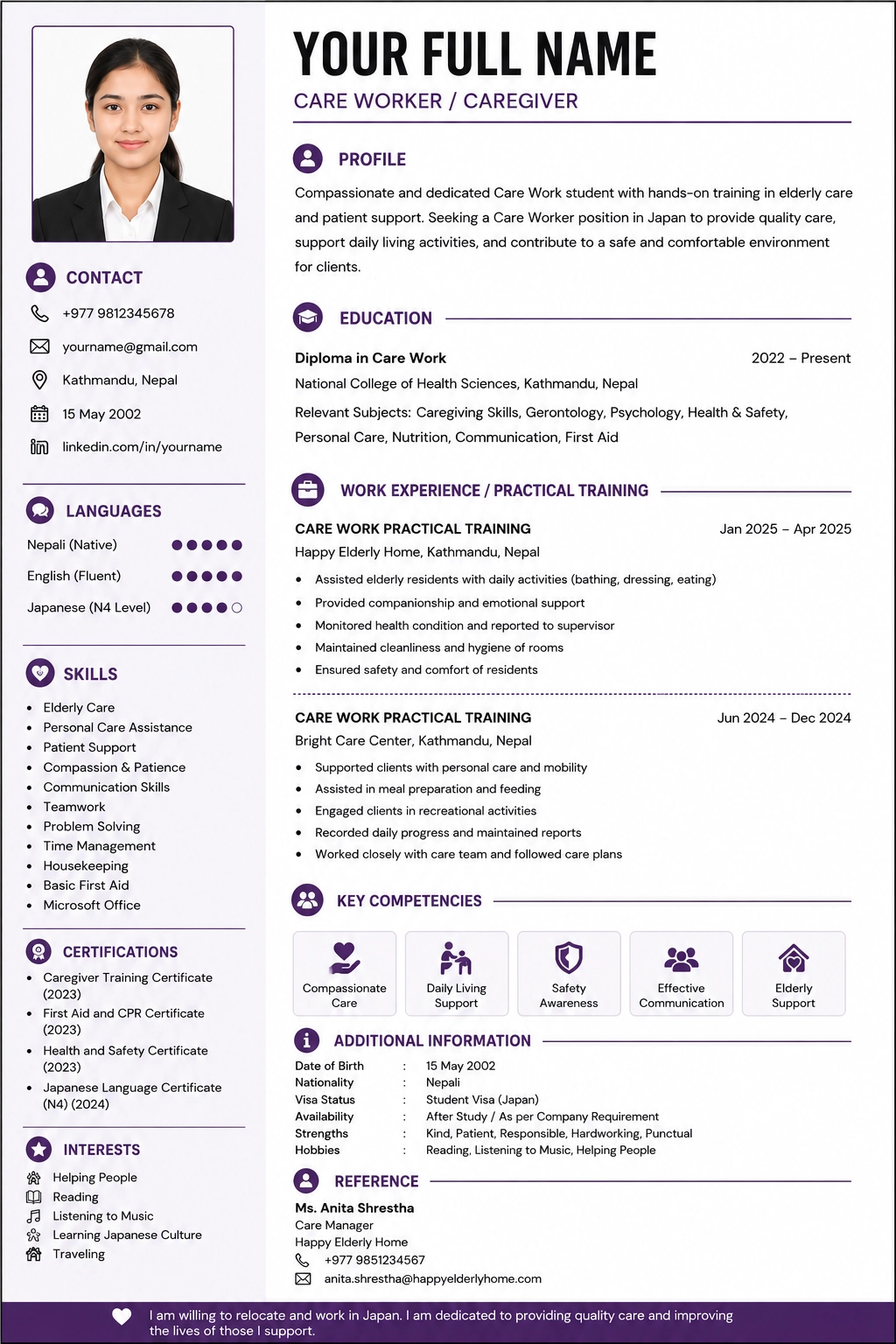
Care work
Here is the real CV example for the Care work job:
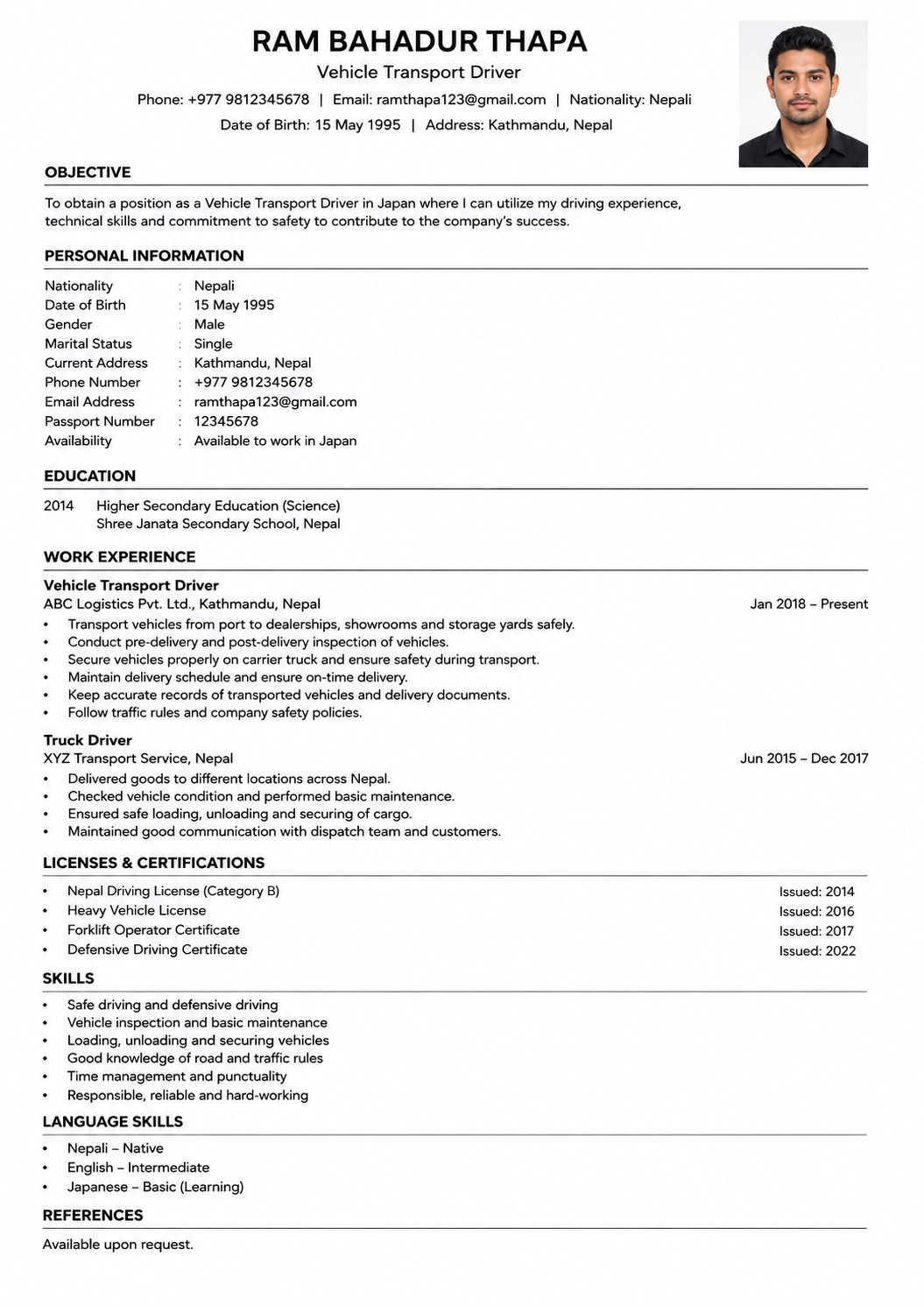
Automobile transport
Here is the real CV example for the Automobile transport job:
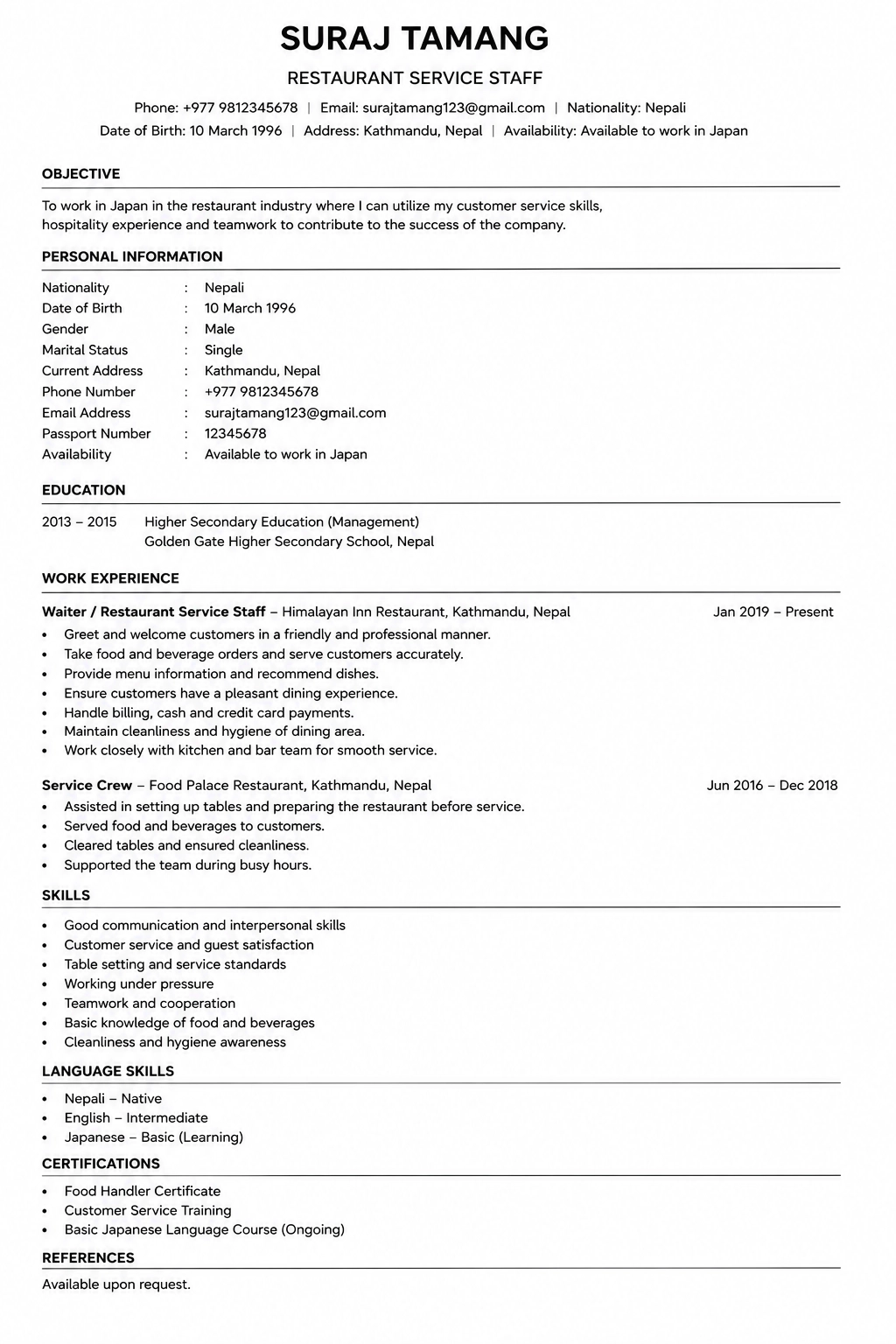
Restaurant services
Here is the real CV example for the Restaurant services job:
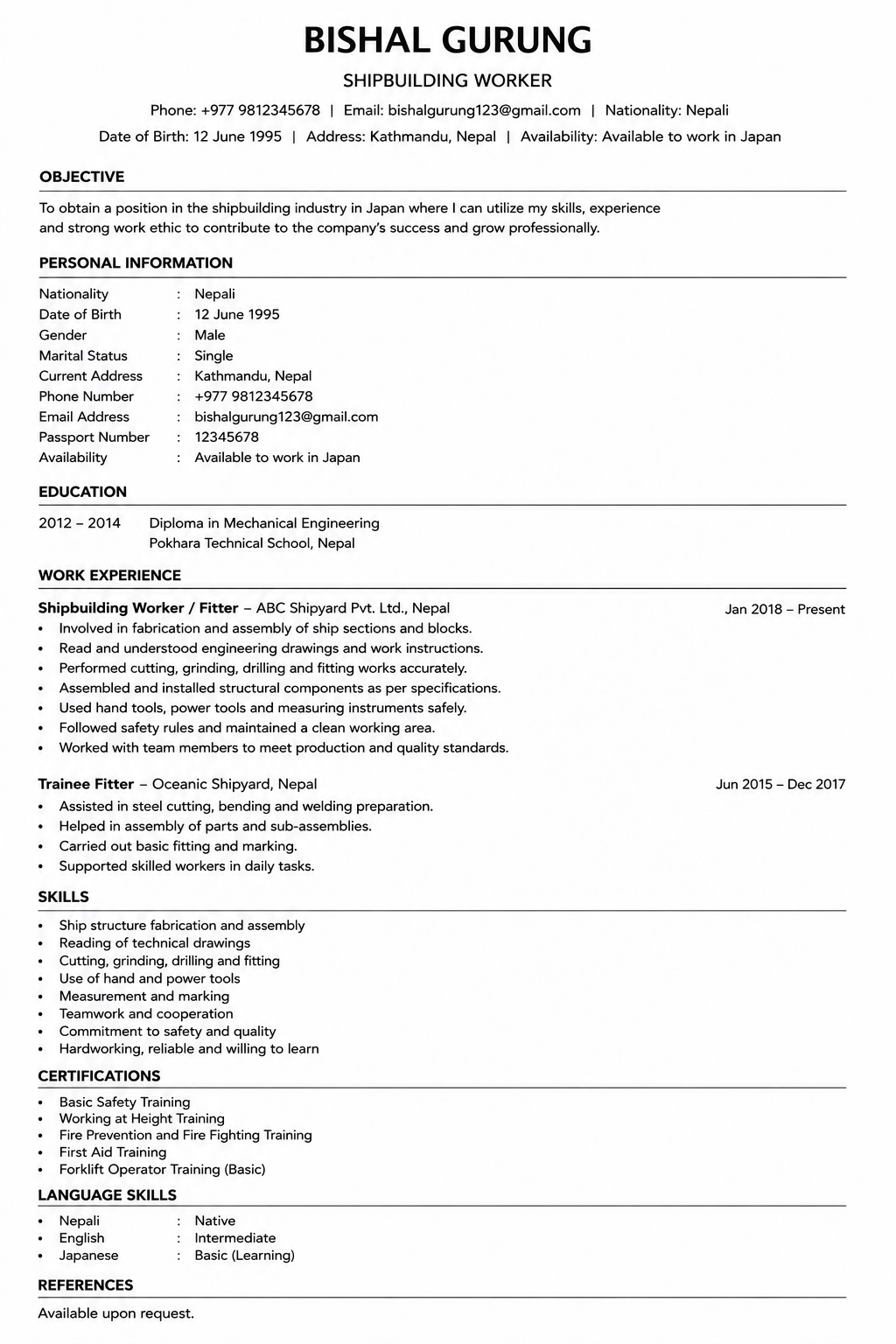
Shipbuilding
Here is the real CV example for the Shipbuilding job:
This tells you exactly which fields Japan is actively recruiting for. If your experience falls into any of these categories you have a real and legal pathway into Japan.
Do You Need to Speak Japanese?
Yes, to some degree. This is the question most people ask first and it deserves an honest answer.
To get a Specified Skilled Worker visa you need to pass two tests. One tests your skills in your specific industry. The other tests your Japanese language ability.
The minimum language level required is JLPT N4. This is basic conversational Japanese. Not fluency but not nothing either. You need to understand simple sentences and handle basic daily conversations.
For hotel and restaurant roles some Japanese is genuinely necessary because you will be talking to Japanese guests every day.
The good news is you can study for the Japanese language test for free through the official SSW Japan Study Portal. Most people with no prior Japanese knowledge reach N4 level with three to six months of consistent daily study.
If you plan to go as a student first the language barrier is lower. Language schools teach you Japanese as part of the programme and you build skills while already in the country.
Visa Routes Into Japan for South Asian Workers
Specified Skilled Worker Visa
This is the most direct route for workers with relevant industry experience.
You need to pass the skills exam and the Japanese language test at N4 or above.
Your employer applies for the visa on your behalf after signing an employment contract with you. You cannot start the visa process without a job offer from a Japanese employer first.
Type 1 allows you to stay and work for up to five years. You cannot bring family members on this type.
Type 2 allows unlimited renewals and lets you bring family members. It requires a higher level of demonstrated skill.
For most South Asian workers starting out, Type 1 is the realistic entry point.
Student Visa
If you want to study Japanese first or are applying to a university or language school this is your route.
You need a high school diploma and enough savings to support yourself, typically around two to three million yen.
The student visa is also popular because once you are already in Japan it is significantly easier to find a job and switch to a work visa than applying from outside.
Engineer and Humanities Visa
This is the standard professional work visa for IT workers, engineers, and international business roles.
It requires either a bachelor's degree or ten years of relevant work experience.
Many South Asian IT professionals use this route.
How to Find a Job in Japan From Your Home Country
Finding a job before you arrive is possible but takes persistence.
GaijinPot Jobs is one of the most established job boards for foreigners looking for work in Japan. Many listings are in English and employers there are explicitly open to international candidates.
Japan Dev focuses on technology roles and is well regarded for English-friendly tech companies.
JETRO is the Japan External Trade Organization. They maintain a database of Japanese companies actively seeking global talent.
Recruitment agencies like Robert Half and Hays have offices in Japan and regularly place foreign professionals.
For Specified Skilled Worker positions there are also registered support organizations that help match foreign workers with Japanese employers in the eligible industries.
One important thing to understand. You cannot apply for a work visa on your own. A Japanese employer has to sponsor and apply for it on your behalf. Finding a job offer is the first step, not the last.
Your CV for Japan - What Is Actually Different
Japan has its own CV tradition that is different from what most South Asian workers are used to.
The Rirekisho
Traditional Japanese companies use a standardized CV format called a rirekisho.
It is a structured document covering your personal details, educational history, and work history in a very specific layout. Many rirekisho forms are still filled in by hand, which traditional employers view as a sign of seriousness and effort.
For most foreign workers applying through international channels, a clean English CV is acceptable and often preferred. But if you are applying to a traditional Japanese company through a Japanese recruiter, ask whether they expect a rirekisho.
If you are applying to modern Japanese companies that use ATS software, our ATS guide explains exactly how to format your CV for these systems.
What Japanese Employers Look For
Japanese employers pay close attention to how long you stayed at previous jobs.
Changing jobs frequently is viewed negatively in Japan. If your CV shows several short stints, be prepared to explain each one clearly.
Precision and attention to detail matter more in Japan than in many other countries. A CV with spelling mistakes or inconsistent formatting makes a genuinely bad impression.
Any experience working with Japanese companies or Japanese clients is worth highlighting. Even indirect familiarity with Japanese business culture is worth mentioning.
What to Include on Your Japan CV
- Your full name clearly at the top
- Contact details including phone number and professional email
- Current location and visa status or the visa you plan to apply for
- A professional passport style photo - this is standard and expected in Japan
- Your JLPT level if you have taken the test, even a basic level shows commitment
- Work experience listed from most recent to oldest
- Specific descriptions of what you did and what you achieved - not generic phrases
Generic descriptions like "managed daily operations" tell a Japanese employer very little.
Specific descriptions like "managed front desk operations for a 120 room hotel handling check-in and checkout for an average of 80 guests per day" tell them something real.
Will Your Employer Provide Accommodation
This is one of the most practical questions and the answer depends on your employer and visa type.
For Specified Skilled Worker visa holders, registered support organizations are legally required to help with finding accommodation if you need it.
Many employers in the SSW programme provide housing directly, particularly in agriculture, food manufacturing, and construction where workers are often based outside major cities.
In practice many SSW workers in food manufacturing or agriculture earn between 180,000 and 230,000 yen per month before deductions. Employer-provided accommodation significantly reduces your actual living costs.
For corporate roles and student visas, accommodation is typically your own responsibility.
Japan has a reputation for making it difficult for foreigners to rent apartments. Many landlords traditionally required a Japanese guarantor and were reluctant to rent to foreign nationals. This has been improving but remains a real challenge especially in your first weeks.
Practical options when you first arrive:
Share houses are very popular in Japan among new arrivals. They are cheaper than renting alone, require no guarantor, and let you settle in before finding something longer term.
Monthly apartment services rent furnished apartments without traditional guarantor requirements.
Accommodation provided by your employer or school is worth asking about specifically before you arrive.
The key is to arrange somewhere to stay before you land. Arriving in Japan without accommodation sorted is significantly harder to fix once you are there.
Opening a Bank Account in Japan
Opening a bank account in Japan as a foreigner has historically been complicated but the situation has improved.
To open a standard account you generally need your residence card. You receive this after registering at your local municipal office. You cannot get a residence card until you are in Japan on a long-term visa.
Once you have your residence card the most accessible bank for foreign workers is Japan Post Bank. It has a reputation for being more accommodating to foreign nationals and has branches everywhere across the country.
Many employers will tell you which bank to open an account with since your salary will be paid directly into it. Following their guidance simplifies the process.
Bring your residence card, passport, and registered address details when you go to open the account.
Getting a SIM Card
Getting a SIM card in Japan is more straightforward than opening a bank account.
The easiest option for new arrivals is a data SIM from providers like IIJmio, Mineo, or Rakuten Mobile. These are available online and at electronics stores like Yodobashi Camera or Bic Camera.
For a SIM with a voice call plan you typically need to show your residence card and sign a contract.
For a data-only SIM the requirements are less strict and you can often get one at the airport on arrival.
Many new arrivals get a short-term tourist SIM or pocket Wi-Fi device first, then switch to a regular plan once their residence card and bank account are sorted.
What to Realistically Expect When You Arrive
Moving to Japan knowing very few people is a genuine challenge that nobody should underestimate.
Japan is a beautiful and safe country. But it can feel quite isolating at the start, especially if your Japanese is limited.
Things that help with the transition:
The Japanese government's Daily Life Support Portal for Foreign Nationals provides information in multiple languages including Hindi, Bengali, Nepali, Urdu, and Sinhala. It covers health insurance, banking, housing, and other practical topics.
FRESC is a facility in Tokyo with government help desks that provide consultation services for foreign nationals on a wide range of topics.
Registering at your local municipal office as soon as you arrive is important and cannot be skipped. Your residence card and much of what follows depends on this being done first.
Health insurance enrollment is mandatory in Japan. Your employer will typically enroll you in their health insurance scheme. If you are arranging things yourself you need to enroll in national health insurance at your municipal office.
Frequently Asked Questions
Can South Asian workers get a job in Japan without a university degree?
Yes, through the Specified Skilled Worker (SSW) visa route. This visa was specifically designed for workers with industry skills rather than academic qualifications. You need to pass a skills evaluation exam in your target industry and a Japanese language test at JLPT N4 level or above. If you have completed the Technical Intern Training programme in Japan previously, you may be exempt from some of these tests.
How long does it take to get a Japan work visa?
For the Specified Skilled Worker visa, once your employer submits the application you typically wait one to three months for approval. The process cannot begin until you have a signed employment contract with a Japanese employer. Planning for a total timeline of three to six months from starting your job search to arriving in Japan is realistic.
Will my employer help me settle in when I arrive?
If you are coming on a Specified Skilled Worker visa, your employer and the registered support organization are legally required to provide orientation and support when you arrive. This includes helping you with residence registration, bank account setup, and understanding your rights in Japan. The level of support varies between organizations, but it is a strict legal requirement.
What happens if I want to change jobs in Japan?
Under the Specified Skilled Worker Type 1 visa, you can change employers freely as many times as you want, as long as your new job is in the same eligible industry. You do not need to apply for a new visa. If you want to move to a different industry sector, you need to pass the skills evaluation for that sector first.
Can I bring my family to Japan on a work visa?
Under the Specified Skilled Worker Type 1 visa, you cannot bring family members. Under Type 2 you can. For the standard Engineer and Humanities visa, family members can accompany you. If bringing your family is important to your plans, factoring this into which visa type you target from the beginning makes sense.
How do I prepare for the Japanese language test?
The official SSW Japan Study Portal offers free study materials for both the skills evaluation exams and the Japanese language tests. JLPT N4 requires understanding simple sentences and basic conversations. Most people with no prior Japanese knowledge need six months to a year of consistent daily study to reach this level. Starting your language preparation well before you begin job applications gives you the best chance.
Is accommodation always provided by the employer in Japan?
Not always. For Specified Skilled Worker positions in agriculture, food manufacturing, and construction, employer-provided housing is common. For corporate and professional roles, you will usually need to arrange your own accommodation. Share houses are the most practical option for new arrivals who are not sure where they will settle long term.
Sources & Further Reading
To verify visa regulations, immigration procedures, and professional integration requirements discussed in this guide, please visit the following official resources:
Need Help Moving to Japan?
Everything you need in one place — verified agencies, trusted consultancies, and live job openings.
Career Toolkit
Build Your Professional CV for Free
Pick from 30+ professional designs and create a clean, job-ready CV in minutes. 100% Free.
Cover Letter Maker
Professional matching correspondence. Build for Free.
Business Card Maker
Sleek, modern designs for authority branding. 100% Free.
100% Free • No Credit Card • No Watermarks • Instant Access
More Guides
Continue Your Research
Explore the guides required to build the perfect CV.
Gulf Work Guide
Honest guide to working in Gulf countries. Avoid scams, understand contracts, know your rights, and build a CV that gets you hired in UAE, Saudi, and Qatar.
South Korea Guide
Honest guide to South Korea. Learn about GKS scholarships, E-9 visas, Korean language reality, contract verification, and what to know before you go.
ATS CV Guide
Most people misunderstand what ATS actually does. This guide explains how it really works and what your CV needs to pass it in 2026.