
How to Make a CV as a Student or Fresher — What Nobody Tells You
Research Methodology
This guide combines recruiter recommendations, university career center guidance, and practical observations from reviewing student CVs and career resources across international job markets.
Last Fact-Checked: June 13, 2026
When I was a student and needed a CV for the first time I did what most students do.
I searched Google. I found a CV that looked clean and professional. I copied the structure. I copied some of the sections. I even copied some of the skills listed because they sounded good.
Then I sent it out and got nothing back.
The problem was not the format. The problem was that the CV was not about me. It was a copy of someone else's life with my name at the top. The skills I listed were not mine. The structure did not reflect my actual profile. The whole document was built around what someone else had done.
This is one of the most common mistakes students make when writing their first CV. And it is completely understandable because when you have never written a CV before the easiest thing to do is copy one that looks right.
This guide helps you build a CV that is actually about you. Even if you think you have nothing to put on it.
Click to view full screen. Recruiter-approved layout: Clear visual focus on education, projects, and skills.
Download CV Template Image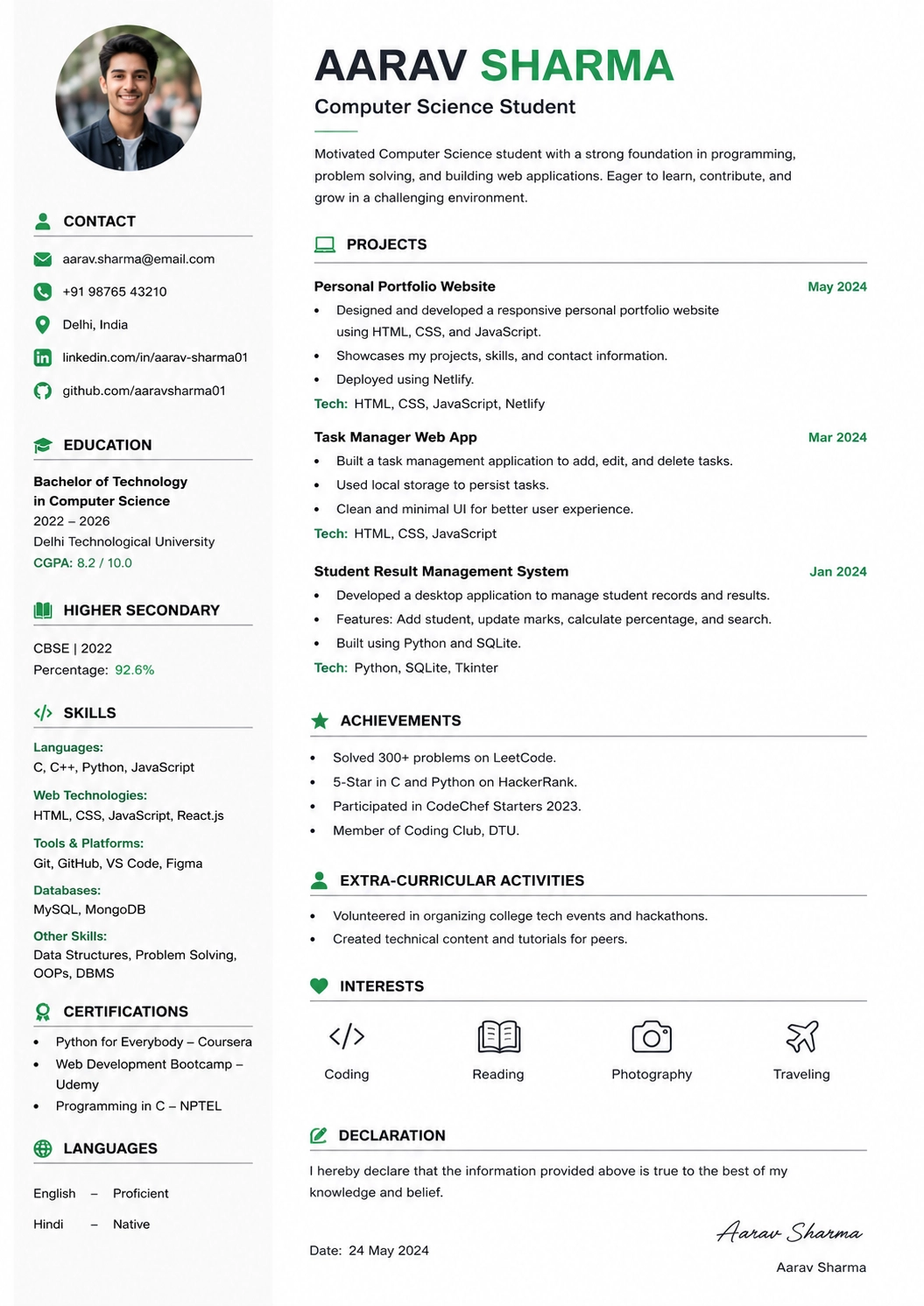
Click to view full screen. Visual roadmap explaining student CV building strategy step by step.
Download Infographic Image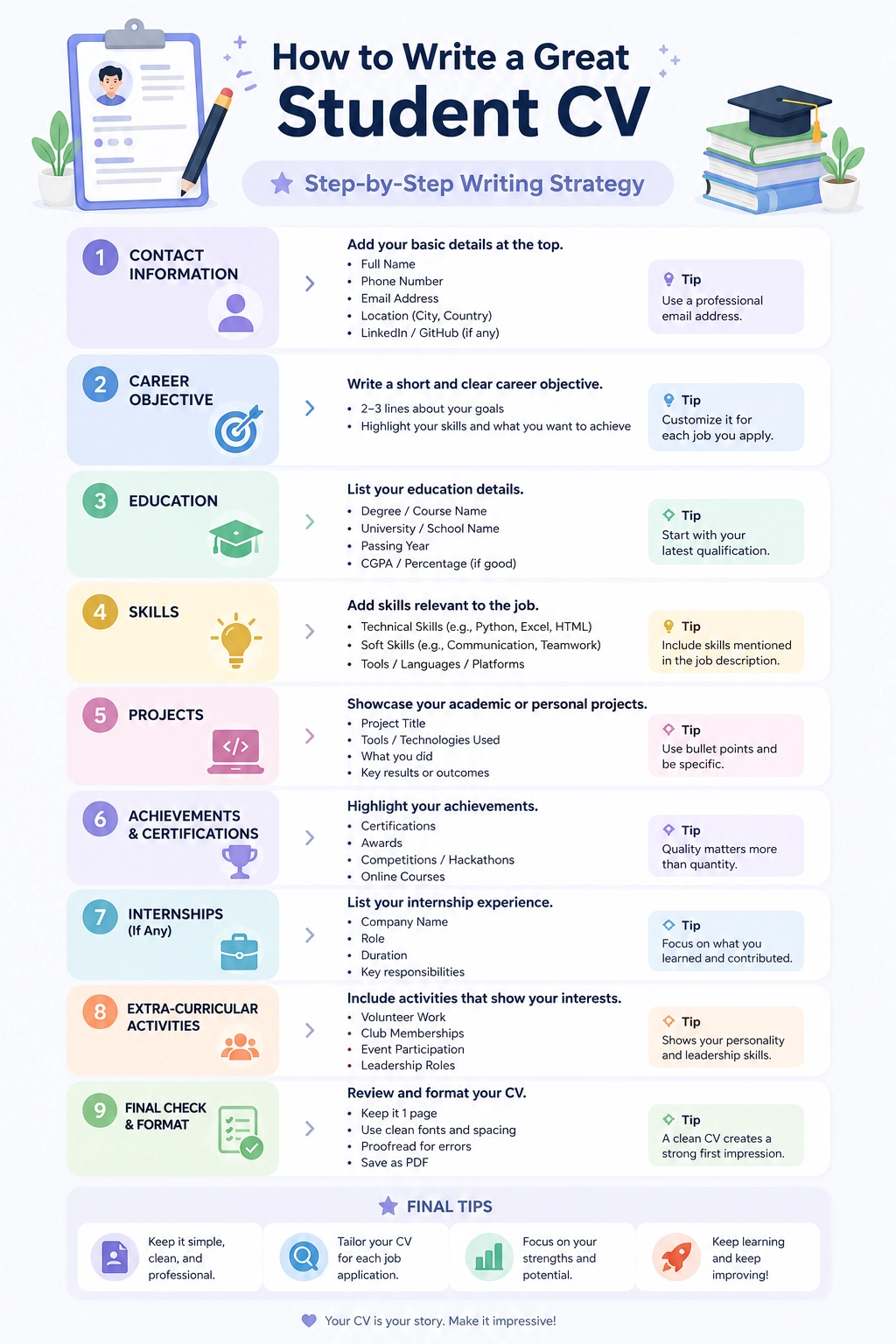
The Biggest Lie Students Tell Themselves
"I have nothing to put on my CV."
Almost every student believes this at some point. Most of them are wrong.
The issue is not that students have no experience. The issue is that they do not recognize the experience they already have as valuable or relevant.
Think about what you have actually done in the last two or three years.
- Have you done any college or university projects? Even group projects count. If you led the group, handled the research, built the presentation, or solved a specific problem that is real experience.
- Have you done any volunteering? Even helping at a school event, a community program, a charity drive, or a religious organization counts. These show responsibility and initiative.
- Have you held any student leadership position? Class representative, club president, sports team captain, debate team member, event organizer. These show that other people trusted you with responsibility.
- Have you completed any online courses, certifications, or training programs? Google certificates, Coursera courses, coding bootcamps, language classes. These show that you invest in yourself.
- Have you done any freelance work, part time jobs, or even informal paid work? Tutoring a neighbor's child, helping a local shop with social media, delivering goods on weekends. These count.
- Have you built any personal projects? A website, an app, a design portfolio, a YouTube channel, a photography collection, a small business. These count significantly.
Most students have at least three or four of these things. They just did not think to include them because nobody told them they were relevant.
Click to view full screen. Roadmap blueprint detailing activities that count as student experience.
Download Roadmap Image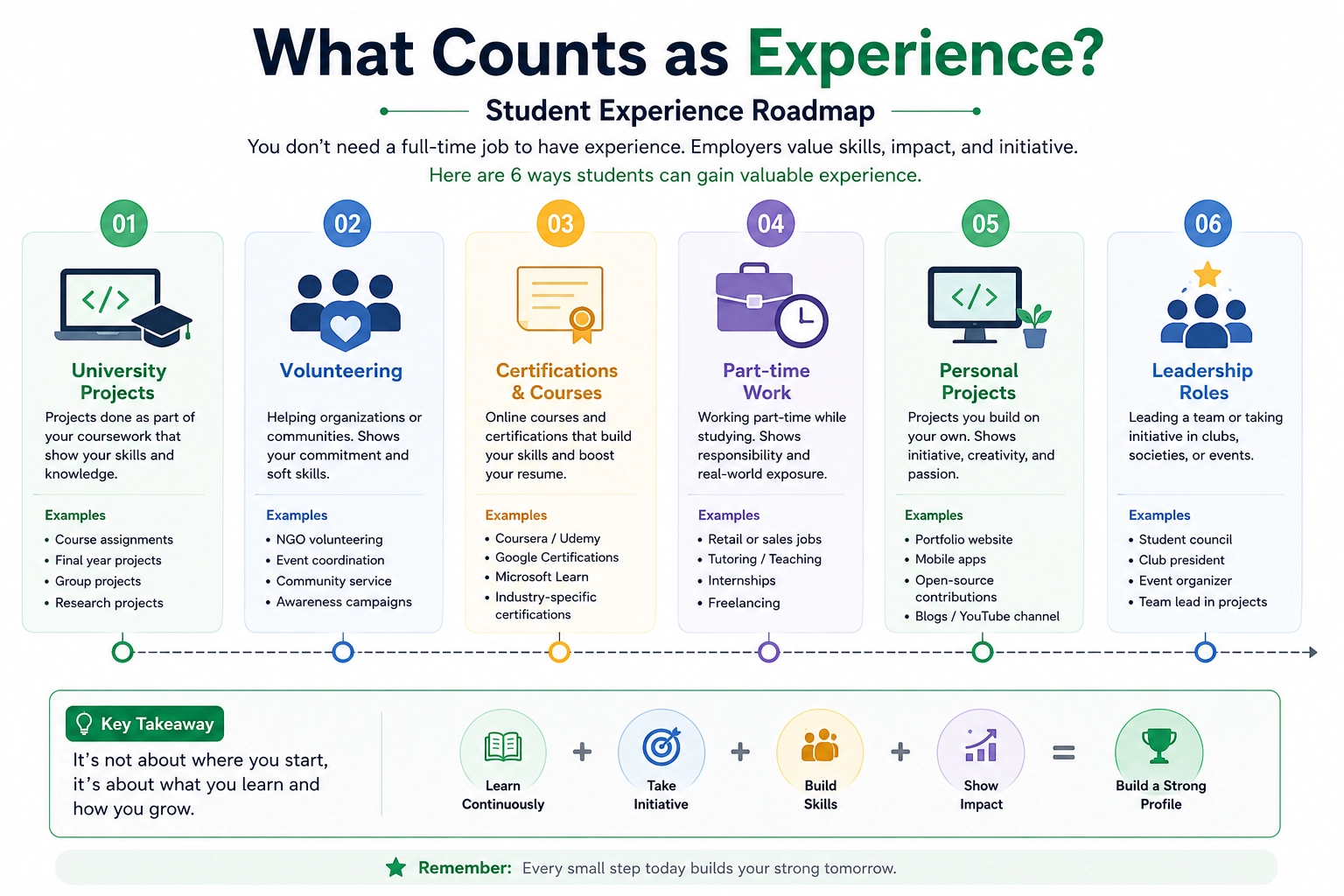
What Employers and Universities Actually Look For
Before you start writing anything it helps to understand what the person reading your CV is actually looking for.
Recruiters we reviewed and career advisors commonly emphasized initiative, project work, and communication skills when evaluating students with limited work experience.
Recruiters and career advisors commonly note that employers hiring students and fresh graduates do not expect extensive professional experience. What they are looking for is evidence that you are worth investing in.
Specifically they want to see that you can take responsibility for something and see it through. That you have shown some initiative beyond just attending classes. That you can communicate clearly in writing. That you have some relevant knowledge or skills for the role. And that you are honest and specific about your qualifications.
For universities reviewing applications for graduate programs or scholarships they are looking at your academic record first. But beyond grades they want to see that you have applied your knowledge somewhere, that you have shown some leadership or involvement, and that you have a clear reason for wanting the specific program you are applying for. Many students working on study abroad programs find it extremely useful to coordinate their applications with verified educational consultancies to align their CVs with international admission standards.
Neither an employer nor a university admission team expects a student CV to look like a senior professional CV. They expect it to look like an honest and specific account of what you have done.
Common Student CV Mistakes
Avoid these common pitfalls that university career advisors and recruiters frequently note:
- Using generic skills without evidence:Avoid listing traits like "great communicator" or "detail-oriented" without adding a project or event description to back them up.
- Listing every school subject: Only show coursework modules that are directly relevant to the specific job or target study discipline.
- Using unprofessional email addresses: Always use a clean email format such as
first.last@gmail.cominstead of childhood nicknames. - Copying CV templates word-for-word: A template is a visual guide. Swapping only the name while leaving standard sample content shows lack of care.
- Including irrelevant personal details: Leave out details like marital status, height, or religious affiliations unless legally required in your target market.
- Sending the same CV everywhere: Applying to five different sectors with the exact same objective statement signals generic interest.
What to Include on a Student or Fresher CV
Click to view full screen. Structure blueprint breaking down key structural sections of a student CV.
Download Diagram Image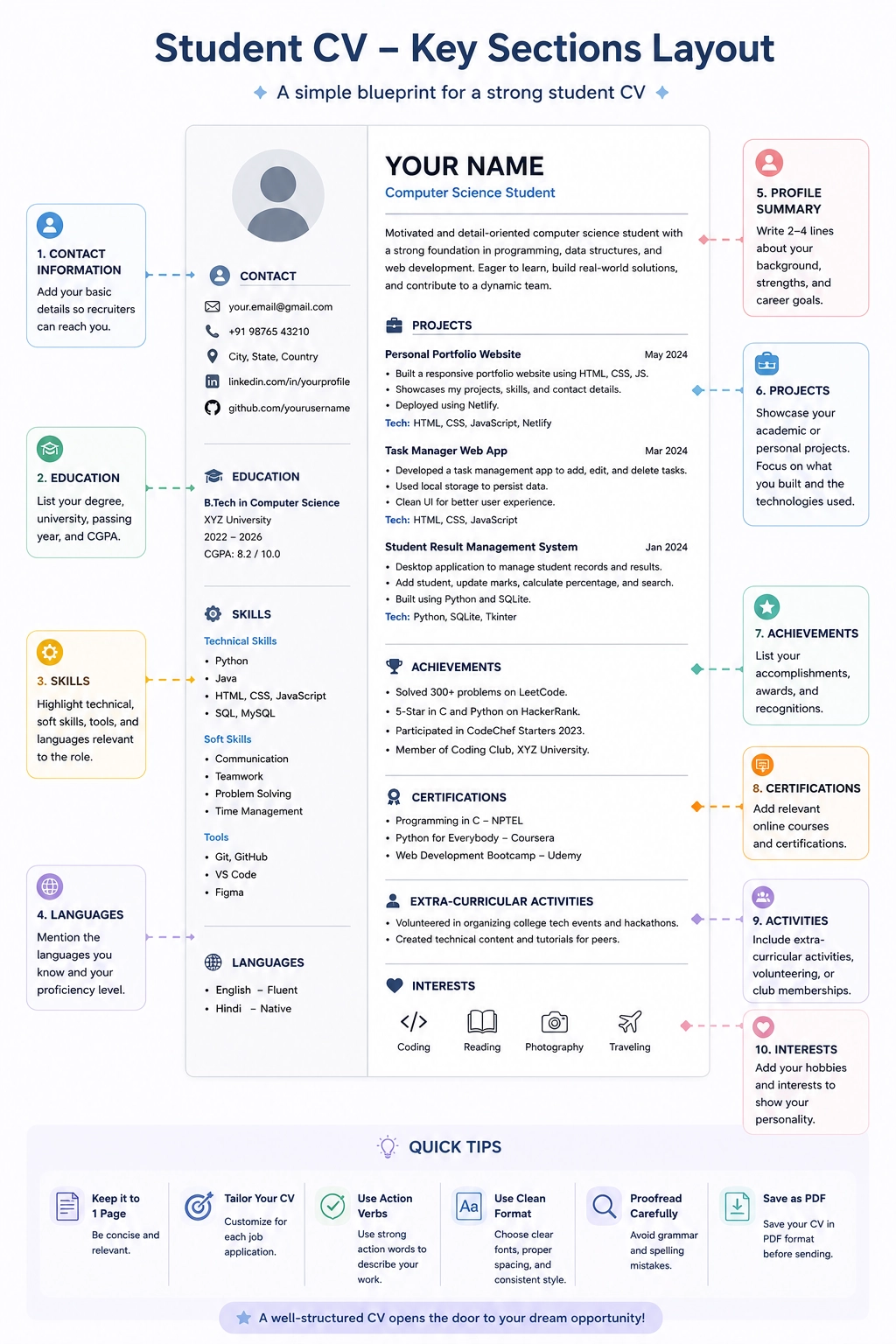
Contact Information
Your full name at the top. Your phone number. Your email address. Make sure your email looks professional. An address like yourname@gmail.com is fine. An address like partylover2005@gmail.com is not.
Your LinkedIn profile if you have one and it is reasonably complete. Your city and country if you are applying internationally.
A Short Professional Summary or Objective
Two to four sentences at the top that explain who you are, what you are studying or have studied, what you are looking for, and what you bring. Keep it specific and avoid vague phrases like hardworking and passionate.
❌ BAD (Vague & Generic)
"I am a hardworking and passionate student looking to gain experience and grow in a challenging environment."
✅ GOOD (Recruiter Friendly)
"Final year Computer Science student at XYZ University specializing in web development. Built three personal projects using React and Node.js. Seeking an entry-level developer role where I can apply practical coding skills in a professional environment."
The second version is specific. It tells the reader exactly who this person is and what they bring.
Education
List your most recent qualification first. Include the institution name, the degree or qualification, your graduation year or expected graduation year, and your grade or GPA if it is strong.
For students you can also include relevant coursework if it directly relates to the role you are applying for. A Computer Science student applying for a data analyst role could list modules like Data Structures, Statistics, and Database Management. A Business student applying for a marketing role could list modules in Consumer Behavior, Digital Marketing, and Brand Management.
Do not list every module. Only the ones that are genuinely relevant to the specific role or program you are applying for.
Projects
This is the section most students skip that they should be using.
For every project include a title or brief description of what it was, what you did, what tools or skills you used, and what the result or outcome was.
Weak Project Description
"Group marketing project for a local business."
Stronger Project Description
"Developed a full digital marketing strategy for a local restaurant as part of a four-person university team. Conducted competitor analysis, designed a social media content calendar, and presented findings to the business owner. Project received highest grade in the cohort."
The second version shows real work, real skills, and a real outcome. A recruiter reading this can see what this student actually did.
Work Experience
If you have any paid or unpaid work experience list it here. Part time jobs, internships, work placements, casual work, freelance work. All of it counts.
For each role include the job title or role description, the company or organization name, the dates, and three to five specific bullet points describing what you did and what resulted from it.
Even simple part time jobs can show valuable things. A student who worked as a cashier at a supermarket for a year has evidence of reliability, customer service, cash handling, and consistent attendance. Describe those things specifically rather than just listing the job title.
Volunteer Work and Extracurricular Activities
Include any volunteer work, student clubs, sports teams, community involvement, or leadership roles. For each one describe what you did specifically not just that you were a member.
Being the treasurer of a student society shows financial management. Organizing an event shows project management. Coaching a junior sports team shows leadership and communication. Leading a debate team shows research and public speaking.
These things are more valuable than most students realize. Describe them the same way you would describe a job.
Skills
List specific skills that are relevant to the role or program you are applying for. Not generic soft skills. Real specific abilities.
Technology Role
- Python basics
- HTML and CSS
- Microsoft Excel
- Git version control basics
- Figma for UI prototyping
Business Role
- Excel (including Pivot Tables)
- Google Analytics basics
- PowerPoint design
- Market research techniques
- Basic financial analysis
Creative Role
- Adobe Photoshop
- Canva
- Video editing (Premiere)
- Content & Copywriting
- Social media management
See our complete CV skills list guide for job specific skills examples across many different roles and industries.
Certifications and Courses
Any completed certificates or courses are worth listing even free ones. Google Career Certificates, Coursera completions, LinkedIn Learning certificates, language test results, coding bootcamp completions. These show that you invest time in learning outside of formal education.
Include the certificate name, the issuing organization, and the completion date.
References
For student CVs you can either list one or two academic or professional references with their contact details, or simply write references available upon request. Either is acceptable.
The Template Copying Problem
Going back to something I mentioned at the beginning.
When you copy a CV template from Google or Pinterest the structure might look good. But the actual content needs to come from your own life not from whoever made the template.
Many students copy templates and accidentally keep skills or phrases from the original that have nothing to do with them. Some copy entire sections and just swap the name at the top. The result is a CV that looks like dozens of other CVs because it was never really personalized.
The format of a template is useful. Use it as a starting point for layout and structure. But every single word of content needs to come from your own genuine experience and skills.
A unique specific CV that honestly describes what you have done will almost always outperform a polished template filled with generic content. If you want to make sure your layout is readable by recruitment systems, read our comprehensive guide on how to write an ATS friendly CV.
Tailoring Your CV to Each Application
Career advisors generally recommend tailoring a CV to each application whenever possible.
A CV tailored to a specific role or program shows the reader that you understand what they are looking for and that you have thought about why you are a good match.
Before each application read the job description or program requirements carefully. Identify the specific skills, experiences, and qualities they mention. Then make sure those things are visible and clearly described on your CV if you genuinely have them.
This does not mean rewriting your entire CV for every application. It means adjusting your summary, emphasizing the most relevant projects and skills, and making sure the language you use reflects the language they use in the description.
Ready to build your first professional CV?
Build Your Student CV FreeA Simple Checklist Before You Send
Before sending your CV to anyone run through these quickly.
- Does every section contain information specific to you and not copied from a template?
- Does your summary describe who you actually are and what you are looking for?
- Have you included your projects, volunteer work, and extracurricular activities?
- Are your skill descriptions specific to the role you are applying for?
- Have you removed any irrelevant personal information?
- Does the CV make sense for the specific opportunity you are applying for?
- Have you checked for spelling mistakes?
If you can honestly say yes to all of these your CV is genuinely ready.
Frequently Asked Questions
What if I genuinely have no experience at all?
Almost no student has zero experience. Look closely at university projects, volunteering, personal projects, online courses, and informal work. Even one or two examples from these areas give you something real to list. Focus on showing the output of what you built or coordinated.
How long should a student CV be?
One page is ideal for most students and fresh graduates. If you have significant project work, internships, or volunteer experience that genuinely needs space one and a half pages is acceptable. Never go to two pages unless you have extensive relevant experience. Recruiters and admissions teams appreciate brevity and focus from student applicants.
Should I include my high school results if I am at university?
Generally only if you are in your first or second year of university and do not have much else to include. Once you have university results, projects, and other experience your high school results become less relevant and can be removed or mentioned briefly. If you have a notable high school achievement that is directly relevant to the role it is worth keeping.
Is it okay to include personal projects even if they are not finished?
Yes if you are honest about the status. "Currently developing a personal finance tracking app using Python and Flask" is honest and shows initiative. Presenting an unfinished project as completed is not. Describe what you have built so far and what you are working toward.
Should I include a photo on my student CV?
It depends on where you are applying. In most Western countries including the UK, USA, Australia, and Canada photos are not expected and are generally left off. In Gulf countries, Japan, Korea, Singapore, and many Asian markets a professional photo is commonly included and sometimes expected. Research the norm for the specific country and type of organization you are applying to.
What is the difference between a CV and a resume for students?
For most student and entry level job applications the terms are used interchangeably. Both refer to a one to two page document summarizing your education, experience, skills, and qualifications. The main difference in formal usage is that a CV can be longer and more detailed, often used in academic or research contexts. For most student job applications treat them as the same thing and focus on making the content genuinely strong.
More Guides
Continue Your Research
Explore the guides required to build the perfect CV.
Japan Work Guide
Visas, jobs, accommodation, banking, and what living in Japan actually costs. A practical guide for workers and students from Asia moving to Japan in 2026.
Gulf Work Guide
Honest guide to working in Gulf countries. Avoid scams, understand contracts, know your rights, and build a CV that gets you hired in UAE, Saudi, and Qatar.
South Korea Guide
Honest guide to South Korea. Learn about GKS scholarships, E-9 visas, Korean language reality, contract verification, and what to know before you go.
CV Toolkit
Build Your Professional CV for Free
Pick from 30+ recruiter-approved designs and start applying in minutes. 100% Free.
Cover Letter Maker
Professional matching correspondence. Build for Free.
Business Card Maker
Sleek, modern designs for authority branding. 100% Free.
100% Free • No Credit Card • No Watermarks • Instant Access