

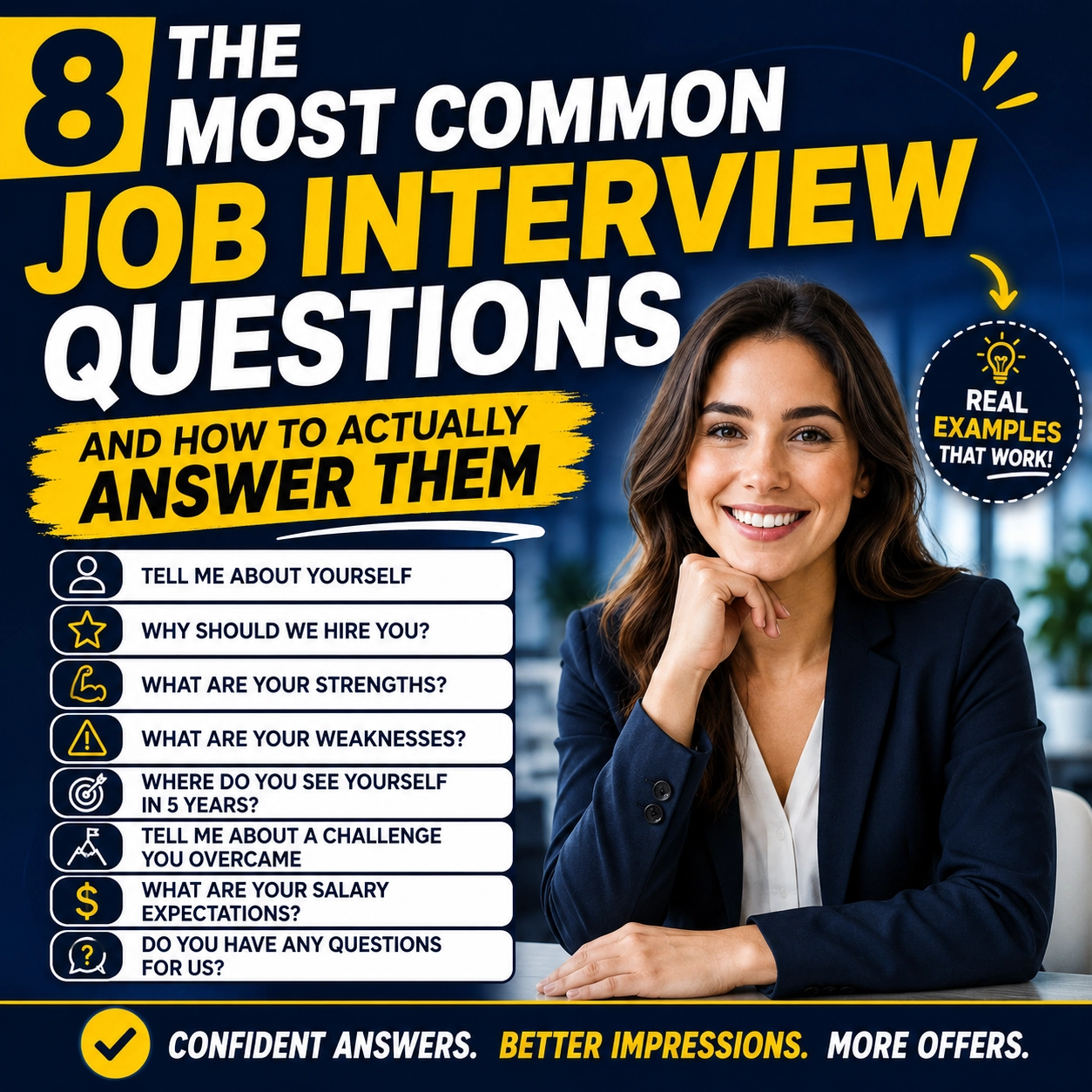
The 8 Most Common Job Interview Questions and How to Actually Answer Them
Struggling with interviews? Learn how to answer Tell Me About Yourself, Why Should We Hire You, salary expectations, strengths and weaknesses, and other common interview questions with real examples.
When I first started applying for jobs and getting interviews I had no idea what interviewers actually wanted to hear.
The first time someone asked me to tell them about myself I talked about where I was from, my family background, my personal interests. I thought that was what they meant. A few interviews later I slowly realized they were not asking about my life story. They were asking about my professional story. My experience, my skills, what I have done and what I can do for them.
Nobody told me that. I had to figure it out through failed interviews.
The salary question was even worse. Every single time I was asked what salary I expected I went low. Even when I had the skills to justify a higher number I could never say it out loud. I always undersold myself and walked away knowing I had accepted less than I was worth.
These are not unique struggles. Almost everyone faces them. The difference between candidates who handle these questions well and those who do not is usually not confidence or personality. It is simply knowing what the interviewer is actually asking and having a prepared honest answer ready.
This guide covers the eight most common interview questions that come up across almost every job and every market whether you are interviewing in Gulf countries, Japan, Korea, Singapore, or Canada. For each one we cover what the interviewer actually means, what a weak answer looks like, and what a strong answer looks like.
Quick Interview Cheat Sheet
| Question | What They Really Want |
|---|---|
| Tell Me About Yourself | Your professional story |
| Why Do You Want This Job | Motivation + company research |
| What Are Your Strengths | Evidence-backed claims |
| What Are Your Weaknesses | Self-awareness + improvement |
| Where Do You See Yourself in Five Years | Career direction + commitment |
| Salary Expectations | Market awareness + confidence |
| Do You Have Any Questions for Us | Genuine interest + curiosity |
| Why Should We Hire You | Value you bring specifically |
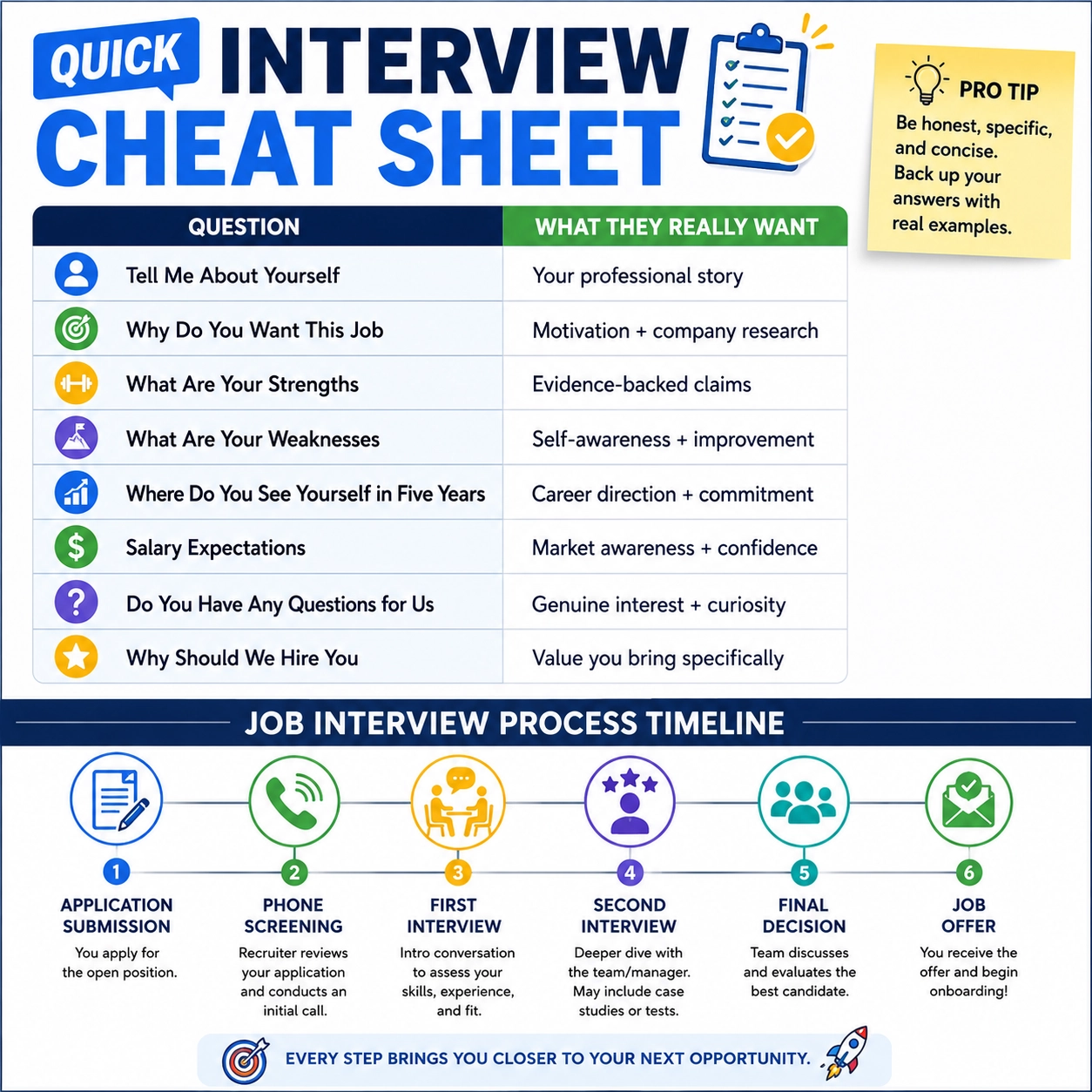
Visual: The typical job interview process from application to job offer.
Question 1 — Tell Me About Yourself
This is almost always the first question in any interview anywhere in the world. And it is the one most people answer badly. It appears in almost every first-round interview regardless of industry or level, making it arguably the single most important question to prepare for.
What most people say (Weak):
"My name is [name]. I am from [country]. I studied [subject] at [university]. I enjoy reading and spending time with my family."That is a personal biography. The interviewer already knows your name. They do not need to know where you are from or what you enjoy doing in your spare time.
What the interviewer is actually asking:
They want your professional story. Who are you as a professional, what relevant experience do you have, and why are you sitting in front of them today. They want you to connect your background directly to the role you are applying for.
A strong answer follows this simple structure: Who you are professionally, what relevant experience you have, what you are looking for, and why this specific role interests you.
Strong example for a hotel housekeeping applicant:
"I have three years of experience in housekeeping at a four-star hotel in the Philippines where I was responsible for servicing up to 18 rooms per shift to international cleanliness standards. I also trained two new team members during my second year. I am looking to bring that experience to a Gulf hotel environment and I am particularly interested in this role because of your hotel's reputation for service excellence."Strong example for a fresh graduate with no experience:
"I recently completed my degree in Computer Science with a focus on web development. During my studies I built three personal projects using React and Node.js and completed an internship where I contributed to a live product used by real customers. I am now looking for my first professional role where I can apply those practical skills in a team environment."Keep your answer to about 60 to 90 seconds. Practice it beforehand so it flows naturally. If you are a student or recent graduate with limited experience, our student CV guide can help you identify what professional story to tell. And if you are starting from scratch and need to design a professional layout, you can use our free CV builder to prepare. This is the one question you can almost always prepare for in advance because it is almost always asked first.
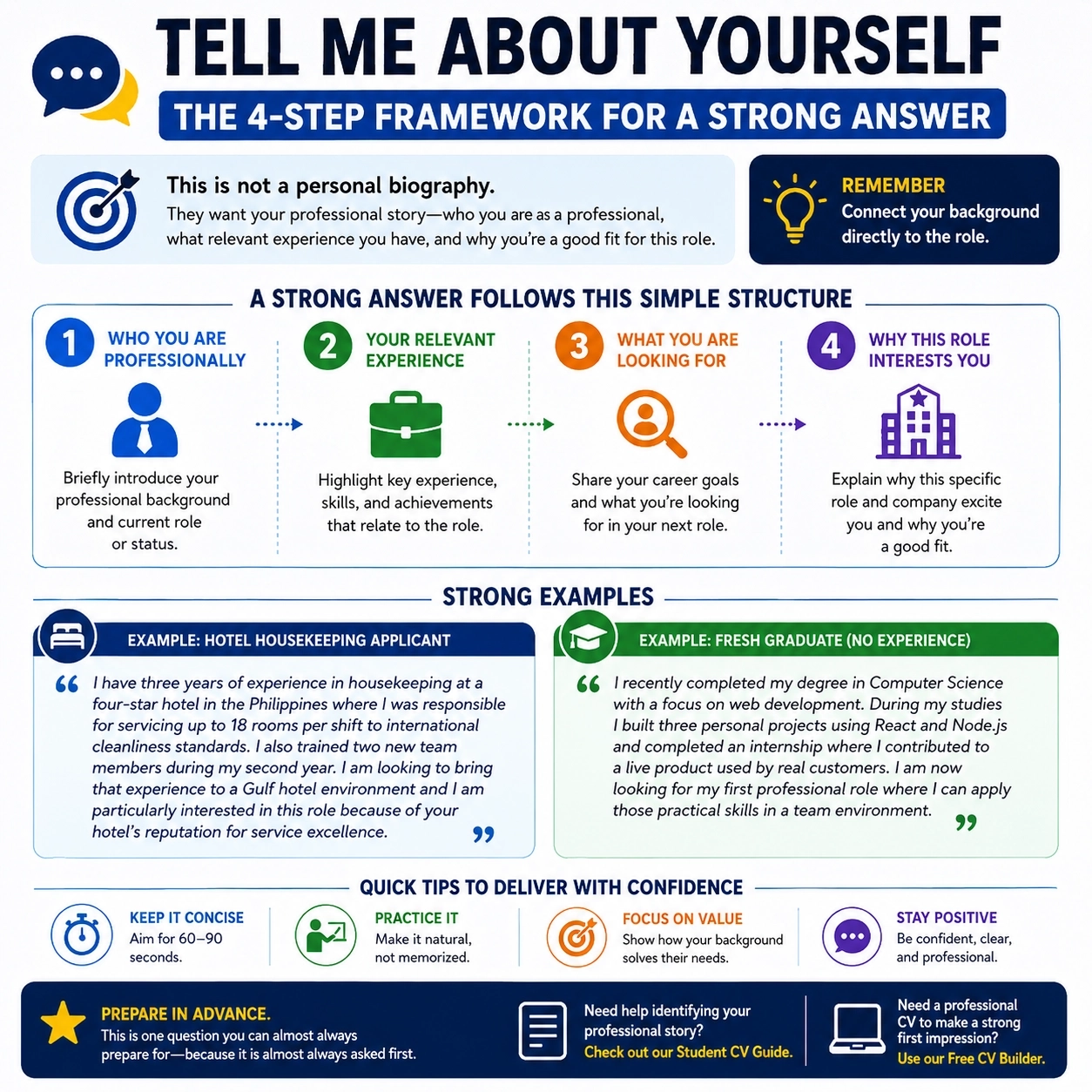
Visual: The four-step framework for answering "Tell me about yourself" professionally.
"Tell Me About Yourself" Structure
Professional Background
Your professional identity and title.
Relevant Experience
Key roles and major achievements.
What You Look For
Career direction and next steps.
Why This Role
Why this company fits perfectly.
Question 2 — Why Do You Want This Job
This question is checking two things: Whether you have actually done any research about the company or role, and whether your motivation for wanting the job is genuine rather than just needing any job. Research shows that candidates who demonstrate specific company knowledge are significantly more likely to receive a callback than those who give generic answers.
What most people say (Weak):
"I am looking for a good opportunity to grow and this company seems like a great place to develop my career."That answer could apply to any job at any company. It tells the interviewer nothing specific and suggests you have not thought about why this role in particular.
What the interviewer is actually asking:
Why this specific role and why this specific company. Show that you know something about them and that there is a genuine connection between what they need and what you offer.
Strong example:
"I have been following your hotel group's expansion in Dubai and I know your housekeeping team won a regional service award last year. I want to work in an environment where standards are taken seriously because that is how I approach my own work. My experience in a high-volume hotel environment means I can contribute immediately rather than needing a long adjustment period."Even basic research makes a significant difference. Look at the company's website, find one or two specific things about them, and reference those in your answer. A strong cover letter paired with your answer here can reinforce your research and motivation even further.
Question 3 — What Are Your Strengths
This question sounds simple but many people either give vague generic answers or go so broad that the answer means nothing.
What most people say (Weak):
"I am hardworking, a good team player, and I always give my best."Those are the same words on every candidate's answer. They prove nothing.
What the interviewer is actually asking:
What can you do well that is specifically relevant to this role. Show them with an example, not just a claim.
Strong example:
"I am very precise with detail-oriented work. In my previous housekeeping role I maintained a zero complaint record across six months because I developed my own personal checklist to make sure every room met the standard before I marked it complete."That answer shows a strength with evidence. It is far more convincing than claiming to be hardworking. Showing key strengths on your resume in a readable layout is also critical for scanners — read our ATS CV guide to ensure your strengths are formatted correctly. You can also see how real candidates present their strengths in our CV examples collection.
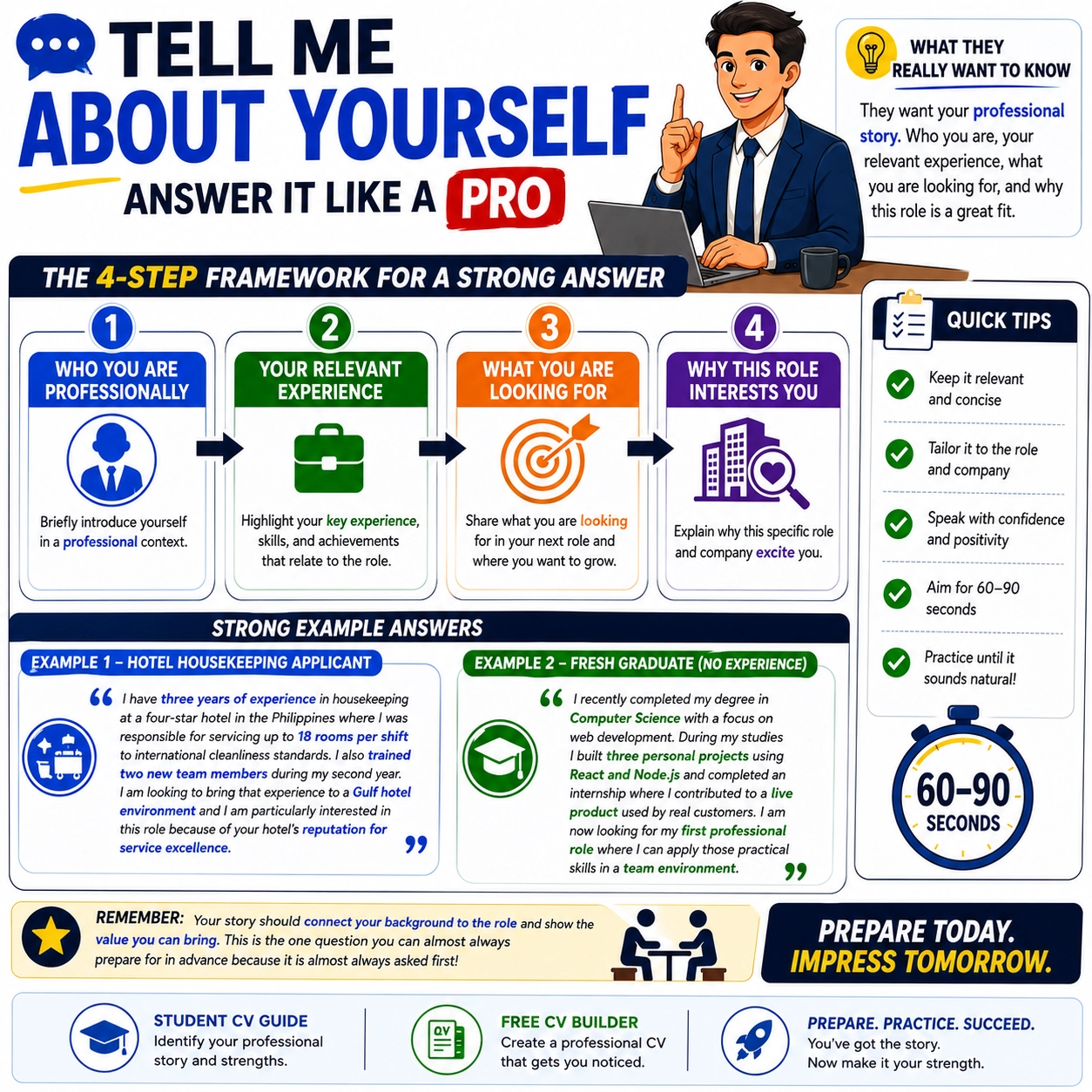
Visual: Essential interview preparation checklist covering all the steps before, during, and after the interview.
Question 4 — What Are Your Weaknesses
This is the question most people dread and most people answer badly in one of two ways. Either they say something fake like "I work too hard" or "I care too much" which sounds dishonest, or they confess a genuine weakness that actually does affect their ability to do the job.
What the interviewer is actually asking:
They want to see self-awareness and the ability to reflect honestly on areas for improvement. They also want to see that you are actively working on your weaknesses rather than ignoring them.
The right approach is to be genuinely honest about a real weakness that is not central to the role, and to explain what you are doing about it.
Strong example for a hotel staff applicant:
"My written English was something I struggled with when I first started in hospitality because so much documentation needs to be accurate. I started doing an online writing course about a year ago and my supervisors have noticed the improvement in my incident reports and handover notes. It is still something I keep working on."That answer is honest, shows self-awareness, and demonstrates that you take improvement seriously. It does not suggest you cannot do the job.
Question 5 — Where Do You See Yourself in Five Years
This question makes many candidates nervous because they either do not know the answer or they worry that their real answer will put the interviewer off.
What most people say (Weak):
"I see myself growing within this company and taking on more responsibility over time."That is fine but vague. It does not show any real thought about your career.
What the interviewer is actually asking:
They want to know if your goals are realistic, whether you are likely to stay with them for a reasonable period, and whether you have genuine professional ambitions in this field.
You do not need to have a perfect five year plan. You need to show that you are serious about building a career in this field rather than just treating any job as a temporary situation.
Strong example:
"In five years I would like to be working as a senior security officer or team leader in a hotel or residential complex environment. I want to build enough experience in Gulf security operations that I can take on some supervisory responsibility. This role feels like the right foundation for that."Question 6 — What Are Your Salary Expectations
This was the question I struggled with most throughout my career. Every time it came up I went low even when I knew I was worth more. I would say a number that felt safe rather than a number that reflected my actual value and I would leave knowing I had undersold myself again. Most job seekers accept the first salary offered without negotiating, often leaving significant money on the table.
Most people do this for the same reason. Saying a high number out loud feels risky. What if they say no? What if they think I am too expensive? What if I lose the offer?
Here is what I wish someone had told me earlier.
Employers expect you to negotiate.
A candidate who confidently states a realistic salary expectation based on market rates is not being greedy. They are being professional. Employers often have a budget range and asking for something reasonable within that range is expected behavior, not a red flag.
Before any interview research the typical salary range for the role you are applying for in that specific country or city. For Gulf jobs this means researching what security guards, hotel staff, drivers, or whatever role you are applying for typically earn in UAE or Saudi Arabia. Our Gulf salary guide covers realistic salary expectations, and you can see standard layout formats in our Gulf CV examples guide.
When the question comes state a range confidently based on your research and your experience level.
Strong example:
"Based on my research and my four years of relevant experience I am looking for a package in the range of AED 2,000 to AED 2,500 per month. I am open to discussing the full package including accommodation and other benefits."That answer is specific, grounded in research, shows you understand the market, and opens the door to discussing the full package rather than just the basic number.
If you genuinely do not know the market rate yet it is acceptable to say:
That response is professional and buys you time to negotiate from a more informed position.
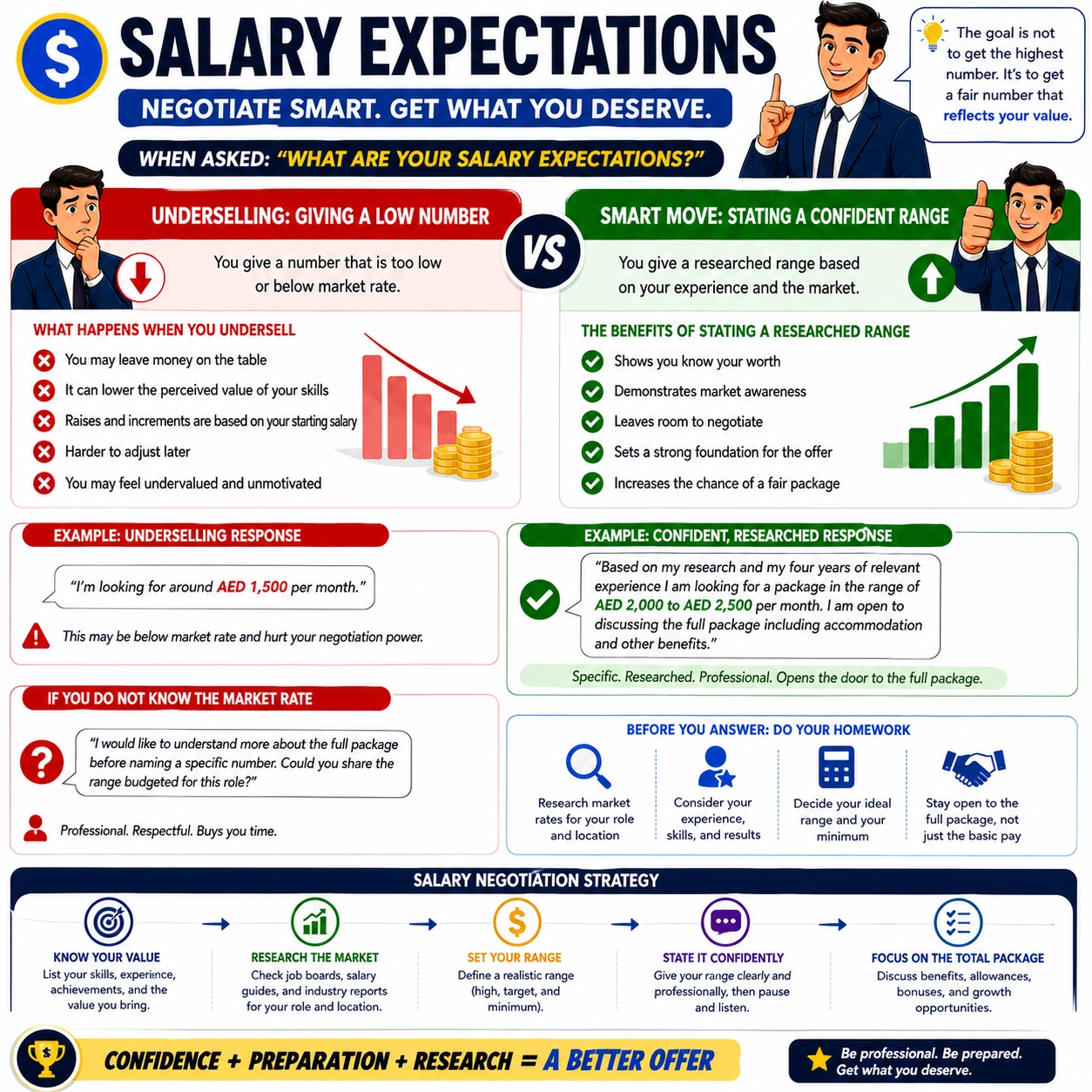
Visual: Strategy comparison showing the difference between underselling and stating a confident range.
Underselling Strategy
- Saying a low number immediately to feel "safe" from rejection.
- Accepting the first offer without questioning allowances or benefits.
- Avoiding research on local market rates before the discussion.
Professional Range Strategy
- Stating a researched target range based on experience level.
- Framing expectations around the "total package" (housing, transport).
- Redirecting politely to find the employer's budget first.
Question 7 — Do You Have Any Questions for Us
Most candidates say one of two things. Either "no I think you covered everything" or they ask something generic like "what does a typical day look like."
Saying no questions is a missed opportunity. It suggests you are not deeply interested in the role or have not thought carefully about it.
This is your chance to show genuine curiosity and professionalism. Prepare two or three real questions before every interview.
Avoid asking about salary, benefits, or holidays in this moment if those have not been discussed yet. Save those for when an offer is made or when the interviewer raises them.
Question 8 — Why Should We Hire You
This question sounds intimidating but it is actually one of the easiest to prepare for because the answer is always the same structure. Match what you can do to what they need.
What most people say (Weak):
"I am a very dedicated and hardworking person. I believe I would be a great asset to your team and I am ready to give 100% to this opportunity."That answer could come from any candidate applying for any role. It says nothing specific and gives the interviewer no reason to choose you over someone else.
What the interviewer is actually asking:
What specific value do you bring that makes you a better fit than other candidates. They want you to connect your skills, experience, and strengths directly to the requirements of this role. Not a generic pitch. A targeted one.
Strong example for a hotel security applicant:
"You need someone who can manage guest safety in a high-traffic five-star environment. I have four years of experience doing exactly that at a major hotel in Doha, where I managed access control for over 500 guests daily and reduced incident response time by implementing a floor-by-floor communication protocol. I also hold a valid first aid certification and I speak three languages which helps when dealing with international guests."Strong example for a fresh graduate:
"I know I am early in my career but during my internship I built and deployed a customer dashboard that is still being used by the sales team today. That experience taught me how to work under tight deadlines and collaborate with non-technical stakeholders. I also completed two relevant certifications on my own time which shows I am serious about growing in this field."The key is specificity. Every claim you make should point back to something real you have done. Numbers, results, specific projects, specific outcomes. That is what separates a strong answer from a forgettable one. Make sure these same achievements are reflected clearly on your CV — our ATS CV guide shows you how to structure them for maximum impact.
The STAR Method —Answering Behavioral Questions
Many interviewers now use behavioral questions. These are questions that start with "Tell me about a time when..." or "Give me an example of...". They want a specific story, not a general claim.
The best way to structure your answer to any behavioral question is the STAR method: Situation, Task, Action, Result.
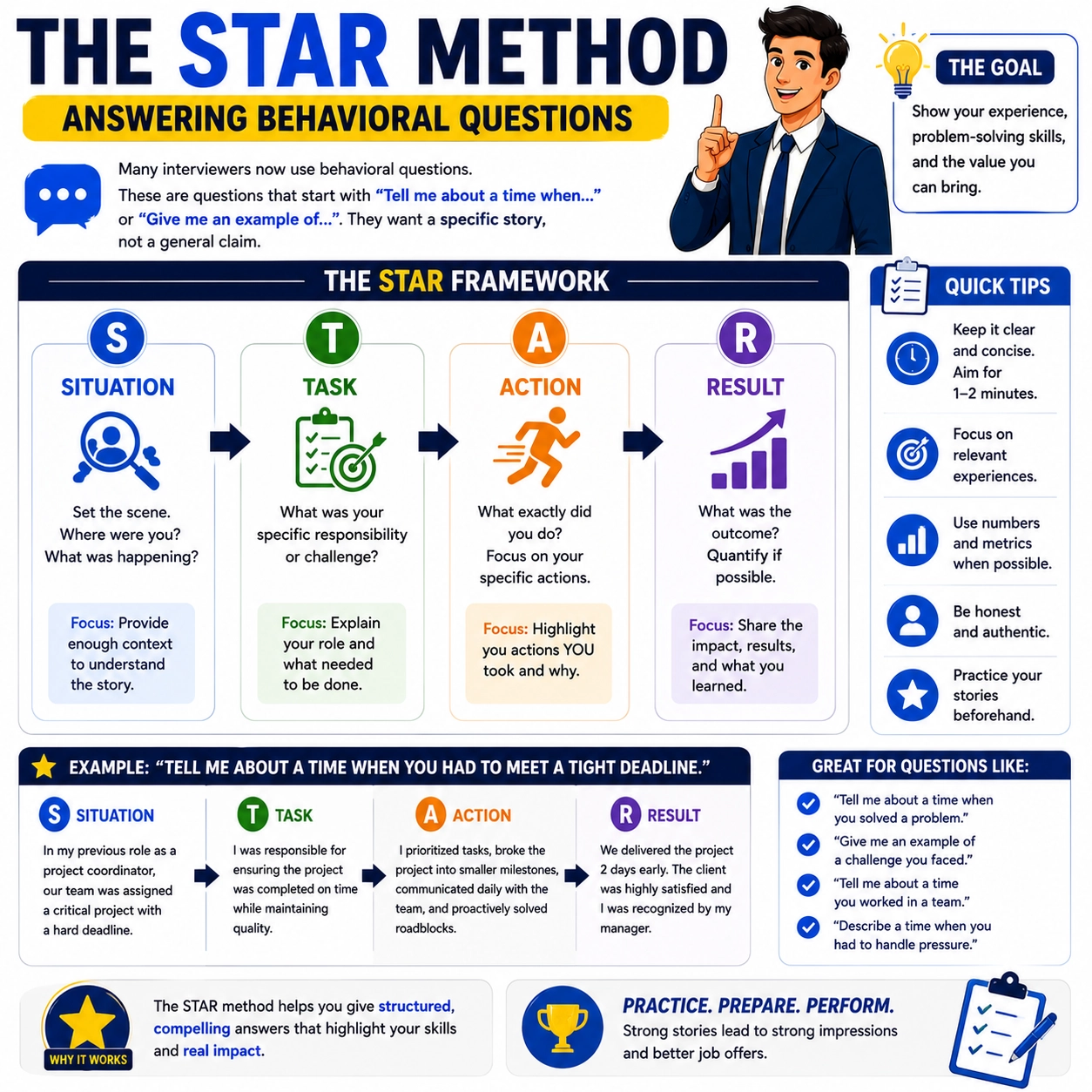
Visual: The STAR method framework for structuring answers to behavioral interview questions.
The STAR Framework
Situation
Set the scene. Where were you? What was happening?
Task
What was your specific responsibility or challenge?
Action
What exactly did you do? Focus on your specific actions.
Result
What was the outcome? Quantify if possible.
Example using the STAR method:
Question: "Tell me about a time you handled a difficult customer."
Strong STAR example:
Situation: "At my hotel in Manila, a guest arrived late at night and found their room had not been cleaned properly."
Task: "As the on-duty housekeeper, it was my responsibility to resolve the situation immediately."
Action: "I personally cleaned the room within 15 minutes, arranged complimentary refreshments from the kitchen, and followed up the next morning to make sure the guest was comfortable."
Result: "The guest left a five-star review specifically mentioning the quick response and I was commended by my supervisor."
Notice how every part of that answer is specific and verifiable. No vague claims. No generic statements. Just a clear, structured story that proves the skill the interviewer was looking for. This method works for any behavioral question across any industry or market.
For building the CV that gets you to the interview stage in the first place, explore our Gulf CV examples, our ATS guide, and our free CV builder.
The One Thing That Matters More Than Any Answer
Preparing good answers matters. But the single thing that makes the biggest difference in any interview is this:
Know your own story well enough to talk about it naturally.
Every strong interview answer comes from a genuine understanding of your own experience, your own skills, and your own goals. The candidates who handle interviews well are not necessarily the most talented people in the room. They are the people who have thought clearly about what they have done and what they want, and who can communicate that clearly when asked.
Practice your answers out loud before the interview. Not to memorize a script but to get comfortable talking about yourself professionally. The difference between a rehearsed answer and a natural one is simply practice.