

What Asian Students Get Wrong About Canadian Resumes, Work Eligibility, and First Jobs
Learn how Canadian resumes differ from Asian CVs, how international students should show work eligibility, and the reality of finding a first job in Canada. Avoid common mistakes and improve your chances of getting hired.
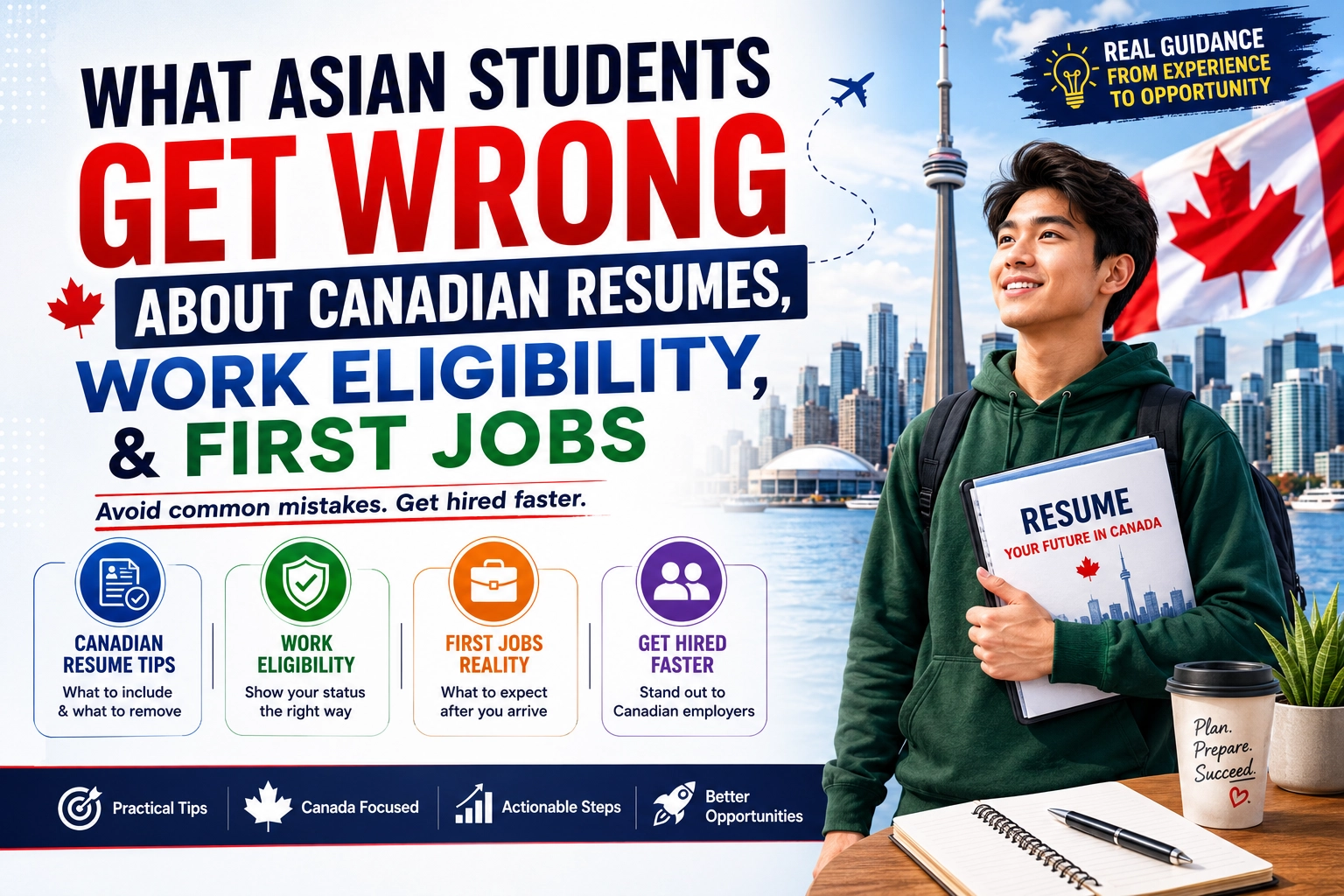
Most international students arriving in Canada have written a CV before. They know how to format one. They have included everything they were taught to include back home.
The problem is that what works on a CV in Nepal, India, Bangladesh, the Philippines, or most Gulf countries actively works against you in Canada.
Canadian employers expect something completely different. And the gap between what Asian students typically submit and what Canadian employers want to see is one of the most common and avoidable reasons newcomers struggle to get their first call back.
This guide covers the most important differences, how to fix them, and what to honestly expect when it comes to finding your first job after arriving.
The Photo Mistake — Remove It Before You Apply
If you are coming from South Asia, Southeast Asia, or any Gulf country you are probably used to including a professional photo on your CV. In many of those places a photo is expected or even required.
In Canada do not include a photo.
Canadian employers and recruiters are trained to evaluate candidates without photos to reduce the risk of unconscious bias in hiring. Including a photo does not make your CV look more professional in Canada. It makes it look like you do not understand local standards, which is itself a red flag for Canadian employers who need to know you can adapt to a new professional environment.
The same applies to several other personal details that are completely normal to include in Asian and Gulf CVs but should not appear on a Canadian resume.
Visual: Comparison showing which elements to remove from your Asian CV when building a Canadian resume.
Typical Asian CV vs. Canadian Resume
Typical Asian & Gulf CV (Remove)
- ✕ Professional photo
- ✕ Date of birth or age
- ✕ Gender & Marital status
- ✕ Nationality & Religion
- ✕ Father's name or family details
- ✕ Passport or visa number
Standard Canadian Resume
- ✓ Full Name
- ✓ Professional Email & Phone
- ✓ Current City & Province
- ✓ Skills & Core Qualifications
- ✓ Relevant Work Experience & Education
Canadian employers want to know your name, how to contact you, where you are based, what you can do, and what you have done. Everything else is not only unnecessary but can actually create legal complications for employers who are required to make hiring decisions based on skills and qualifications alone.
Work Eligibility — State It Clearly and Correctly
This is something many international students are unsure about and it costs them opportunities.
Canadian employers often hesitate to contact candidates if they cannot quickly tell whether the person is legally allowed to work. If your eligibility is unclear from your resume many employers will simply move on to the next candidate rather than contact you to ask.
State your work eligibility clearly and briefly near the top of your resume. Here is what to write depending on your situation:
If you are a current student with a valid study permit:
Work Authorization: Valid Canadian study permit with authorization to work off-campus up to 24 hours per week during academic terms.If you have graduated and are applying for your PGWP:
Work Authorization: Eligible for Post-Graduation Work Permit. Application in progress.If you already hold a PGWP:
Work Authorization: Post-Graduation Work Permit holder. Authorized to work in Canada without employer sponsorship.One clear line answers the employer's most immediate question about you and removes the biggest source of hesitation. For a detailed breakdown of how study permit conditions work or how long your PGWP will be valid, see our comprehensive Canada study guide.
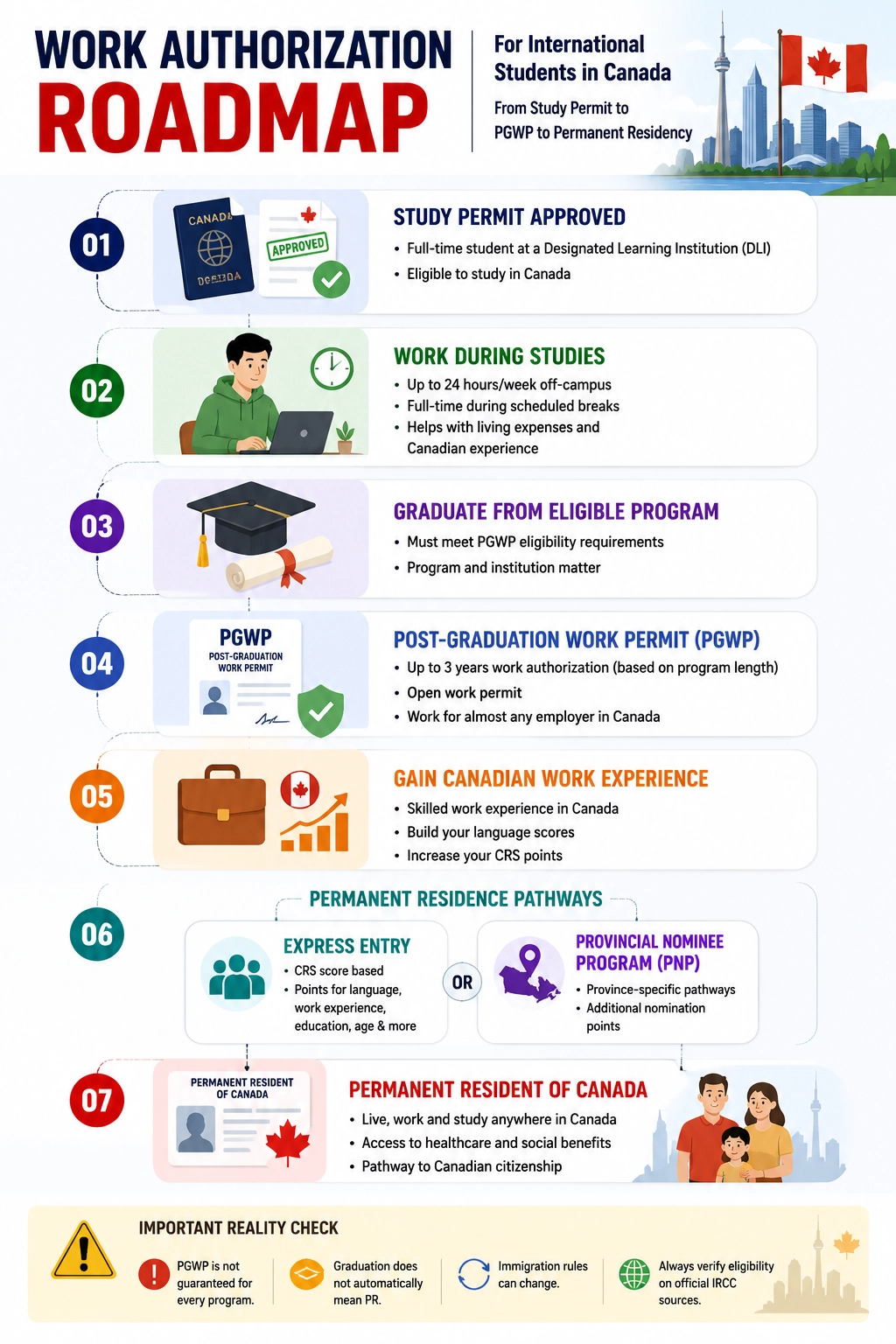
Visual: Career and immigration roadmap for international students moving from a study permit to PR.
Work Permit Roadmap in Canada
Study Permit
Authorized for off-campus work up to 24 hours/week during active academic semesters.
PGWP Application
Eligible to work full-time on implied status once PGWP application is officially submitted.
Post-Graduation Work Permit
Open work permit. Authorized to work full-time without requiring employer sponsorship.
Address Section — Another Common Mistake
Many international students write their addresses exactly how they would back home, including a Permanent Address in their home country (e.g. Kathmandu, Nepal) alongside their new temporary address in Canada.
Canadian employers do not care about your home country permanent address.
In fact, listing a foreign country address only confuses recruiters and automated systems, making them wonder if you are actually physically located in Canada yet. All you need is your current city and province.
Instead of listing a full street address, apartment number, and permanent address, keep it simple. Writing Toronto, ON or Mississauga, ON is enough.
Canadian Resume Header Example
To make sure you format the top of your resume correctly, here is a clean, standard header layout that Canadian recruiters expect:
Aarav Sharma
Toronto, ON | +1 (647) 555-0199 | aarav.sharma@email.com | linkedin.com/in/aaravsharma
Work Authorization:
Valid Study Permit — Authorized for Off-Campus Work up to 24 hours/week during academic terms.
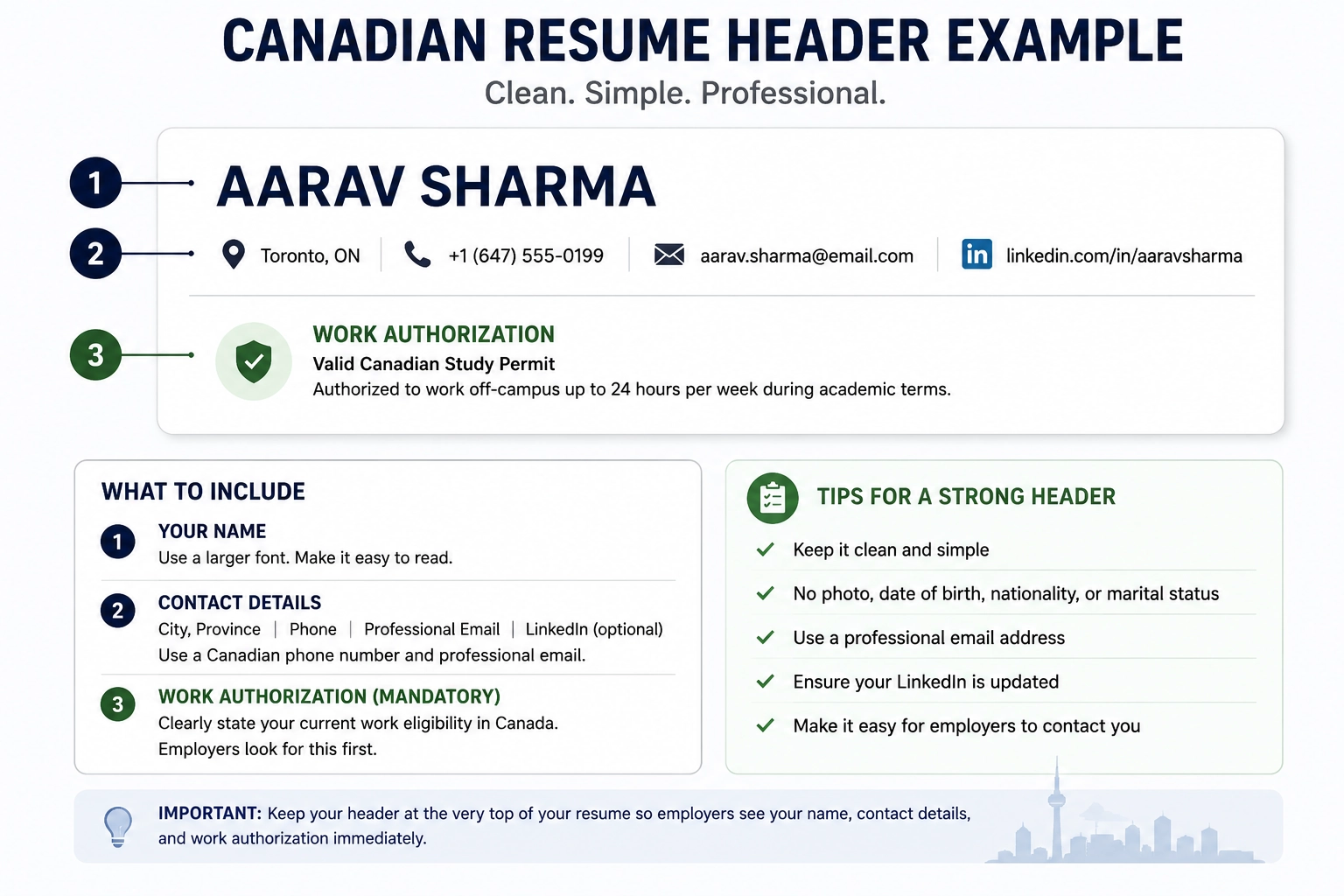
Visual: Example layout of a standard Canadian resume header with work authorization.
This clean header tells the recruiter exactly who you are, how to reach you locally, and answers their immediate question about your legal work status in Canada.
Canadian Employers Value Simplicity Above Everything
Many international students submit resumes that are three or four pages long. They include every certificate they have ever earned, academic achievements from secondary school, detailed descriptions of every job going back many years, and long objective statements explaining their career aspirations.
Canadian resumes are different.
For students and recent graduates one page is the standard. For professionals with significant experience two pages is acceptable. Three pages or more is almost never appropriate.
Canadian employers scan resumes quickly. They want to find relevant information fast. A long resume does not communicate experience and depth in Canada the way it might in some other contexts. It communicates an inability to prioritize and present information clearly, which is itself a professional skill employers are assessing. To understand exactly how automated applicant tracking systems parse your layout, check out our complete ATS CV guide for detailed formatting rules.
Keep your Canadian resume focused on your most relevant and recent experience, your skills that match the role you are applying for, and your education. Cut everything that does not directly support your application for this specific job.
Remove long objective statements. Instead write a short professional summary of two to three sentences that clearly states who you are, what you are looking for, and what you bring. Make it specific to the role you are applying for.
The Canadian Resume Checklist
- ✓ No photo or personal details (age, gender, etc.)
- ✓ Work authorization clearly stated at the top
- ✓ One page max for students & fresh grads
- ✓ Canadian phone number formatted correctly
- ✓ Key skills and core achievements at the very top
- ✓ Tailored specifically to the targeted job description
- ✓ Spelling and grammar checked thoroughly
- ✓ Saved as a clean PDF with a professional file name
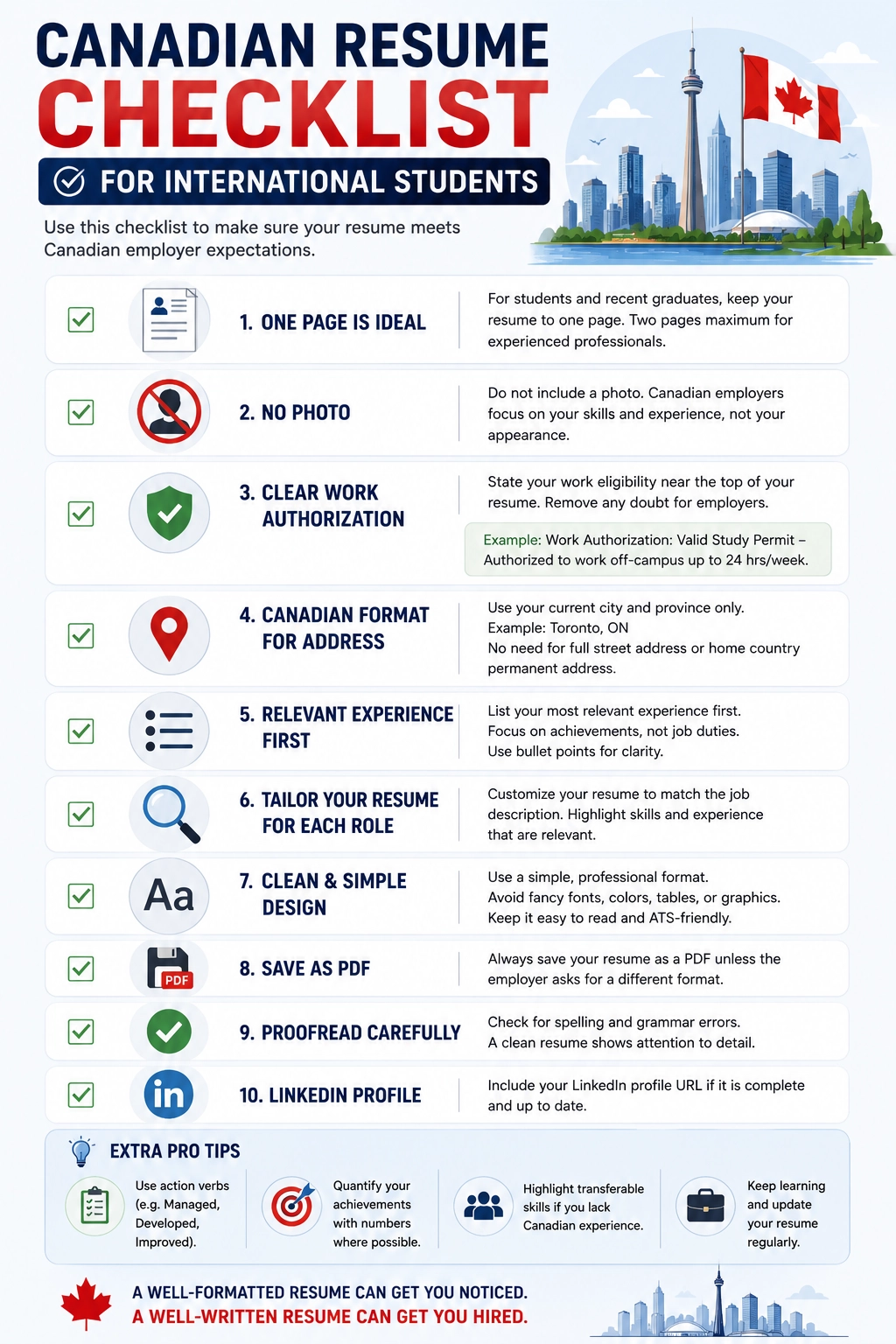
Visual: A quick reference checklist for Canadian resume formatting rules.
The First Job Reality — What Most Students Are Not Told
This is the section most study abroad consultancies skip. Probably because it is not what students want to hear before they pay enrollment fees.
Many international students arrive in Canada expecting to find a job in their field within a few weeks of arrival. Some expect to find something within days.
Here is what is more realistic.
For survival jobs such as retail, food service, customer service, cashier work, warehouse jobs, and delivery work the timeline is typically one to four weeks depending on the city, the season, and how actively you are applying.
For professional jobs in your field of study the timeline is significantly longer. Several months is common. For highly competitive fields or roles that specifically require Canadian experience the search can take much longer. For a breakdown of local job markets and average living expenses, you should review our guide to the best Canadian cities for international students.
This is not a reason not to come to Canada. It is a reason to plan financially for a gap between arriving and earning, and to approach your job search with realistic expectations.
The first jobs most international students get in Canada include:
Your Canadian Career Progression
- • Retail Associate & Cashier
- • Warehouse & Fulfillment Worker
- • Barista & Food Service Staff
- • Customer Service Representative
- • Delivery Driver
- • Campus Assistant / Library Staff
- • Accountant / Financial Analyst
- • Software Developer / IT Support
- • Marketing Coordinator
- • Mechanical / Civil Engineer
- • Data & Operations Analyst
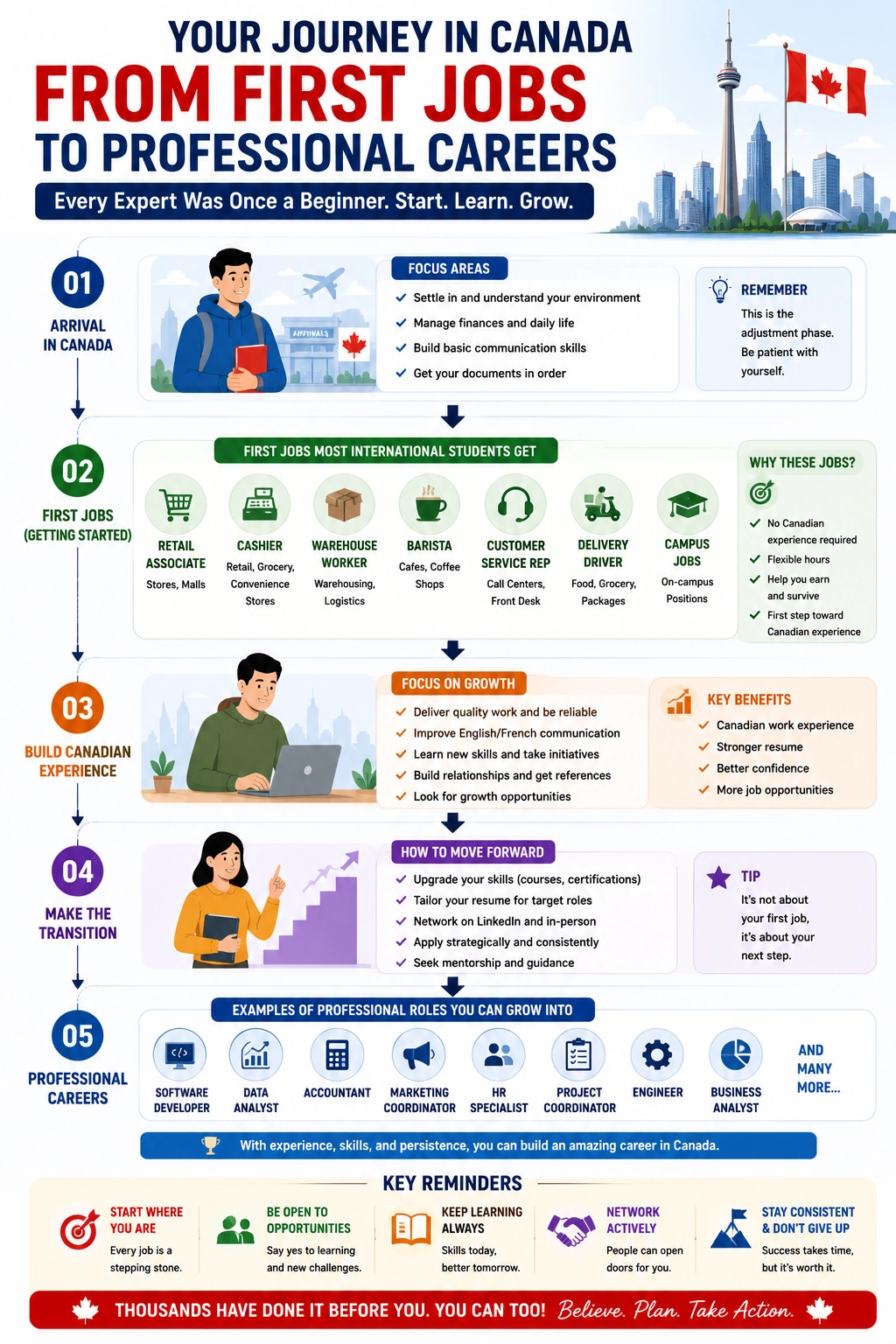
Visual: Career progression diagram from survival jobs to professional corporate employment in Canada.
None of these jobs are failures. For most newcomers these roles serve two important purposes. They provide income while you are searching for professional work. And they build Canadian work experience and references, which leads directly to the next point. If you have limited experience and need to know how to structure these roles on your CV, read our dedicated student CV guide for step-by-step formatting guidelines.
"Canadian Experience" — What Employers Actually Mean
Many newcomers encounter the phrase "Canadian experience required" in job listings and find it frustrating. You have real experience. Why does it have to be Canadian experience specifically.
The honest answer is that Canadian employers use this phrase to mean several different things, not all of which are about where you physically worked.
What employers usually mean when they say Canadian experience:
- Familiarity with how Canadian workplaces operate including communication norms, workplace culture, and professional expectations.
- The ability to interact confidently with Canadian customers or clients.
- References from people within Canada who can vouch for your work.
- Demonstrated English communication skills at a professional level in a Canadian context.
This is why volunteer work matters more in Canada than many newcomers expect. Volunteering at a food bank, a community organization, a sports club, or a university event gives you Canadian references, demonstrates initiative, and shows employers that you have engaged with the community. It costs nothing and it directly addresses the most common objection to hiring newcomers.
Starting to volunteer immediately after arriving, even while you are job searching, is one of the most practical things a newcomer can do to make the Canadian experience barrier lower.
Networking Matters More Than Your Resume Alone
Many students believe the process is straightforward. Submit a strong resume, get interviews, get a job.
In Canada, especially for professional roles, the process more commonly looks like this. Submit a resume, build a LinkedIn presence, make connections with people in your industry, get referred by someone who knows someone, get an interview.
Referrals and connections significantly increase your chances of getting an interview for professional roles compared to cold applications. This does not mean cold applications do not work. They do, especially for entry level and service roles. But for professional and graduate-level positions networking actively through LinkedIn, industry events, and university career services meaningfully improves your outcomes.
Update your LinkedIn profile with the same information on your resume before you start applying. Connect with alumni from your university who are working in Canada. Attend career fairs organized by your university. These activities take time but they produce results that resume submissions alone often do not.
What to Prepare Before You Arrive
Arriving in Canada with these things already done puts you in a significantly better position from day one:
- A Canadian-format resume ready to submit: No photo, no personal details, work authorization stated, one page, focused on your most relevant skills and experience. Use our free CV builder to design one in minutes.
- A complete and professional LinkedIn profile that matches your resume exactly.
- A realistic financial plan that covers at least three to four months of living expenses without relying on employment income. This removes financial pressure during your job search.
- Basic research on targeted local employers in the city you are moving to.