

What Nobody Tells Asian Students Before Studying in Canada
Research Methodology
This guide is based on official updates from Immigration, Refugees and Citizenship Canada (IRCC), actual university cost reports, and firsthand experiences of South Asian students studying and working across Canada.
Last Fact-Checked: June 17, 2026
Canada is one of the most popular study abroad destinations for students from South and Southeast Asia. And for good reason. Strong universities, a multicultural environment, English as the primary language, and a genuine pathway to work and potentially stay after graduation.
But there is a significant gap between what students are told before they enroll and what they actually experience after they arrive. That gap costs some students years of their life and thousands of dollars.
This guide covers the things most study abroad consultancies do not tell you. Not because the information is hidden, but because it is complicated, changes frequently, and sometimes discourages enrollment which consultancies have a financial interest in avoiding.
The PGWP Misconception — The Most Important Thing to Understand Before You Enroll
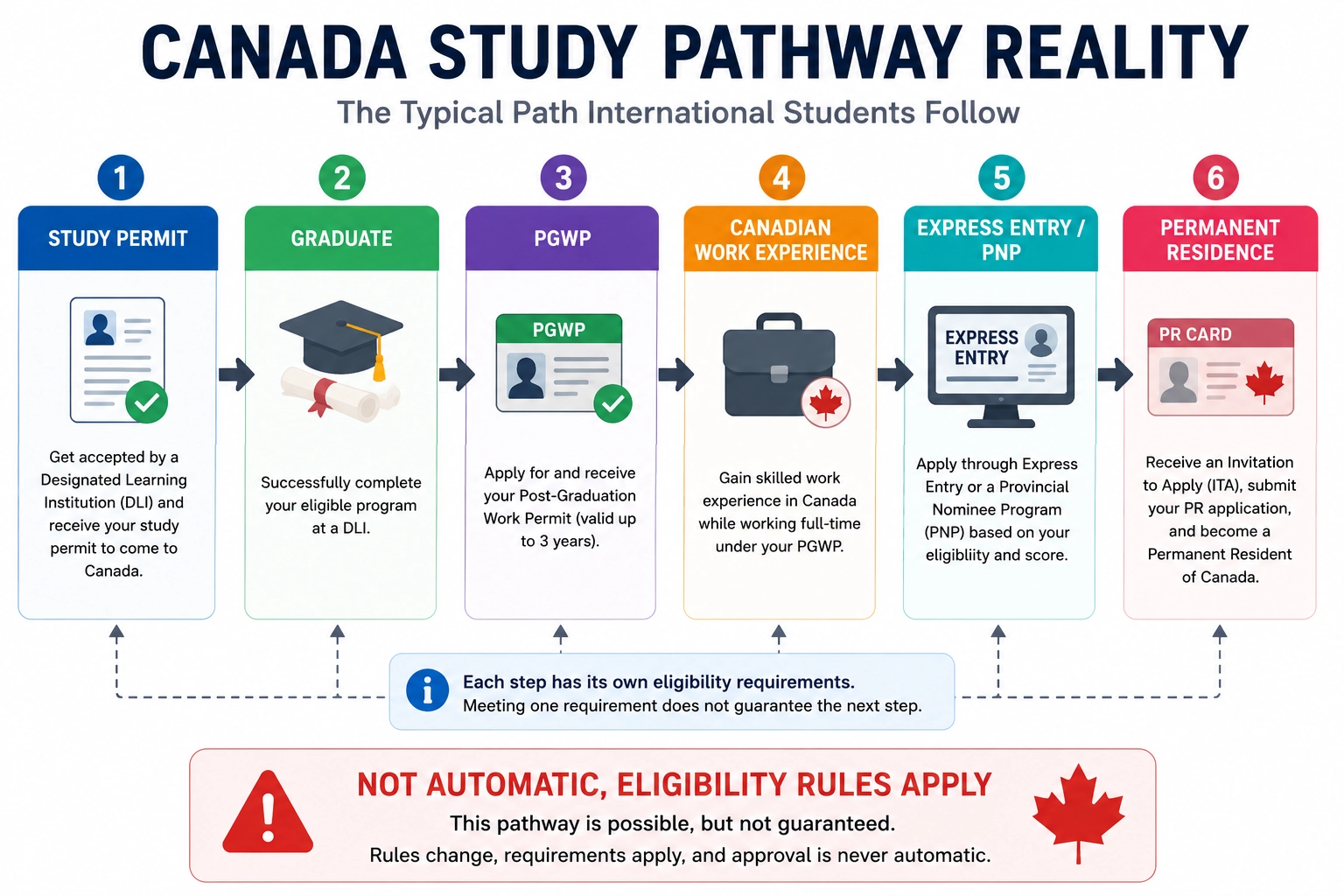
The Post-Graduation Work Permit, commonly called PGWP, is the main reason many international students choose Canada over other countries. The PGWP allows eligible graduates to work in Canada for up to three years after graduating. That work experience is then used to apply for permanent residence.
The problem is that most students understand this pathway in its simplified form: Study in Canada, get a PGWP, get permanent residence. The reality has significantly more conditions attached to it, and the rules have changed substantially in recent years.
Here is what you need to understand before you enroll in any Canadian program.
Not every program qualifies for a PGWP.
Graduating from a designated learning institution does not automatically make you eligible for a PGWP. The program itself must also be on the eligible list.
Starting November 1, 2024, graduates from college diploma programs must belong to an eligible field of study (STEM, Healthcare, Trades, Transport, and Agriculture) to qualify for a PGWP. General business, hospitality, and management diplomas at the college level are no longer eligible for students who apply for their study permits on or after this date. Graduates of university degree programs (Bachelor's, Master's, and Doctoral) in business remain eligible regardless of field of study.
This matters enormously. Many students enrolled in college diploma programs in business, hospitality, and general management specifically because they were told those programs led to a PGWP. International students who plan to work in Canada after graduation should confirm that their intended program of study is PGWP-eligible before applying.
Not every school qualifies either.
Students in public-private partnership programs who started after certain cutoff dates are now mainly ineligible for PGWP. Many private career colleges operate through these kinds of arrangements. A program at a private college that sounds like a pathway to a PGWP may not actually qualify.
Language requirements now apply.
As of November 2024, most PGWP applicants now need to provide proof of language results when they apply. This is a new requirement that did not exist previously and catches some students off guard if they did not meet the specific language benchmark required.
The PGWP is not permanent residence.
A PGWP gives you the right to work in Canada for up to three years. It does not give you permanent residence. Permanent residence requires a separate application through systems like Express Entry, and approval depends on factors including your work experience, language scores, education, and the points-based ranking system. Roughly 42 percent of all Express Entry invitations in 2025 went to PGWP holders, which shows the pathway does work for many people, but it is not automatic and requires meeting additional criteria.
The single most important thing you can do before enrolling in any Canadian program is verify independently that your specific program at your specific institution is currently PGWP-eligible. Do not rely on what a consultancy or the school itself tells you. Check the official IRCC website directly at canada.ca.
The Real Cost of Studying in Canada
Most students research tuition fees when planning to study in Canada. Many underestimate or overlook the other costs that make up the majority of what they actually spend.
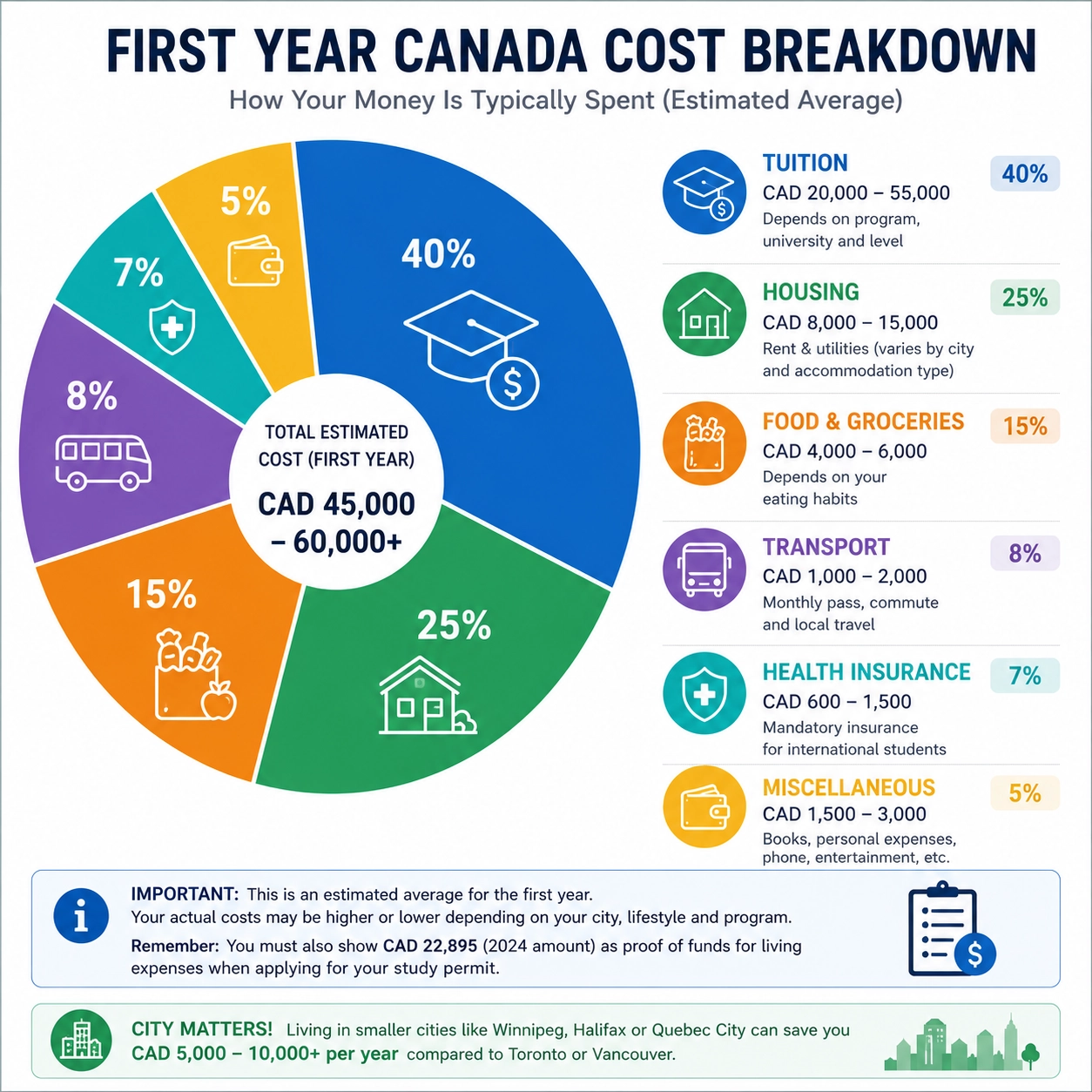
The total cost of studying in Canada ranges from CAD 30,000 to CAD 60,000 per year. The students who succeed financially plan for all three main cost categories from day one rather than just tuition.
Tuition
Tuition ranges from CAD 20,000 to CAD 55,000 per year depending on program and university. This varies significantly. A college diploma program may cost less than a university degree, but as discussed above, it may also not qualify for a PGWP.
Living costs
According to Immigration, Refugees and Citizenship Canada, students must now show a minimum of CAD 22,895 for yearly living expenses, separate from tuition and travel costs.
The government minimum is exactly that. A minimum. In cities like Toronto and Vancouver actual monthly living costs are significantly higher.
Shared apartment or student housing ranges from CAD 600 to CAD 1,200 per month. Private apartments can go higher, especially in major cities.
Food and groceries cost around CAD 250 to CAD 400 per month depending on your habits. Cooking at home is usually more affordable than eating out regularly.
Transportation monthly student passes range from CAD 90 to CAD 160. Most cities offer a discounted student rate.
Smaller cities cost significantly less
Winnipeg, Halifax, Quebec City, and other smaller cities offer lowest living costs of CAD 10,800 to CAD 15,600 per year compared to Toronto and Vancouver at CAD 18,000 to CAD 24,000 per year. You can save CAD 5,000 to CAD 10,000 per year by choosing a smaller city.
This is a genuinely important consideration that many students overlook because they focus on the prestige of universities in Toronto or Vancouver without calculating whether those cities are affordable on their actual budget.
Real-Life Comparison: Toronto vs. Winnipeg
To understand how these numbers play out in real life, look at the difference in monthly budgets and outcomes for these two students:
- Tuition: CAD 28,000 /year
- Rent: CAD 1,100 /month
- Part-time Income: CAD 1,400 /month
- Result: Still relied heavily on family support.
- Tuition: CAD 22,000 /year
- Rent: CAD 650 /month
- Part-time Income: CAD 1,300 /month
- Result: Covered most living expenses independently.
Healthcare is not free for international students
International students in Canada are not automatically covered by the public healthcare system known as Medicare. Most universities automatically enroll students in a mandatory health insurance plan and add the cost to tuition. This is an additional cost that students often do not factor into initial budgets.
Reality Check: First-Year Costs by City
Here is a realistic comparison of what your first year might actually cost depending on where you study. All figures are in CAD per year.
| Expense | Toronto / Vancouver | Winnipeg / Halifax |
|---|---|---|
| Tuition | $25,000 – $40,000 | $18,000 – $28,000 |
| Rent (shared) | $12,000 – $16,800 | $7,200 – $10,800 |
| Food & Groceries | $3,600 – $4,800 | $3,000 – $4,200 |
| Transport | $1,440 – $1,920 | $1,080 – $1,440 |
| Health Insurance | $600 – $1,200 | $600 – $1,200 |
| Miscellaneous | $1,800 – $3,000 | $1,200 – $2,400 |
| Estimated Total | $44,440 – $67,720 | $31,080 – $48,040 |
Figures based on 2026 estimates from official university fee schedules and IRCC cost-of-living data.
Can Part-Time Work Pay Your Bills?
Many students plan to cover living expenses through part-time work in Canada. The honest answer is that part-time work helps but rarely covers everything.
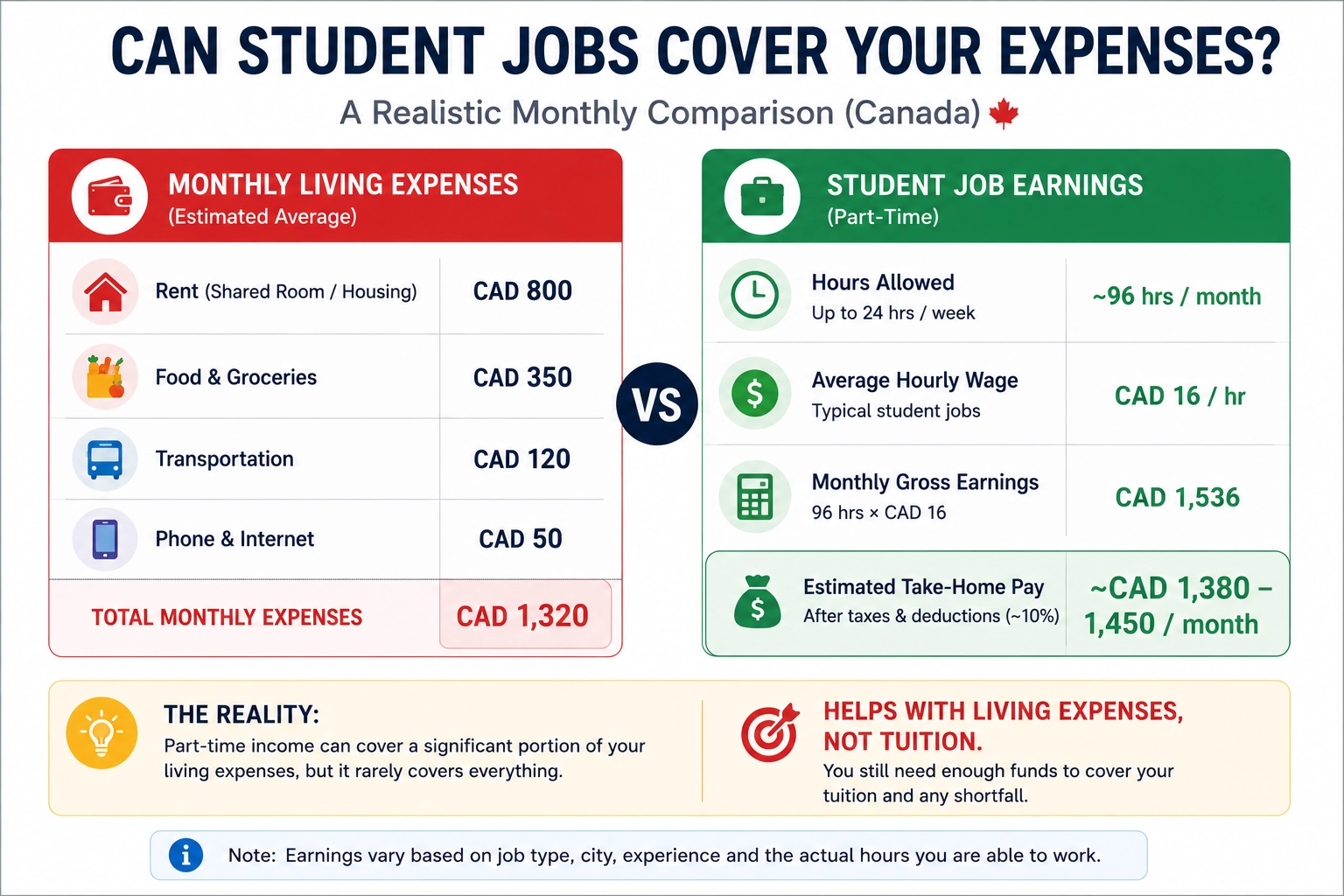
International students are currently permitted to work up to 24 hours per week off-campus during academic terms. While this helps with pocket money it is rarely enough to cover both rent and tuition.
Students can earn CAD 960 to CAD 1,600 per month at typical student jobs paying CAD 15 to CAD 18 per hour working within the standard weekly limit. This can cover a significant portion of living expenses.
So part-time work can realistically cover a meaningful portion of monthly living costs like food and transport. It will not cover tuition. And in expensive cities like Toronto or Vancouver it may not even fully cover rent. The realistic picture is this. You need to arrive with enough funds to cover tuition for your program upfront, and enough living expense funds to support yourself. Part-time work supplements that, it does not replace it.
Choosing the Wrong Program or School
This is where some of the most costly mistakes happen.
Many students choose programs based on which ones are easiest to get into, which consultancy recommended them, or which ones have the lowest tuition. These are understandable decisions under financial and time pressure, but they can lead to outcomes nobody planned for.
A student who completes a two-year college diploma in business management, pays tuition, lives in Canada for two years, graduates, and then discovers their program was not PGWP-eligible has lost significant time and money with no pathway forward.
Before committing to any program verify three things independently and directly on official government and university websites.
First, is the program at a designated learning institution that qualifies for study permits. Second, is the specific program on the current PGWP-eligible list if you plan to work after graduation. Third, what are the actual employment outcomes for graduates of this program in Canada.
Students who have already applied or are about to apply for programs at Designated Learning Institutions can proceed without fear that their pathway to a three-year open work permit will disappear mid-study under the current 2026 freeze, but conditions can change in future years.
PGWP Eligible vs Not Eligible — Know Before You Enroll
This comparison illustrates the difference between choosing a verified eligible pathway versus a risky one. One mistake here can cost you years.
- ✓Public University or College Degree
- ✓Program on PGWP-eligible list
- ✓Leads to Canadian work experience
- ✓Express Entry / PNP pathway available
- ✓Up to 3-year open work permit after graduation
- ✗Some Private College Programs
- ✗May not be PGWP eligible
- ✗May end after graduation with no work permit
- ✗No clear PR pathway
- ✗Years of time and money potentially lost
⚠️ Always verify your specific program's PGWP eligibility directly on canada.ca before enrolling.
Graduation Does Not Automatically Mean Permanent Residence
The PR misconception deserves its own clear section because it affects how students plan their entire study abroad journey.
Canada does have genuine and achievable pathways to permanent residence for international graduates. The Express Entry system, Provincial Nominee Programs (PNP), and other immigration streams have helped many former international students build permanent lives in Canada.
But none of these pathways are automatic. They depend on factors including your language test scores in English or French at the required level, your work experience in Canada gained through PGWP employment, your education level and field, and your Express Entry Comprehensive Ranking System score which determines your position in the pool of applicants.
Many students plan their entire financial investment in Canadian education around the assumption that they will get permanent residence. When that does not happen on the timeline or in the way they expected the financial and personal consequences can be significant.
Research the specific PR pathway relevant to your situation before you enroll, not after you graduate.
What Happens If You Don't Get PR?
Many students are afraid to ask this question, but they want someone to answer it honestly. If your PGWP expires and you have not received an invitation to apply for permanent residence, what actually happens?
You generally have four main pathways if permanent residence does not work out on your initial timeline:
- Return Home: Returning home is a realistic outcome that you should be prepared for. The international degree and work experience you gained in Canada are highly valued in South and Southeast Asian markets, often leading to fast-tracked careers in corporate roles or multinational firms back home.
- Employer-Sponsored Pathways: If you have a skilled job and an employer who wants to keep you, they can sponsor you. This typically involves an Labor Market Impact Assessment (LMIA) where the employer proves they could not find a Canadian citizen to do the job, which allows you to transition to a closed work permit.
- Transition to Another Permit: Some graduates transition to a tourist visa, apply for a new study permit to pursue a higher level of education (like a Master's or PhD to gain more CRS points), or explore regional streams that allow longer stays.
- Move to Another Country: Many former students use their Canadian education and native English skills to explore work opportunities in other receptive markets like the Middle East, the UK, Europe, or Australia where skilled international experience is also in demand.
4 Possible Outcomes After Your PGWP
Understanding these pathways before you start studying helps you plan realistically and reduces anxiety about the future.
PR Approved
Express Entry or PNP success
Employer Sponsorship
LMIA-backed work permit
New Study Permit
Master's or PhD for more CRS points
Return Home
Canadian degree valued globally
None of these outcomes are failures. Each is a valid next step — but you should know they exist before you enroll, not after your PGWP expires.
What to Research Before You Commit to Canada
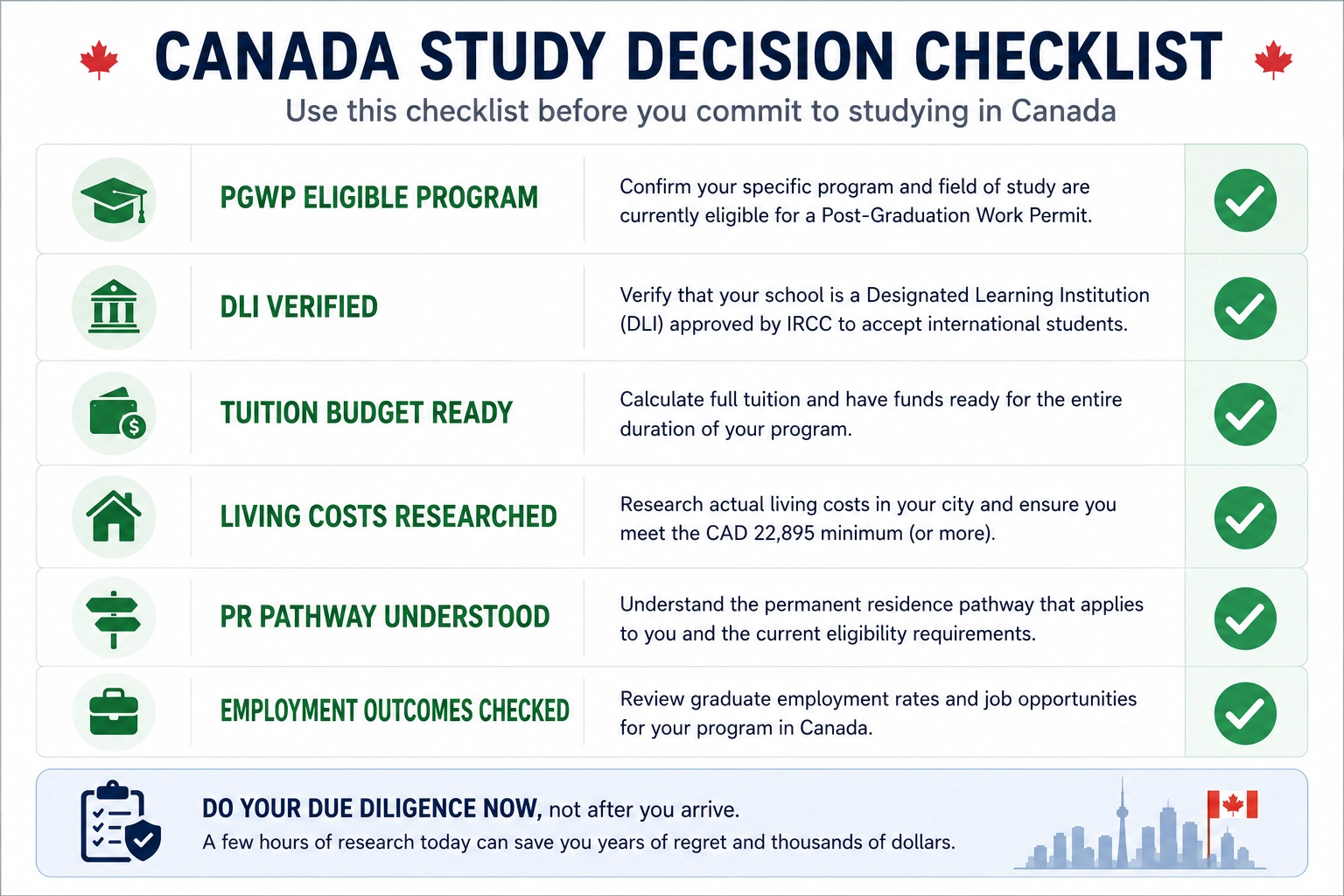
Before spending significant money on enrollment, here is what you should verify with official sources rather than consultancies:
- Whether your specific program at your specific institution qualifies for a PGWP. This is the most important check.
- The realistic total cost for your first year including tuition, the government-required proof of funds, health insurance, and actual living costs in the city where your school is located.
- The current work permit rules for students including how many hours per week you can work during studies.
- The PR pathway that applies to your situation and what scores or qualifications it currently requires, based on recent Express Entry draw data from the IRCC website.
- The graduate employment outcomes for your specific program, ideally from independent sources rather than the school's marketing materials.
Taking these steps before you enroll is significantly less stressful than discovering problems after you have already paid tuition and moved across the world.
For information on building a CV that works for Canadian job applications after your studies, see our ATS CV Guide which covers how Canadian employers screen applications and what formatting works best. You can also read our detailed Student CV Guide for academic layouts, or use our Cover Letter Guide to build a matching cover letter.
Ready to build your professional CV?
Build Your Free CVFrequently Asked Questions
What is the PGWP and how long does it last?
The post-graduation work permit allows students who have graduated from eligible designated learning institutions to gain valuable Canadian work experience. It can last up to three years depending on the length of your program. A program of two years or more typically results in a three-year PGWP. Programs shorter than two years result in a PGWP matching the length of the program.
Does every Canadian university program qualify for a PGWP?
No. The program must be at a designated learning institution and the specific field of study must meet current IRCC eligibility requirements. In 2024, IRCC introduced a field-of-study requirement for some post-secondary graduates applying for a Post-Graduation Work Permit. Always verify your specific program on the official canada.ca website before enrolling.
How much money do I need to study in Canada?
A moderate budget for a bachelor's degree including tuition, GIC, rent, food, and transport ranges from CAD 45,000 to CAD 55,000 for the first year. This varies significantly by city and program. Smaller cities cost meaningfully less than Toronto or Vancouver.
Can I work while studying in Canada?
Yes. International students can currently work up to 24 hours per week off-campus during academic terms and full time during scheduled breaks. This income helps with living costs but is not sufficient to cover full tuition expenses.
Does graduating from a Canadian university guarantee permanent residence?
No. A degree and PGWP create opportunities toward permanent residence but do not guarantee it. PR requires meeting separate eligibility criteria through systems like Express Entry, which considers language scores, work experience, education, and other factors in a points-based ranking system.
Is it better to study in a smaller Canadian city?
For most students on limited budgets yes. Smaller cities like Winnipeg, Halifax, and Quebec City offer significantly lower living costs compared to Toronto and Vancouver, potentially saving CAD 5,000 to CAD 10,000 per year. Many smaller city universities are also well regarded and have strong employment connections in their regions.
Sources & Policy Notice
All immigration and policy information in this guide is based on official sources including Immigration, Refugees and Citizenship Canada at canada.ca and CIC News at cicnews.com. Costs are based on verified 2026 data from official university and government sources. Always verify current requirements directly on the IRCC official website.