

Warehouse Worker Skills for CV
What to List (2026)
Warehouse roles are physical and operational. Employers are not interested in reading that you are a hard worker or a team player. They need to know whether you can operate warehouse systems, handle inventory accurately, and work safely in a fast-paced environment.
If you hold a forklift licence, that alone can put your CV ahead of dozens of others. Similarly, experience with warehouse management systems like SAP WM, Manhattan, or Oracle WMS is increasingly important as warehouses become more technology-driven.
Use the skills below to build a CV that shows you understand warehouse operations. Pick the ones you have genuinely done, not the ones that sound impressive.
Top 9 Warehouse Worker Skills Employers Look For
Example: How These Skills Look on a Real CV
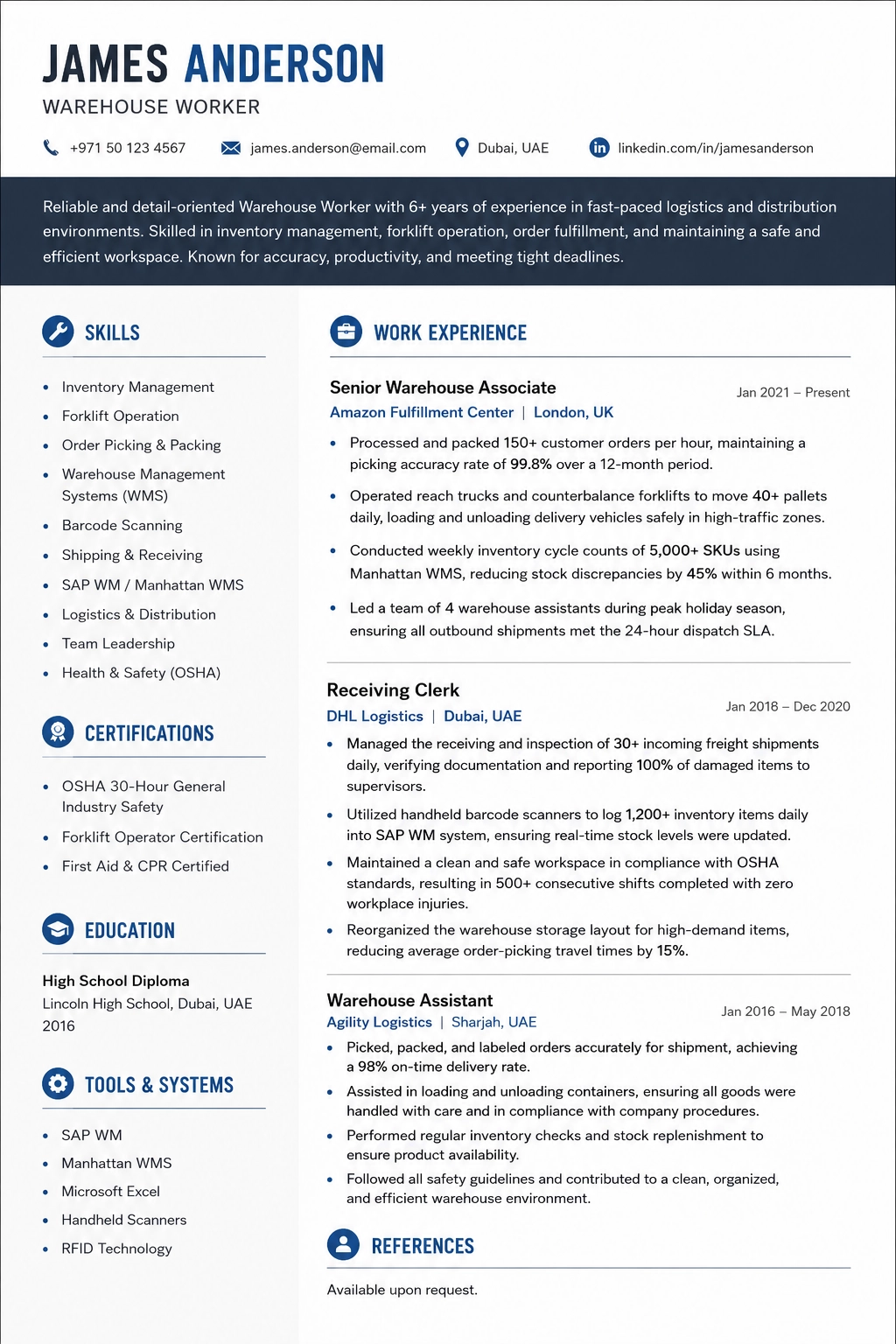
Listing skills is important, but showing how you used them in real work experience is what gets you interviews. Here is how a strong Warehouse Worker CV presents these skills.
Senior Warehouse Associate
Amazon Fulfillment Center London
- •Processed and packed 150+ customer orders per hour, maintaining a picking accuracy rate of 99.8% over a 12-month period
- •Operated reach trucks and counterbalance forklifts to move 40+ pallets daily, loading and unloading delivery vehicles safely in high-traffic zones
- •Conducted weekly inventory cycle counts of 5,000+ SKUs using Manhattan WMS, reducing stock discrepancies by 45% within 6 months
- •Led a team of 4 warehouse assistants during peak holiday season, ensuring all outbound shipments met the 24-hour dispatch SLA
Receiving Clerk
DHL Logistics Dubai
- •Managed the receiving and inspection of 30+ incoming freight shipments daily, verifying documentation and reporting 100% of damaged items to supervisors
- •Utilized handheld barcode scanners to log 1,200+ inventory items daily into SAP WM system, ensuring real-time stock levels were updated
- •Maintained a clean and safe workspace in compliance with OSHA standards, resulting in 500+ consecutive shifts completed with zero workplace injuries
- •Reorganized the warehouse storage layout for high-demand items, reducing average order-picking travel times by 15%
Visual CV Example Template
Complete Warehouse Worker Skills List
Common ATS Keywords for Warehouse Worker
Applicant Tracking Systems scan your CV for specific keywords before a human ever reads it. Make sure these terms appear naturally in your skills section and work experience.
Warehouse Worker Skills Explained in Detail
Understanding what each skill really means helps you describe it accurately on your CV and discuss it confidently in interviews.
Inventory Management and Stock Control
Inventory management is a critical function within warehouse operations that directly impacts order fulfillment and customer satisfaction. It involves organizing, tracking, and auditing all physical stock items to ensure that the warehouse records match the actual physical inventory. A warehouse worker skilled in stock control participates in regular cycle counts, verifies incoming goods against purchase orders, and documents any discrepancies such as damaged items, short shipments, or mislabeled products.
Maintaining an organized warehouse layout is essential for efficient inventory control. This includes placing products in designated locations, updating shelf labels, and utilizing stock rotation methodologies like First-In, First-Out (FIFO) to prevent inventory obsolescence or spoilage. By keeping inventory organized and documented, warehouse workers minimize picking errors, reduce search times for other team members, and ensure that the purchasing department has accurate data for restocking.
On your CV, describe your inventory management skills by mentioning the volume of stock you managed and the specific systems you used. Explain the scale of the operations to give recruiters context about your experience level. For example, you might write that you performed weekly cycle counts for an inventory of 8,000 SKUs using a handheld scanner and SAP, which helped maintain a 99.5% inventory accuracy rate. This tells employers that you are detailed, accurate, and comfortable with logistics technology.
Order Picking and Packing
Order picking and packing are the core activities in fulfillment centers and distribution hubs. Picking involves locating and retrieving the correct products from storage to fulfill specific customer orders, which requires navigating the warehouse layout efficiently and verifying item numbers or barcodes. Packing involves selecting appropriate packaging materials, packing items securely to prevent damage during transit, and applying the correct shipping labels. Both processes require high speed and precision to meet shipping deadlines.
Modern picking processes are heavily tech-driven, relying on digital tools like pick-to-light systems, RF barcode scanners, or voice-picking headsets. A competent worker must operate these tools comfortably while maintaining high safety standards. In the packing phase, understanding how to maximize space, use dunnage effectively, and handle fragile or hazardous materials according to safety guidelines is essential for reducing shipping costs and damage claims.
To showcase your picking and packing skills effectively, include your productivity metrics and accuracy rates in your CV. Recruiters want to see that you can work quickly without compromising on quality. You could write that you picked and packed an average of 180 items per hour while maintaining a 99.9% accuracy rate, consistently ranking in the top 10% of the warehouse team. This concrete data proves your efficiency and reliability in a fast-paced environment.
Safety Compliance and Manual Handling
Warehouses are high-risk environments with moving vehicles, heavy machinery, elevated storage racks, and physical lifting requirements. Safety compliance is therefore the most important skill for any warehouse worker. It involves following strict safety guidelines, wearing appropriate Personal Protective Equipment (PPE) such as steel-toed boots and high-visibility vests, and keeping walkways clear of debris. Understanding how to identify and report hazards, report incidents, and participate in safety meetings is vital for maintaining a accident-free workplace.
Manual handling is a core physical skill required for lifting, carrying, and moving heavy items safely. It involves using correct body mechanics, such as bending at the knees and keeping the back straight, to prevent personal injury. It also requires the safe operation of mechanical aids, such as hand trucks, pallet jacks, and lift tables, when loads exceed safe manual limits. Workers who prioritize safety protect not only themselves but also their colleagues and the company's assets.
When describing safety skills on your CV, highlight any relevant certifications, safety training records, or safety records from your previous roles. Mention how you contributed to a safe working culture or participated in safety audits. For instance, you could state that you completed certified manual handling training and served on the site safety committee, contributing to a record of 400 days without a lost-time accident. This demonstrates a professional commitment to safety that employers value.
Skills to Avoid on a Warehouse Worker CV
These generic terms appear on nearly every CV. They tell the recruiter nothing specific about your abilities and will not help you pass an ATS filter.
How to Present These Skills on Your CV
Put your forklift licence type and expiry date near the top of your CV if you have one. It is often the first thing employers look for.
Name the specific WMS systems you have used. SAP, Manhattan, Oracle WMS, or even basic inventory spreadsheets.
In your experience section, mention throughput numbers if you know them: orders picked per shift, pallets moved per day, or accuracy rates.
Include any health and safety training or certifications like manual handling or first aid.
Frequently Asked Questions
Do I need a forklift licence for warehouse work?
Not always, but having one significantly increases your chances. Many warehouse roles require it, and employers often prioritize candidates who already hold a valid licence over those who would need training.
What if I have no warehouse experience?
Focus on transferable skills from any physical or operational role. Stacking shelves in retail, loading deliveries, or any role involving stock management counts. Highlight your manual handling awareness and willingness to learn systems.
Should I mention the warehouse size I worked in?
Yes. Working in a 10,000 square foot local warehouse is very different from a 500,000 square foot distribution center. The scale shows employers what pace and complexity you can handle.
Is night shift experience worth mentioning?
Yes. Many warehouse roles involve shift work and employers want to know you are willing and able to work nights, weekends, or rotating patterns.
Build Your CV Free
Ready to build your CV with a properly structured skills section? Our free CV builder helps you create a professional, ATS-friendly CV with no login, no watermarks, and instant PDF download.
Related Skills Guides
CV Toolkit
Build Your Professional CV for Free
Pick from 30+ recruiter-approved designs and start applying in minutes. 100% Free.
Cover Letter Maker
Professional matching correspondence. Build for Free.
Business Card Maker
Sleek, modern designs for authority branding. 100% Free.
100% Free • No Credit Card • No Watermarks • Instant Access