

Security Guard Skills for CV
What to List (2026)
Security guard roles are competitive, especially in the Gulf and international markets. Employers are not looking for someone who simply writes "responsible" or "hardworking" on their CV. They need to see that you understand the specific duties of a security officer and have the practical skills to perform them from day one.
Your CV should demonstrate knowledge of access control systems, surveillance equipment, and emergency procedures. If you have specific certifications like SIA licensing or fire safety training, those belong prominently on your CV. Recruiters scanning your application are looking for these exact terms.
Below are the skills that actually matter for security guard positions. Pick the ones that genuinely match your experience and leave out anything you cannot back up in an interview.
Top 10 Security Guard Skills Employers Look For
Example: How These Skills Look on a Real CV
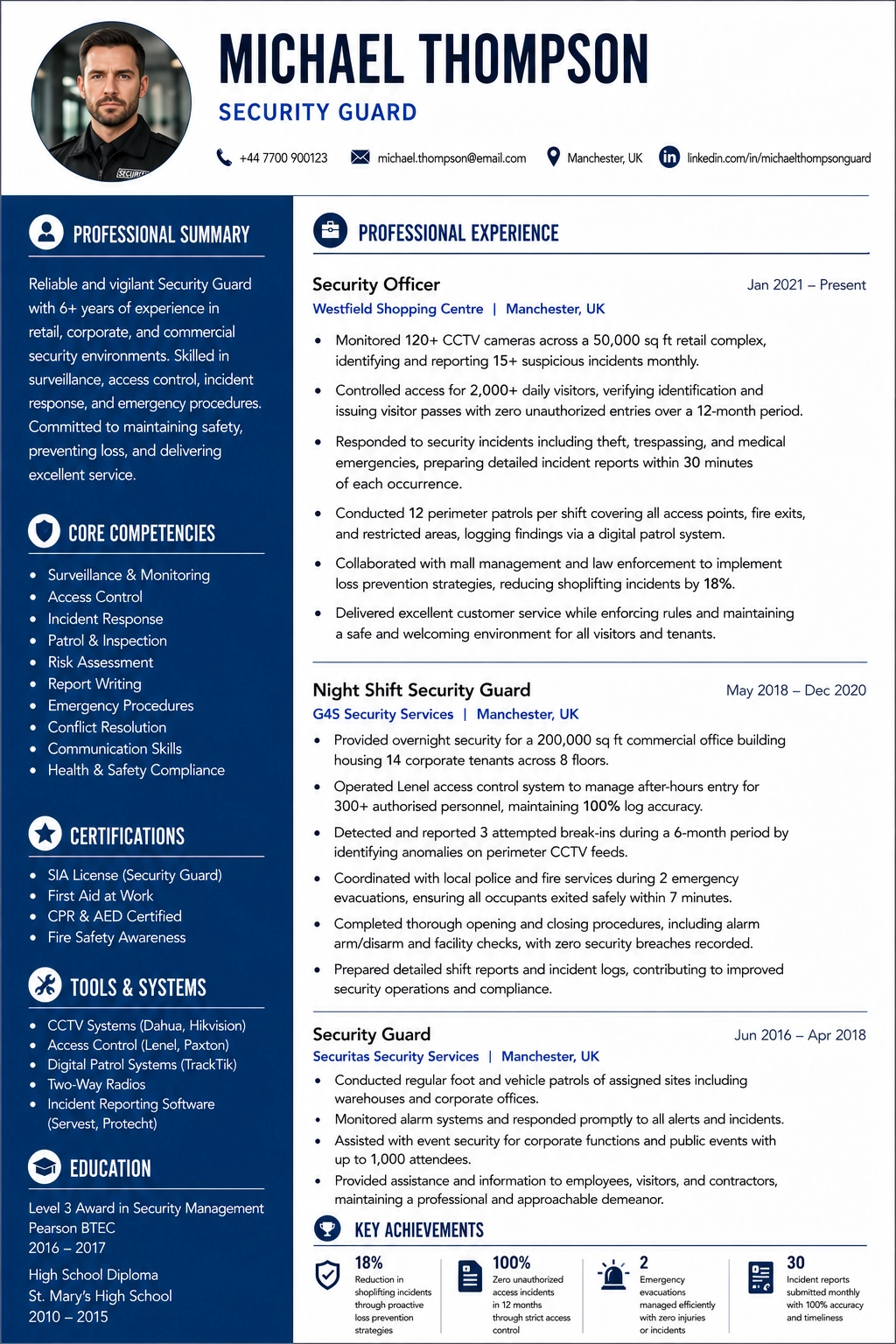
Listing skills is important, but showing how you used them in real work experience is what gets you interviews. Here is how a strong Security Guard CV presents these skills.
Security Officer
Westfield Shopping Centre
- •Monitored 120+ CCTV cameras across a 50,000 sq ft retail complex, identifying and reporting 15+ suspicious incidents monthly
- •Controlled access for 2,000+ daily visitors, verifying identification and issuing visitor passes with zero unauthorized entries over a 12-month period
- •Responded to security incidents including theft, trespassing, and medical emergencies, preparing detailed incident reports within 30 minutes of each occurrence
- •Conducted 12 perimeter patrols per shift covering all access points, fire exits, and restricted areas, logging findings via a digital patrol system
Night Shift Security Guard
G4S Security Services
- •Provided overnight security for a 200,000 sq ft commercial office building housing 14 corporate tenants across 8 floors
- •Operated Lenel access control system to manage after-hours entry for 300+ authorised personnel, maintaining 100% log accuracy
- •Detected and reported 3 attempted break-ins during a 6-month period by identifying anomalies on perimeter CCTV feeds
- •Coordinated with local police and fire services during 2 emergency evacuations, ensuring all occupants exited safely within 7 minutes
Visual CV Example Template
Complete Security Guard Skills List
Common ATS Keywords for Security Guard
Applicant Tracking Systems scan your CV for specific keywords before a human ever reads it. Make sure these terms appear naturally in your skills section and work experience.
Security Guard Skills Explained in Detail
Understanding what each skill really means helps you describe it accurately on your CV and discuss it confidently in interviews.
CCTV Monitoring and Surveillance
CCTV monitoring is far more than simply watching screens. A competent security officer systematically scans camera feeds, identifies patterns of suspicious behaviour, and knows the difference between normal activity and genuine security threats. Modern surveillance systems often include motion detection, facial recognition, and automatic number plate recognition, and employers expect guards to operate these features confidently.
Effective CCTV operators develop a scanning routine that covers all cameras within a set rotation period, typically every 60 to 90 seconds depending on the number of feeds. They maintain concentration over extended periods, often eight to twelve hour shifts, and document all observations in a surveillance log that can be used as evidence if needed.
On your CV, do not just write CCTV monitoring. Specify the system you used, the number of cameras you monitored, and the outcomes of your surveillance work. For example, state that you monitored 80 cameras using a Hikvision system and identified 12 shoplifting incidents in one quarter.
Access Control and Visitor Management
Access control is the first line of defence for any secured premises. It involves verifying the identity of everyone who enters, ensuring they have authorisation to be there, and maintaining accurate records of all movements in and out of the building. This applies equally to employees, contractors, delivery personnel, and visitors.
Modern access control goes beyond a sign-in sheet. Security officers are expected to operate electronic systems such as Lenel, C-Cure, or Paxton, issue temporary access cards, and manage visitor pre-registration databases. Understanding how to lock down a building during an incident by restricting access through these systems is a key competency.
When listing this skill on your CV, mention the specific systems you have used, the volume of people you processed daily, and any improvements you made. For example, you might state that you managed access for 1,500 daily visitors using a Paxton Net2 system with zero security breaches over your tenure.
Incident Reporting and Documentation
Every security incident, no matter how minor, requires clear and accurate documentation. Incident reports serve as official records that may be used by management, insurance companies, law enforcement, or legal teams. A poorly written report can undermine a prosecution or an insurance claim, so this skill is taken seriously by employers.
A strong incident report includes the date, time, and location of the event, the people involved, a factual description of what happened, the actions taken by security staff, and the outcome. Reports should be written in plain language, avoid speculation or personal opinions, and be completed as soon as possible after the event while details are fresh.
On your CV, demonstrate this skill by mentioning the volume of reports you have written and the systems you used to file them. For example, you could state that you completed an average of 8 incident reports per week using an electronic reporting system, with all reports submitted within the required 30-minute window.
Emergency Response Procedures
Emergency response is one of the highest-stakes responsibilities a security guard holds. Whether dealing with a fire alarm, a medical emergency, a bomb threat, or an active intruder situation, the guard is often the first person on site who must take decisive action before emergency services arrive. Employers need to know you have been trained and tested in these scenarios.
Competent emergency response requires knowledge of your site-specific emergency plan, the locations of all emergency equipment including fire extinguishers, defibrillators, and first aid kits, and the ability to coordinate an evacuation calmly and efficiently. Many sites conduct regular drills, and guards are expected to lead or assist in these exercises.
To present this skill effectively on your CV, reference specific training you have completed such as fire marshal certification or first aid at work qualifications. Mention any real emergencies you have managed, the number of evacuations you have coordinated, and the outcomes. For example, state that you led quarterly fire drills for a building of 400 occupants with an average evacuation time of 6 minutes.
Skills to Avoid on a Security Guard CV
These generic terms appear on nearly every CV. They tell the recruiter nothing specific about your abilities and will not help you pass an ATS filter.
How to Present These Skills on Your CV
List your security-specific skills in a dedicated Skills section near the top of your CV, directly below your personal statement.
Include your SIA licence number, expiry date, and any certifications like first aid or fire safety in a separate Certifications section.
In your work experience, describe what you actually did using these skill terms rather than vague statements.
If you have experience with specific systems like Lenel, C-Cure, or Milestone, name them directly.
Frequently Asked Questions
Do I need an SIA licence to work as a security guard?
In the UK, yes. An SIA licence is a legal requirement for most security roles. In the Gulf and other international markets, requirements vary by country but having any recognised security certification strengthens your CV significantly.
Should I mention physical fitness on my security guard CV?
Yes, but briefly. Saying you maintain physical fitness for the demands of the role is enough. Do not list gym routines or personal bests. Employers just need to know you can handle patrol duties and potentially physical situations.
What if I have no security experience?
Focus on transferable skills like conflict resolution from customer service roles, observation skills, or any military or police background. List any completed training courses even if you have not worked a security post yet.
Should I include my driving licence on a security guard CV?
Yes, especially if you hold a clean licence. Many security posts require mobile patrol or site-to-site travel. A valid driving licence can be the difference between getting shortlisted or not.
Build Your CV Free
Ready to build your CV with a properly structured skills section? Our free CV builder helps you create a professional, ATS-friendly CV with no login, no watermarks, and instant PDF download.
Related Skills Guides
CV Toolkit
Build Your Professional CV for Free
Pick from 30+ recruiter-approved designs and start applying in minutes. 100% Free.
Cover Letter Maker
Professional matching correspondence. Build for Free.
Business Card Maker
Sleek, modern designs for authority branding. 100% Free.
100% Free • No Credit Card • No Watermarks • Instant Access