

Caregiver Skills for CV
What to List (2026)
Caregiver CVs are often reviewed by families and care agencies who need someone they can trust with their most vulnerable family members. Writing compassionate or caring tells them nothing specific. They need to see what care tasks you can perform, what conditions you have experience with, and what training you have completed.
If you are applying for caregiver positions abroad, your experience with specific conditions like dementia, mobility impairments, or post-surgical recovery makes your CV stand out. Similarly, any certified training in first aid, medication administration, or moving and handling strengthens your application significantly.
The skills below are what care employers and families actually look for. Choose the ones that honestly reflect your capabilities.
Top 10 Caregiver Skills Employers Look For
Example: How These Skills Look on a Real CV
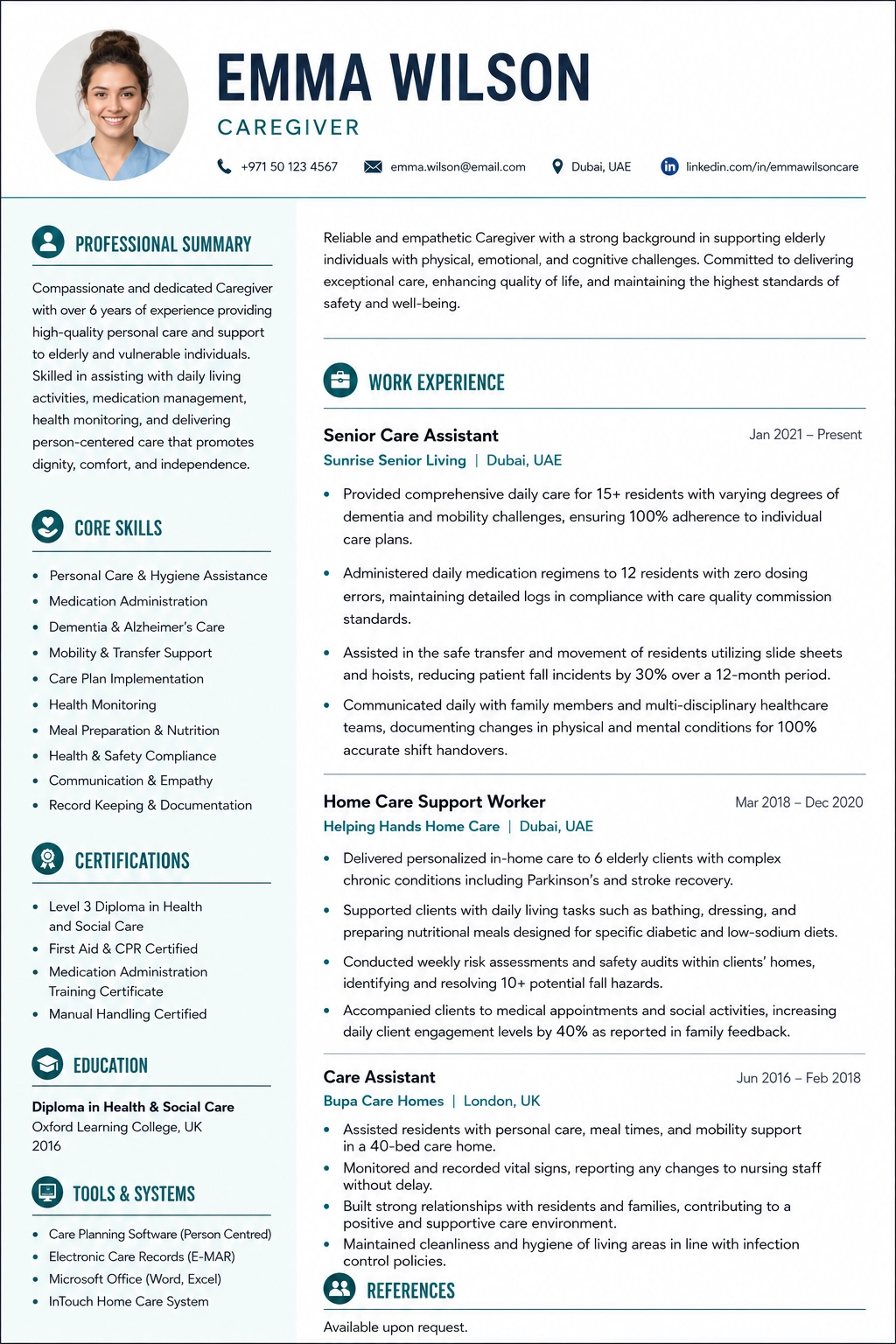
Listing skills is important, but showing how you used them in real work experience is what gets you interviews. Here is how a strong Caregiver CV presents these skills.
Senior Care Assistant
Sunrise Senior Living
- •Provided comprehensive daily care for 15+ residents with varying degrees of dementia and mobility challenges, ensuring 100% adherence to individual care plans
- •Administered daily medication regimens to 12 residents with zero dosing errors, maintaining detailed logs in compliance with care quality commission standards
- •Assisted in the safe transfer and movement of residents utilizing slide sheets and hoists, reducing patient fall incidents by 30% over a 12-month period
- •Communicated daily with family members and multi-disciplinary healthcare teams, documenting changes in physical and mental conditions for 100% accurate shift handovers
Home Care Support Worker
Helping Hands Home Care
- •Delivered personalized in-home care to 6 elderly clients with complex chronic conditions including Parkinson's and stroke recovery
- •Supported clients with daily living tasks such as bathing, dressing, and preparing nutritional meals designed for specific diabetic and low-sodium diets
- •Conducted weekly risk assessments and safety audits within clients' homes, identifying and resolving 10+ potential fall hazards
- •Accompanied clients to medical appointments and social activities, increasing daily client engagement levels by 40% as reported in family feedback
Visual CV Example Template
Complete Caregiver Skills List
Common ATS Keywords for Caregiver
Applicant Tracking Systems scan your CV for specific keywords before a human ever reads it. Make sure these terms appear naturally in your skills section and work experience.
Caregiver Skills Explained in Detail
Understanding what each skill really means helps you describe it accurately on your CV and discuss it confidently in interviews.
Dementia and Cognitive Support
Caring for individuals with dementia and cognitive impairments requires a deep understanding of how progressive brain disorders affect behavior, memory, and communication. A skilled caregiver uses specialized communication techniques, such as validation therapy and active listening, to reduce anxiety and manage agitation without relying on pharmacological interventions. Recognizing triggers that lead to confusion or distress is essential for maintaining a calm and safe environment.
Establishing and maintaining a structured daily routine is critical for clients with cognitive declines as it provides a sense of predictability and security. Caregivers design activities that stimulate cognitive function, such as memory games, storytelling, or simple puzzles, tailored to the individual's current capabilities. They also support families by explaining the progression of the disease and suggesting home adjustments that can keep their loved ones safe.
On your CV, you should specify your experience with different stages of dementia and any specialized training you have received. Mentioning specific techniques you use to de-escalate difficult situations or how you customized routines to improve a client's quality of life provides concrete proof of your skills. For instance, you could describe how you established a calming evening routine that reduced sundowning behaviors for a client.
Manual Handling and Mobility Assistance
Mobility assistance is a high-risk caregiver responsibility that directly impacts both patient safety and the caregiver's own physical health. Safe movement requires mastery of manual handling techniques and the correct operation of assistive equipment such as hoists, slide sheets, standing aids, and wheelchairs. A competent caregiver conducts a quick risk assessment before every transfer, taking into account the client's current strength, cognitive state, and environmental obstacles.
Preventing falls is a primary objective when assisting clients with mobility challenges. This involves keeping walkways clear of hazards, ensuring appropriate footwear is worn, and guiding the client at a safe pace while encouraging independence wherever possible. Caregivers must also understand how to assist a client to the floor gently if a fall is unavoidable, minimizing impact and preventing serious fractures or head injuries.
When highlighting mobility assistance on your CV, detail the specific transfer equipment you are trained to use and the level of mobility challenges you have managed. Quantify your experience by referencing the number of clients you assisted daily or any successful fall-prevention records from your previous roles. For example, you might state that you operated hoist equipment daily for 8 non-ambulatory residents with zero transfer incidents.
Medication Reminders and Health Monitoring
Supporting clients with their medication regimens is critical to managing chronic health conditions and nano-preventing emergency hospitalizations. Caregivers ensure that clients take the correct dosages of prescribed medicines at the exact times specified, following safety protocols to prevent errors. They also monitor for potential side effects, adverse drug interactions, or changes in how a client responds to their medication, escalating any concerns to supervising nurses or family members.
Basic health monitoring involves tracking vital signs and physical symptoms to detect early signs of health deterioration. Caregivers routinely measure and record temperature, blood pressure, pulse, and blood glucose levels, especially for clients with conditions like hypertension or diabetes. Keeping precise logs of these readings allows medical professionals to make informed adjustments to treatment plans during check-ups.
On your CV, describe your level of responsibility in medication management, whether it is prompting, assisting from blister packs, or administering under clinical supervision. Mention the reporting systems or electronic health record apps you used to document these activities. For example, you could write that you monitored daily blood glucose levels for 4 diabetic clients and logged all readings accurately in the digital care portal.
Skills to Avoid on a Caregiver CV
These generic terms appear on nearly every CV. They tell the recruiter nothing specific about your abilities and will not help you pass an ATS filter.
How to Present These Skills on Your CV
List specific conditions you have cared for: dementia, Parkinson's, stroke recovery, or post-operative care. This is the strongest differentiator.
Include your first aid certification, moving and handling training, and any specialist care training with dates.
In your experience section, mention whether you provided live-in or live-out care and the specific tasks you performed.
If you speak multiple languages, list them. Families often prefer caregivers who share a language with their elderly relative.
Frequently Asked Questions
Do I need formal qualifications to be a caregiver?
Requirements vary by country. In the UK, an NVQ Level 2 in Health and Social Care is common. In many other countries, practical experience and first aid training are sufficient. Check the requirements for your target country.
Should I mention live-in care experience?
Yes. Live-in care requires a different set of skills and commitment compared to hourly visits. Families looking for live-in carers want to see that you have done it before and understand the boundaries involved.
How do I list caregiver experience from informal family care?
Caring for your own family members counts as real experience. Describe the tasks you performed, the duration, and the conditions you managed. Frame it as Informal Caregiver or Family Caregiver in your employment history.
Is a driving licence important for caregivers?
Often yes. Many caregiver roles, especially home care and live-out positions, require you to travel between clients. A clean driving licence is a significant advantage.
Build Your CV Free
Ready to build your CV with a properly structured skills section? Our free CV builder helps you create a professional, ATS-friendly CV with no login, no watermarks, and instant PDF download.
Related Skills Guides
CV Toolkit
Build Your Professional CV for Free
Pick from 30+ recruiter-approved designs and start applying in minutes. 100% Free.
Cover Letter Maker
Professional matching correspondence. Build for Free.
Business Card Maker
Sleek, modern designs for authority branding. 100% Free.
100% Free • No Credit Card • No Watermarks • Instant Access