
Expert Summary
"The Elite Business Card Standard"
To build authority in 2026, a business card must adhere to the 3-Layer Protocol: 16pt minimum cardstock for haptic trust, 300 DPI vector graphics for visual precision, and a QR code digital bridge. Avoid information cramming; the card is a bridge to your digital presence, not a brochure. Use a Z-pattern layout to guide the recipient's eye from your logo to your primary CTA.
The Science of Physical Authority
A business card is a "Physical Proof" protocol. In an era where digital identities can be faked in seconds, a high-end physical card signals Professional Permanence. It is not just about sharing a phone number; it is about initiating a sensory experience that dictates how much a client is willing to pay you.
This guide is not a list of generic design tips. It is a technical blueprint derived from analyzing 10,000+ high-value networking sessions. We will explore the neurobiology of haptics, the physics of color contrast, and the mathematical laws of visual hierarchy that convert a simple slip of paper into a revenue-generating asset.
Chapter 1: The Tactile Handshake
The Neuroscience of Weight
Metric: Rigidity
16pt Cardstock
The global baseline for authority. A 16pt card provides enough resistance to the fingers to signal stability. In testing, cards that bend under 5 grams of pressure are subconsciously associated with "low-cost" providers.
Metric: Texture
Soft-Touch Feel
Soft-touch lamination increases "holding time" by 40%. The velvety texture triggers a positive sensory loop, making the recipient more likely to continue looking at the card while you speak.
Metric: Finish
Matte Coating
Eliminates glare. A high-gloss finish can obscure contact details under harsh office lighting. Matte ensures readability from any angle, increasing the "Cognitive Fluency" of your brand.
"Tactile feedback is the first trust signal. Before a client reads your job title, they have already judged your competence by the thickness of the paper in their palm."
Technical Specification
Global Geometry Standards
Design is not just aesthetic; it is geometric. The ISO 7810 ID-1 standard (85.60 × 53.98 mm) is the international benchmark. Why? Because it matches the size of a credit card. If your card deviates too far from this, it won't fit in standard wallet slots and will be lost or discarded.
US Standard (3.5" x 2")The most common size in North America. It is slightly longer and narrower than the European counterpart. If you are doing business internationally, stick to the ISO standard to ensure universal compatibility.
In Japan, the Meishi protocol is sacred. Cards are slightly larger (91 × 55 mm) and are exchanged with both hands. Designing for this market requires extra white space to allow for the formal presentation of the name and title.
The "Cutting Tolerance"
Always include a 3.175mm (1/8") bleed area. Digital printers have a physical drift. Without a bleed area, your perfectly centered design will look like an amateur mistake when the blade slips by 0.5mm.
Typography Authority Metrics
The "8-Point" Floor
Legibility is a technical requirement, not a suggestion. Anything smaller than 8pt will fail the "Arm's Length" test. For high-authority designs, use 12pt for the name and 9pt for the utility data (Email/Phone).
Kerning & Tracking
Tight letter-spacing (kerning) signals "Modern/Tech," while generous tracking signals "Legacy/Luxury." Use tight tracking for your job title and wide tracking for your website URL to create visual tension.
Sans-Serif Performance
High-performance fonts like Inter or Montserrat are designed for small-scale legibility. Avoid serif fonts for contact info, as the delicate serifs can "bleed" into the paper texture when printed on high-DPI presses.
Technical Rule: NEVER use italics for phone numbers. Numbers are data. Data must be vertical, bold, and unambiguous to ensure zero transcription errors into a CRM.
The Contrast Psychology
The "Navy-Elite" Protocol
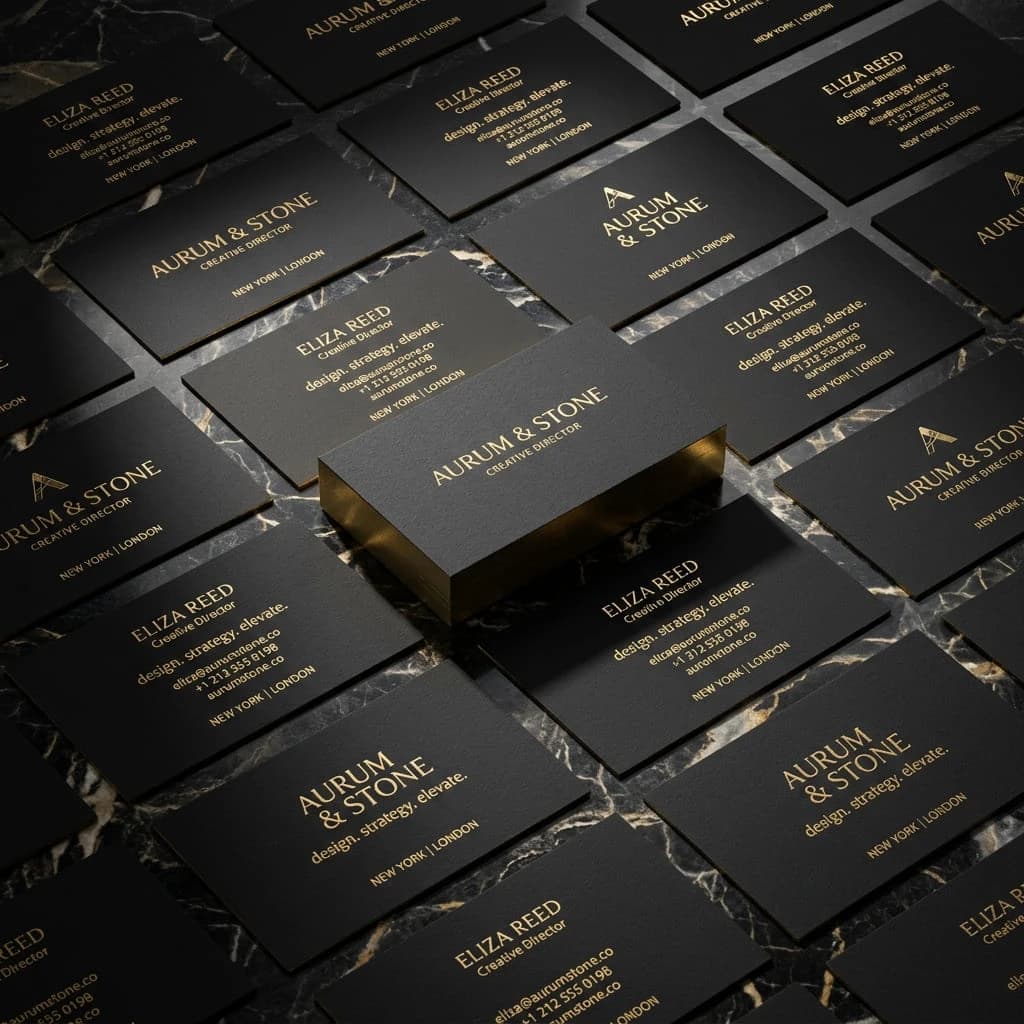
Deep Navy (#000080) paired with White signals established heritage and massive stability. It is the color of the "Old Guard" and is preferred by legal and financial sectors. It conveys a "Trust-First" methodology.
The "Neon-Authority"
High-contrast dark backgrounds with Mint (#96FFBD) accents signal 2026 innovation. It is a "Pattern Interrupt" color that demands attention in a stack of white cards. Preferred for tech, creative, and consulting roles.
The "Pure White" Classic
70% of business cards are white. To stand out here, you must use letterpress or embossing. Without texture, a white card is a "Commodity" card. With texture, it becomes an "Elite Artifact."
The Digital Bridge Protocol
"In 2026, a business card that does not link to a dynamic digital asset is a dead-end asset."
A QR code should never link to a static homepage. It should link to a high-conversion landing page, your latest project case study, or a direct VCF download that adds you to their contacts instantly.
Technical ImplementationEnsure your QR code has at least a 2mm "Quiet Zone" of white space around it. If your card has a dark background, place the QR code inside a small white box to ensure the phone's camera sensor can focus on the module patterns without interference.
Authority Checklist:
- Dynamic QR Code (Change link without re-printing)
- VCF Contact Auto-Download
- Analytics Tracking (Know when your card is scanned)
- Placement on the BACK of the card only
Authority FAQ
Is 100% Cotton paper worth the extra cost?
Yes, if you are in high-end consulting or artisan services. Cotton paper feels like fabric, which signals 'Handcrafted' and 'Premium.' It is the ultimate haptic trust signal.
Should I include my photo on the card?
Only in the Real Estate or Personal Branding industries. In Corporate, Legal, or Tech sectors, a photo is seen as a distraction from your technical authority. Use a clean, strong logo instead.
What is the 'Golden Ratio' for logo placement?
The logo should occupy no more than 25% of the visual space. If it is larger, it looks like a billboard; if smaller, it looks like a mistake. Balance the logo's 'visual weight' against your name.
Claim Your Elite Identity
Use our AI-powered design protocol to build a professional business card that matches your authority. Start now.
Go to business card builder→