
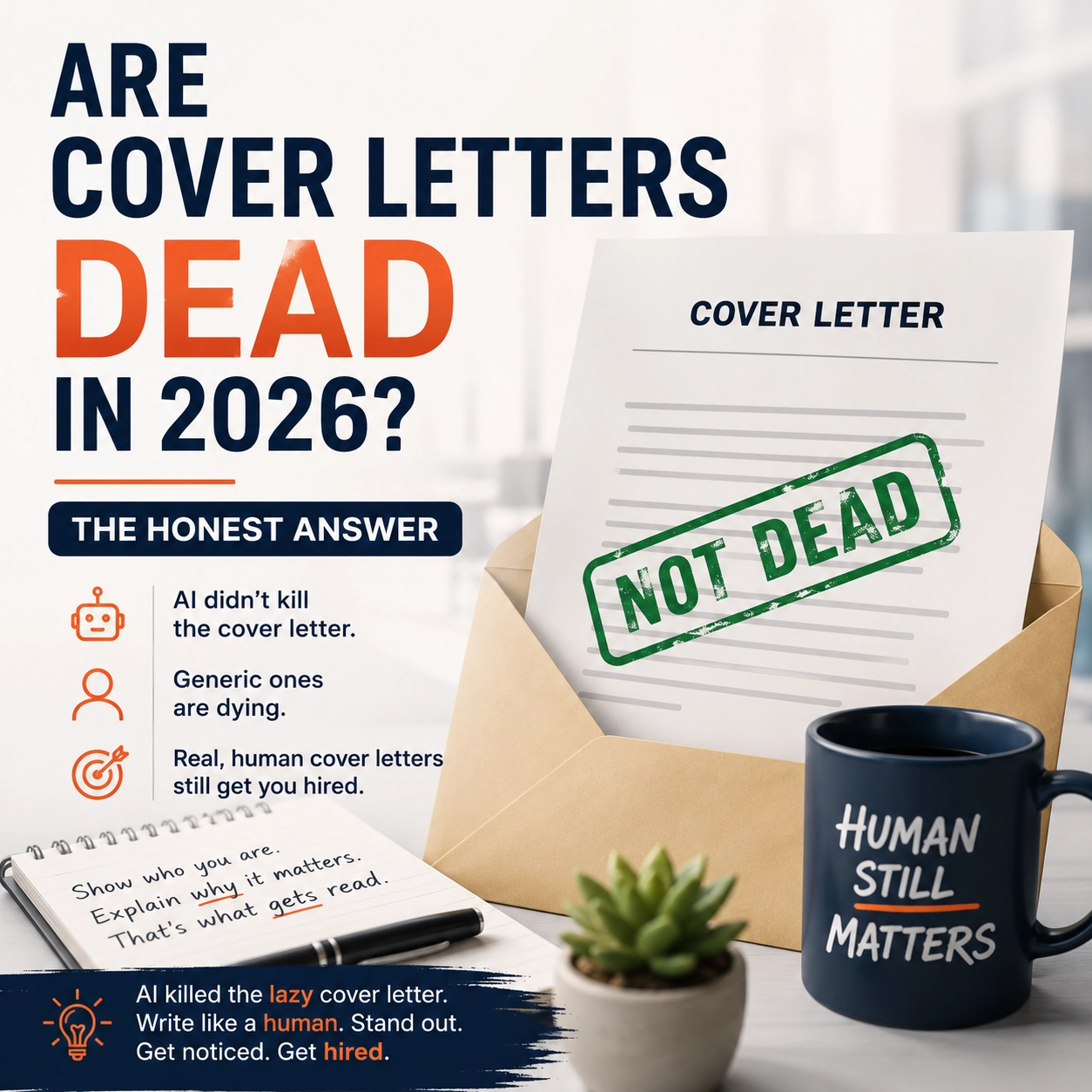
Are Cover Letters Dead in 2026? The Honest Answer
Everyone says AI killed the cover letter. Here is why that is only half true and when a real human cover letter still makes the difference between getting hired and getting ignored.
There is a popular opinion going around right now that cover letters are dead. That AI made them pointless. That nobody reads them anymore and writing one is a waste of time.
Many recruiters argue that cover letters matter less than they once did, particularly when applications are processed through ATS systems and AI screening tools. For global corporations receiving tens of thousands of applications, they are probably right. At that scale nobody has time to read cover letters and AI has made them all sound identical anyway.
But here is the thing. Most jobs are not at global corporations processing tens of thousands of applications every month.
I have applied for jobs myself. Not every application asked for a cover letter. But some did. And those were not random requests. The companies asking for cover letters were usually the ones who actually wanted to understand who they were hiring before bringing someone in for an interview.
Are cover letters dead in 2026? No. Generic cover letters are dying, but specific human-written cover letters still matter for many jobs. That distinction matters more than most people realize.
Why the "Cover Letters Are Dead" Argument Is Only Half True
The argument usually goes like this. AI can generate a cover letter in seconds. Everyone is using it. So every cover letter sounds the same. So they are useless for filtering candidates. So they are dying.
That logic is correct about one specific thing. AI generated cover letters that sound like everyone else's are useless. They tell a recruiter nothing about the actual person.
But that is not an argument against cover letters. That is an argument against bad cover letters.
When a small agency in London is hiring their next designer and they receive 40 applications they read every cover letter. Not to check grammar. Not to see if you can write formally. Just to get a basic sense of who you are as a person and whether you actually want this specific job or just any job.
A cover letter that sounds like it was generated in ten seconds tells them exactly that. This person generated it in ten seconds. They do not particularly want this job. They want a job.
A cover letter written by a real person saying something specific and honest about why they want to work there tells them something completely different. This person actually thought about us.
When Cover Letters Still Matter
Cover letters are not dying equally across all industries and all job types.
For large corporations processing thousands of applications through automated systems cover letters are genuinely becoming less relevant. The systems filter before any human reads anything.
But for smaller companies, agencies, startups, and roles where culture fit matters as much as skills, cover letters are still read and still influence decisions. A hiring manager at a ten person company does not have an automated system making decisions for them. They read what you send.
For international job applications this matters even more. If you are applying for a job in a Gulf country, Singapore, Japan, or Korea as a foreign applicant the cover letter is sometimes the only place where you can explain something your CV cannot show.
Why you are relocating. Why you want to work in that specific country. Why this specific company interests you despite you being based somewhere else entirely. A CV cannot answer those questions. A cover letter can.
For example, if you are a professional or worker applying from Nepal, India, Bangladesh, the Philippines, Sri Lanka, or Pakistan, a foreign recruiter looking at your application has immediate questions: Are you ready to relocate? Do you have your documentation in order? Why are you leaving your home country?
Your CV only lists past dates and employers. A cover letter is where you connect the dots. You can explain that you are ready to relocate immediately, that you already have your passport ready, or that you have spent the last six months studying the work culture and language of the destination country. This changes you from a random international applicant into a serious candidate who has planned their transition.
Situations Where You Should Always Send a Cover Letter
While you don't always need a cover letter, there are specific situations where omitting one is a missed opportunity. You should always write one in these scenarios:
- International applications: When applying for jobs abroad (e.g., from South Asia to the Gulf, Europe, or Canada), you must explain your relocation timeline and work authorization status.
- Career changes: If you are transitioning from one industry or role to another, your CV will look irrelevant on its own. The cover letter is where you explain how your transferable skills apply to the new role.
- Little or no experience: Freshers and students need a space to showcase their enthusiasm, personal projects, and willingness to learn—things a blank CV cannot communicate. If you need help with this, read our comprehensive Student CV Guide or our step-by-step No Experience CV Guide.
- Small companies and startups: In small teams, every hire is a major risk. Founders and hiring managers read every word to ensure you fit their specific culture.
- When specifically requested: If the job description asks for a cover letter, it is a screening test. Failing to send one signals that you do not follow instructions.
Real Cover Letter Example
To help you structure your own application, here is a real example of a specific, human-written cover letter. It is short, direct, and explains key context that a CV cannot show on its own.
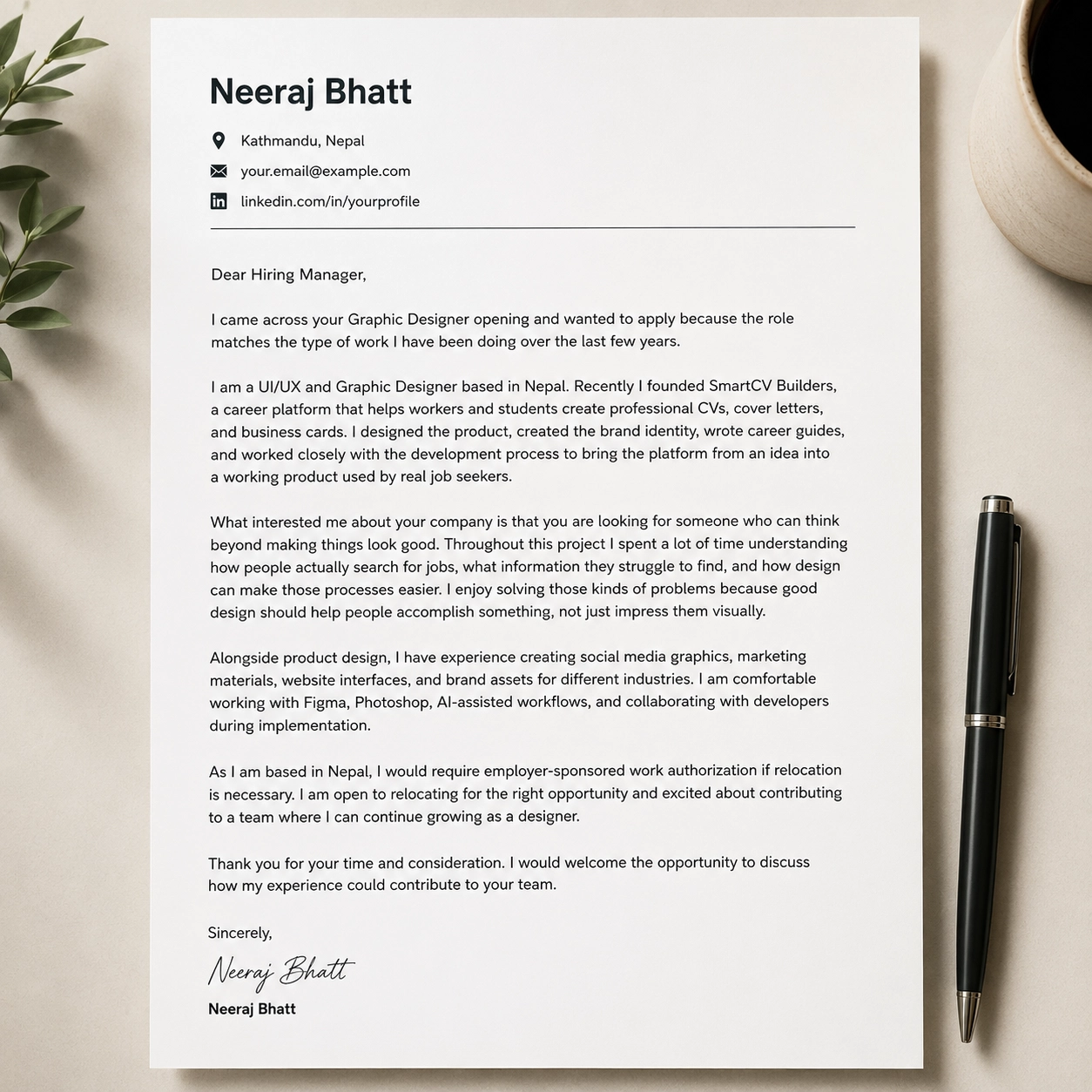
Visual: A professionally formatted, human-written cover letter example. Click to enlarge and download.
What Is Actually Dying
The generic cover letter is dying. The template cover letter is dying. The AI generated paragraph that starts with "I am writing to express my interest in the position of" is dying because it communicates nothing and everyone can see it for what it is.
What is not dying is a short specific honest letter written by a real person that says something genuine about why they want the job and what they actually bring to it.
Those are still read. Those still influence decisions. Those still make the difference between two equally qualified candidates where one took the time to sound human and one did not.
Compare the Difference
The Practical Reality
Not every job application will ask for a cover letter. Many do not. And for the ones that do not you probably do not need to send one unprompted.
But when an application asks for a cover letter that is a signal. It means the person reviewing applications actually wants to know something about you beyond what is on your CV. Sending an AI generated paragraph in response to that signal is almost worse than sending nothing because it shows you understood what was being asked and chose not to engage with it genuinely.
When you are asked for a cover letter write it yourself. Keep it short. Say something specific about the company and the role. Explain one thing about your background that is relevant and that your CV does not already make obvious. End it like a human being not like a template.
That is all it needs to be. And it is still worth doing.
The Bottom Line
AI did not kill the cover letter. AI killed the lazy cover letter that was never doing much work anyway.
If everyone else is submitting AI generated paragraphs that sound identical yours just needs to sound like a real person wrote it to stand out. That bar is lower now than it has ever been.
We are human. Write like one.
If you need help writing a cover letter that sounds genuinely human and specific to the role you are applying for, our free cover letter builder helps you structure it properly without sounding like everyone else.