

Accountant Skills for CV
What to List (2026)
Accounting CVs need precision. Employers reviewing your application want to see which accounting standards you work with, what software you use daily, and whether you hold any professional qualifications. Vague claims about being detail oriented or analytical are not enough.
The specific accounting software you name on your CV matters more than you might think. A company running QuickBooks needs someone who knows QuickBooks. A firm using SAP or Xero will search for those exact terms. Name your tools.
Whether you are applying for a general accounting role, a management accounting position, or a finance department role in another country, the skills below cover what employers actually screen for.
Top 10 Accountant Skills Employers Look For
Example: How These Skills Look on a Real CV
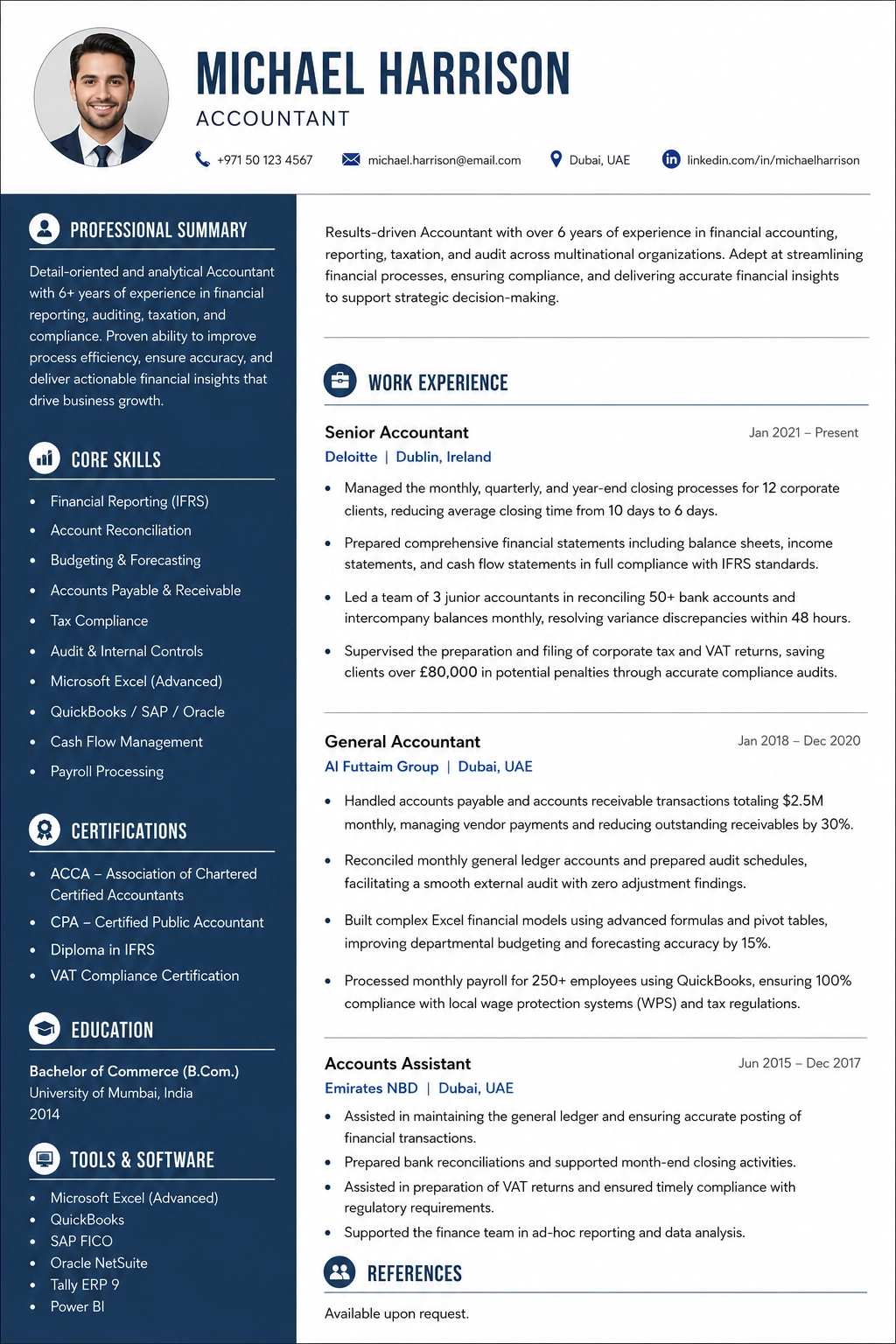
Listing skills is important, but showing how you used them in real work experience is what gets you interviews. Here is how a strong Accountant CV presents these skills.
Senior Accountant
Deloitte Dublin
- •Managed the monthly, quarterly, and year-end closing processes for 12 corporate clients, reducing average closing time from 10 days to 6 days
- •Prepared comprehensive financial statements including balance sheets, income statements, and cash flow statements in full compliance with IFRS standards
- •Led a team of 3 junior accountants in reconciling 50+ bank accounts and intercompany balances monthly, resolving variance discrepancies within 48 hours
- •Supervised the preparation and filing of corporate tax and VAT returns, saving clients over £80,000 in potential penalties through accurate compliance audits
General Accountant
Al Futtaim Group Dubai
- •Handled accounts payable and accounts receivable transactions totaling $2.5M monthly, managing vendor payments and reducing outstanding receivables by 30%
- •Reconciled monthly general ledger accounts and prepared audit schedules, facilitating a smooth external audit with zero adjustment findings
- •Built complex Excel financial models using advanced formulas and pivot tables, improving departmental budgeting and forecasting accuracy by 15%
- •Processed monthly payroll for 250+ employees using QuickBooks, ensuring 100% compliance with local wage protection systems (WPS) and tax regulations
Visual CV Example Template
Complete Accountant Skills List
Common ATS Keywords for Accountant
Applicant Tracking Systems scan your CV for specific keywords before a human ever reads it. Make sure these terms appear naturally in your skills section and work experience.
Accountant Skills Explained in Detail
Understanding what each skill really means helps you describe it accurately on your CV and discuss it confidently in interviews.
Financial Statement Preparation and Analysis
Financial statement preparation is a core accounting skill that requires a deep understanding of accounting principles and standards, such as IFRS or GAAP. It involves consolidating financial data from the general ledger to produce key documents, including the balance sheet, income statement, and cash flow statement. An accountant must ensure that these statements accurately reflect the company's financial position and are completed in accordance with legal and regulatory deadlines. This process requires absolute precision and meticulous attention to detail.
Beyond preparation, the ability to analyze these statements is what provides real value to business leaders. Financial analysis involves calculating key ratios, analyzing variances between actual and budgeted figures, and identifying financial trends or anomalies. By interpreting this financial data, an accountant can provide management with actionable insights regarding profitability, liquidity, and cost-saving opportunities, helping to guide strategic business decisions and operational planning.
On your CV, describe your experience with financial statement preparation by detailing the scale of the organizations you have worked with and the complexity of the reports you generated. Specify the accounting standards you applied and the audience for your reports, such as executive boards or external stakeholders. For example, you might write that you prepared monthly consolidated financial statements for 8 subsidiaries with combined revenues of $15M, ensuring compliance with IFRS standards. This details the level of responsibility you can manage.
Tax Compliance and VAT Filings
Tax compliance is a highly specialized area of accounting that requires continuous learning to stay updated with changing government regulations and tax laws. It involves preparing and submitting accurate tax returns, including corporate income tax, sales tax, VAT, and employee withholding taxes, by their respective deadlines. A competent accountant ensures that the organization claims all eligible deductions and credits while strictly adhering to tax laws, thereby minimizing the company's tax liability and avoiding costly audits or penalties.
In international markets, tax compliance often involves managing VAT or GST registration, calculating input and output taxes, and filing periodic returns. In the Gulf region, for instance, the introduction of VAT has made VAT compliance and reconciliation a highly sought-after skill. Accountants must ensure that all commercial transactions are documented correctly with compliant tax invoices and that accounting systems are set up to track tax rates accurately, reducing compliance risks during tax audits.
To present this skill effectively on your CV, mention the specific tax systems you have worked under and the volume or value of the tax filings you managed. Highlight your success in reducing compliance risks or resolving tax disputes. For instance, you could write that you managed corporate tax and VAT compliance for a retail group, filing quarterly returns of $500,000 with zero filing errors or late penalties. This shows potential employers that you can safeguard their business from tax-related compliance risks.
Advanced Excel and Financial Modeling
While accounting software manages day-to-day transactions, Microsoft Excel remains the ultimate tool for financial analysis, forecasting, and custom reporting. An accountant must possess advanced Excel skills, including the ability to write complex formulas, build dynamic pivot tables, use lookup functions like VLOOKUP or XLOOKUP, and design data validation controls. These technical skills enable accountants to manipulate large datasets, reconcile complex ledgers, and automate repetitive tasks, saving hours of manual work.
Financial modeling is the process of creating a spreadsheet representation of a company's financial performance. These models are used to project future revenues and expenses, evaluate investment opportunities, and perform scenario analyses for budgeting purposes. A well-designed model is dynamic, allowing users to change key assumptions and instantly see the impact on the company's projected cash flow, balance sheet, and profitability, providing a critical tool for business planning.
When listing Excel and modeling skills on your CV, avoid simply writing Excel as a single bullet point. Instead, describe the specific formulas and functions you use and the purpose of the spreadsheets you have created. For example, you might state that you designed a dynamic budgeting and forecasting model in Excel using pivot tables and advanced formulas, which reduced the annual budget preparation cycle by two weeks. This shows that you use Excel to create business value and efficiency.
Skills to Avoid on a Accountant CV
These generic terms appear on nearly every CV. They tell the recruiter nothing specific about your abilities and will not help you pass an ATS filter.
How to Present These Skills on Your CV
List your professional qualification status prominently: ACCA qualified, CPA certified, or part-qualified with the number of exams passed.
Create a Technical Skills section listing software, accounting standards you work with, and Excel proficiency level.
In your experience section, quantify your work: ledgers managed, transaction volumes, or audit values overseen.
If applying internationally, mention your familiarity with IFRS versus local GAAP standards.
Frequently Asked Questions
Should I mention Excel skills on an accounting CV?
Yes, but be specific. Do not just write Excel. Say Excel advanced including pivot tables, VLOOKUP, and financial modeling. Basic Excel is assumed for every office role so it adds nothing.
Do I need to be fully ACCA or CPA qualified?
Not necessarily. Many roles accept part-qualified candidates. Be transparent about your status and how many exams you have completed. Employers appreciate honesty over inflated claims.
How do I list accounting experience from a different country?
Translate your experience into internationally recognizable terms. Use IFRS terminology, name any international software you used, and specify the accounting standards you worked under.
Should I include industry-specific knowledge?
Yes. Accounting in construction, healthcare, retail, or oil and gas has specific requirements. If you have sector experience, highlight it because it narrows the competition.
Build Your CV Free
Ready to build your CV with a properly structured skills section? Our free CV builder helps you create a professional, ATS-friendly CV with no login, no watermarks, and instant PDF download.
Related Skills Guides
CV Toolkit
Build Your Professional CV for Free
Pick from 30+ recruiter-approved designs and start applying in minutes. 100% Free.
Cover Letter Maker
Professional matching correspondence. Build for Free.
Business Card Maker
Sleek, modern designs for authority branding. 100% Free.
100% Free • No Credit Card • No Watermarks • Instant Access